The following publication has been lightly reedited for spelling, grammar, and style to provide better searchability and an improved reading experience. No substantive changes impacting the data, analysis, or conclusions have been made. A PDF of the originally published version is available here.
This article shows that the simple model of how monetary policy increases the assets held by the banking system by injecting new reserves and lowering interest rates may be incomplete. In practice, banks are subject to two constraints—capital and reserve requirements. Where capital requirements are binding, injection of reserves may not achieve the intended increase in bank earning assets and may even lead to a decrease. This helps to explain the possibility of a credit crunch.
A large number of researchers have examined alleged credit crunches—periods in which banks do not grow or decrease their loans or earning assets despite both perceived strong loan demand and efforts by the Federal Reserve to increase bank credit to combat a recession.1 However, the empirical support for these events and their underlying causes are inconclusive, largely because it is statistically difficult to differentiate sufficiently between demand and supply forces. It is important to verify the existence of credit crunches because, if they exist, they may contribute to the perceived excessive procyclicality in banking (the tendency for bank assets to expand and contract more than proportionately with expansions and contractions in the economy) and partially or totally offset expansive monetary policy. In this article, we examine a possible rationale for the alleged credit crunches and excessive procyclicality in bank behavior. We demonstrate that, while these outcomes may be the opposite of what a simple textbook bank deposit expansion model would predict for expansive monetary policy, they are a predictable outcome of a slightly more complex model that introduces a market or regulatory capital constraint in addition to the traditional reserve constraint.
In typical textbook models (e.g., Mishkin,2 Kaufman3), aggregate bank deposit and earning asset expansion is constrained only by reserve requirements, usually expressed as a percent of deposits. Reserves are held by banks against the possible liquidity demands by depositors wishing to withdraw funds. The effective reserve requirement is the higher of that set by the regulatory agencies or that imposed by market forces, though here we focus primarily on regulatory reserve requirements. For convenience, we assume that “excess” reserves held by the banking system above the effective requirement are suboptimal because reserves earn less than earning assets, such as loans and securities.
Because excess reserves are suboptimal, banks will seek to convert excess reserves to earning assets. They do this by making loans or purchasing securities, increasing the amount of deposits up to the limits imposed by the total reserves in the banking system. For example, consider the base case shown in the summary balance sheet in figure 1. Assume that the reserve requirement is 10% of deposits and that banks hold as many deposits as permitted. Now assume that the Federal Reserve, wishing to pursue an expansionary monetary policy in order to boost economic growth, lowers the Fed Funds rate by injecting 100 USD of new reserves into the system by purchasing securities from banks through open market operations. The immediate effect on the banking system is shown in figure 2, step 1. The 100 USD in excess reserves is not optimal to banks, which can increase profits by expanding their portfolios of earning assets through deposit creation. The banking system therefore expands lending, which creates new deposits, resulting in the new equilibrium balance sheet shown in figure 2, step 2. In this new equilibrium the earning assets held by banks have increased from 1,108 USD (in the base case) to 2,008 USD. In the process, the reserves-to-deposit ratio has returned to the required 10%, so banks are once again constrained from increasing loans further. In this example, expansive monetary policy is successful in increasing banks’ earning assets, as the textbooks foretell. Note, however, that in the process of expanding lending, the capital in the banking system as a whole has declined from 8.2% to 4.5% of assets and from 9% to 5% of earning assets.
1. Variance decompositions for regional income
| Region | Oil Prices | U.S. income | Fed funds rate | Regional income |
| New England | 2 | 67 | 0 | 31 |
| Mideast | 3 | 75 | 1 | 21 |
| Great Lakes | 1 | 80 | 1 | 18 |
| Plains | 2 | 51 | 0 | 47 |
| Southeast | 5 | 80 | 0 | 15 |
| Southwest | 1 | 66 | 0 | 33 |
| Rocky Mountains | 1 | 56 | 1 | 42 |
| Far West | 2 | 79 | 0 | 19 |
The reality—two constraints
In fact, banks are subject to various capital requirements as well as reserve requirements.4 For example, bank capital regulations require banks to hold capital as a stated fraction of several categories of assets. Markets impose requirements of their own, through their unwillingness to transact with banks that do not have sufficient levels of capital. Rating agencies consider capital levels in determining the creditworthiness of institutions. And banks, for their own internal risk management purposes, may self-impose minimum levels of capital for the portfolio of risky assets they hold. For illustration, we consider the effects of monetary policy on the banking system of two different capital ratio requirements—capital-to-earning-assets and capital-to-total-assets—without initially differentiating the credit quality of assets held, in addition to a reserve requirement.
Returning to our previous base case (figure 1), assume that regulatory authorities require banks to hold capital equal to 9% of earning assets and that banks do not want to hold “excess” capital greater than the required minimum. The 10% reserves-to-deposit requirement remains in effect. To stimulate the economy the Fed now injects 100 USD of new reserves into the banking system by purchasing securities from banks. The immediate effect is shown in figure 3, case 1. Banks attempt to deploy the excess reserves by increasing earning assets through lending. However, the 100 USD of capital in the system can only sustain 1,108 USD of earning assets. Thus, once the banks have restored the 100 USD of earning assets lost through the sale of securities to the Fed, they can increase earning assets no further, resulting in the banking system balance sheet shown in figure 3, case 2. Even though the 90 USD of excess reserves is suboptimal, the binding capital constraint prevents the banks for improving their balance sheet. Thus, when capital constraints are binding, the Fed may be unable to increase bank earning assets through monetary policy alone.
2. Regional output response following shock to world oil prices
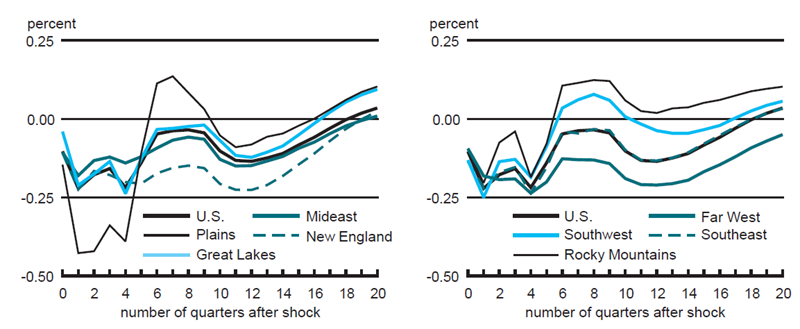
Source: Calculations from author’s statistical model, using the following quarterly data series: IMF—world crude oil prices; BEA—personal income by state; and Board of Governors of the Federal Reserve System—federal funds rate.
If the binding capital requirement was in terms of the capital-to-total rather than earning-assets ratio, monetary policy could be even less effective. Suppose the capital requirement was 8% of total assets. Thus, the 100 USD of capital in the banking system can support at most 1,250 USD of total banking system assets. After the initial reserve injection shown in figure 3, case 1, the efforts of the banking system to increase lending would result in the balance sheet shown in case 3. In this scenario, the capital requirement becomes binding when the level of earning assets is only 1,038 USD. Thus, injection of reserves by the Fed actually has the perverse effect of reducing earning assets held by the banking system from 1,108 USD (in the base case) to 1,038 USD!
The twin constraints of reserve requirements and capital requirements mean that at times banks will hold either excess reserves or excess capital, i.e., their capital ratio will be above the required level. It also means that, if monetary policy is concerned with credit provided through the banking system in addition to the level of interest rates, it is limited in its ability to increase bank credit whenever banks are capital constrained. The Fed can always make reserve requirements less binding by injecting reserves. But this will have the effect of expanding banks’ assets only if the system as a whole has the excess capital necessary to support an expanded portfolio of earning assets or banks can raise additional capital. To achieve the level of earning assets following an injection of 100 USD of reserves shown in figure 2, step 2, the banking system would have to raise an additional 81 USD of new capital if capital is based on earning assets, or 99 USD if capital is based on total assets, resulting in the aggregate balance sheets in figure 4, cases 1 and 2. In both cases, the targeted growth in earning assets is achieved only if the banks can profitably raise the additional capital needed to support the target level of assets. However, capital constraints are most likely to be binding during a recession, when external capital is likely to be more costly making banks reluctant to raise external funds that they may not be able to profitably invest. This interaction of capital constraints and cyclical variations in the cost of external funds can account for the observed procyclical pattern in bank assets.
3. Regional output response following shock to aggregate U.S. income

In addition to limiting the potential effectiveness of monetary policy in stimulating credit expansion, capital constraints impose their own negative effect on banking credit channels. During economic downturns, when monetary policy would wish to stimulate increased lending, actual levels of capital are likely to be declining as loans default. If capital constraints are binding, this forces banks to reduce lending further. The accompanying box demonstrates these same relations mathematically.
4. Regional output response following shock to federal funds rate

The effective capital requirement may also increase during downturns if it is risk sensitive. Under proposals by the Basel Committee on Banking Supervision to reform capital requirements, the level of required regulatory capital would increase as the credit risk of the assets held in the loan portfolio increases. In a downturn, not only do more loans default, but the default risk of performing loans (in aggregate) tends to increase. This translates into an increase in the effective required regulatory capital ratio, and further reduces the level of earning assets that the banking system can support on the existing (remaining) capital base.
Earning assets (bank credit) may also be divided into loans and securities (investments) and distinctions made between them with respect to economic impact. Some commentators perceive increases in loans to provide more stimulus than an equal increase in securities. Credit crunches are then defined by changes in loans rather than in total assets. The empirical studies of the reported credit crunch sightings of the early 1990s frequently focused on the adverse impact of the risk-based Basel capital requirements, which were being phased in at the time, on changes in loans, which generally have higher capital requirements than on other earning assets, such as securities. Indeed, if Treasury securities are assigned a zero-risk weight, capital constrained banks can increase aggregate earning assets by purchasing these securities but not by expanding loans.
Conclusion
We have shown how the simple one-constraint (reserve requirements) model of how monetary policy increases the assets held by the banking system by injecting new reserves and lowering interest rates may be incomplete. In practice, banks are subject to two constraints—capital and reserve requirements. Where capital requirements are binding, injection of reserves may not achieve the intended increase in bank earning assets and may even lead to a decrease.
If either constraint is binding, earning assets cannot grow further. Monetary policy can directly impact only one of the two potential constraints banks face (the reserve requirement) and is impotent to affect the other (capital) constraint. Where monetary policy seeks to increase earning assets, it can do so successfully through injection of reserves only if the effective capital requirement is not binding or if market conditions allow banks to raise additional capital profitably. On the other hand, if monetary policy seeks to constrain the growth of earning assets, e.g., to slow an overheated expansion, it is able to do so by withdrawing reserves. As a result, banks must reduce their lending and investment in securities because they can no longer sustain the same level of deposits to support these investments. If, at this time, the capital constraint is not binding, banks will either hold excess capital or reduce the excess through buybacks or dividend increases.
Observed fluctuations in the level of bank capital through the business cycle—higher capital ratios during economic expansions and lower ratios during recessions—together with changes in the effective capital requirement if the ratio is risk-sensitive, are likely to create further procyclical changes in bank loans and earning assets. Capital requirements are likely to become binding at just the time that the Fed is seeking to stimulate credit expansion—at the bottom of a business cycle.
If, in this situation, banks cannot raise new capital at favorable prices, the only direct tool the Fed has to remove the binding capital constraint is to lower the regulatory capital requirement. However, this has potential adverse consequences for bank safety and soundness and, in any case, may not be sufficient if the effective capital requirement is being determined by the market or internal risk-management concerns rather than by regulatory fiat.
Notes
1 Monetary policy is not solely concerned with the aggregate level of credit, nor is the banking system the sole credit channel, though it remains an important component. The primary monetary policy target currently used by the Fed to influence macroeconomic activity is the level of the fed funds rate.
2 Frederic S. Mishkin, 2001, The Economics of Money, Banking and Financial Markets, sixth edition, Boston: Addison Wesley.
3 George G. Kaufman, 1995, The U.S. Financial System, sixth edition, Englewood Cliffs, NJ: Prentice Hall.
4 The importance of a capital requirement on bank credit has been noted by Skander J. Van der Heuvel, 2002, “Does bank capital matter for monetary policy,” Federal Reserve Bank of New York, Economic Policy Review, May, pp. 259–265, and Ben S. Bernanke and Cara S. Lown, 1991, “The credit crunch,” Brookings Papers on Economic Activity, No. 2, pp. 205–239.