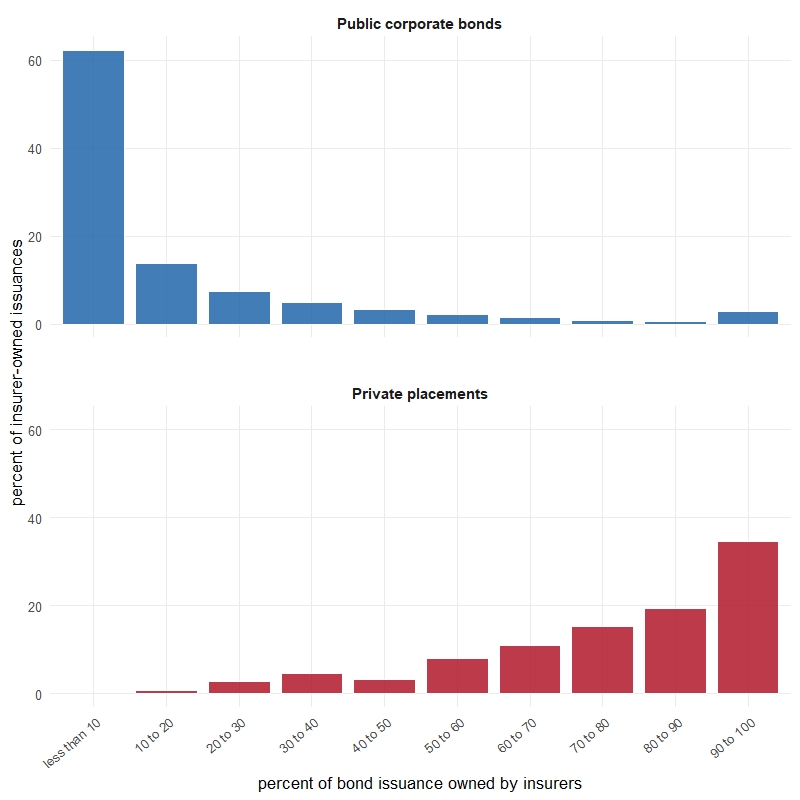
Life insurance companies are among the largest investors in corporate bonds. A growing body of research shows that risk assessments ignoring overlapping portfolios (i.e., those with a significant share of similar asset holdings) tend to understate systemic vulnerability (Greenwood et al., 2015; and Acemoglu et al., 2015). Additionally, prior research indicates that during the 2008 financial crisis, insurers with overlapping portfolios were more likely to sell the same corporate bonds, amplifying price movements (Girardi et al., 2021). Over the past decade, life insurers have shifted investments away from public corporate bonds and into privately placed corporate bonds, or private placements1—which grew from 14% of life insurers’ corporate bond holdings in 2016 to 22% in 2024.2 Unlike public corporate bonds, where life insurers hold only a small fraction of each issuance, insurers own the majority of most private placement issuances (see figure 1). Private placements are thinly traded and have limited disclosures (see note 1). Therefore, forced sales of private placements could have an outsized price impact.
1. Life insurers’ ownership of public corporate bonds and private placements
Source: Authors’ calculations based on data from life insurers’ statutory filings with the National Association of Insurance Commissioners from S&P Global Market Intelligence.
Against this backdrop, a key question is whether the recent shifts in life insurers’ corporate bond holdings away from public corporate bonds and into private placements has increased portfolio overlap among insurers and consequently the potential for contagion amplified through forced asset sales.
It is not obvious that the shift toward private placements necessarily increases the overlap in life insurers’ portfolios. On the one hand, insurers concentrating in private placements may buy more of the same private placements, increasing overlap. If so, distress at one insurer arising from distress in private placement markets could raise concerns at other insurers with similar holdings. On the other hand, increased investment in the rapidly expanding private credit space, which includes private placements, may decrease overlap in insurers’ portfolios as insurers make different choices from a wider pool of companies and investments.3
To examine whether life insurers’ bond portfolios have become increasingly similar, we employ two complementary approaches for assessing portfolio similarity: cosine similarity and a network analysis.
- The first measure, cosine similarity, captures the magnitude of portfolio overlap (Girardi et al., 2021)—i.e., the amount of common asset holdings between an insurer pair.
- The second measure, a network analysis statistic, tells us how likely the observed overlap exceeds what is expected by chance and captures portfolio overlap that is systematic—i.e., the portfolio overlap that reflects distinctive similarities between the insurer pair’s portfolios, such as a shared investment manager or investment strategy, rather than the result of “buying the market,” or the common practice of investing across a wide range of assets (in this case, corporate bonds) proportionate to their market representation (we explain this key distinction between systematic and market-buying overlaps in greater detail in the next section).
In our analysis, we find that over the period 2016–24, life insurer portfolio overlap, measured by cosine similarity, declined in magnitude across both public corporate bond and private placement markets as insurers diversified across a growing set of assets. However, in the private placement market, the network analysis shows an increase in the number of insurer pairs with systematic overlaps, suggesting increases in shared bespoke investment strategies among insurer pairs. Together these findings highlight the diversification benefits from increased investments in the growing private credit space, but potential emerging risks from overlapping concentrations in less liquid private placements. However, the potential contagion risks and spillovers discussed in Girardi et al. (2021) are attenuated by the decline in cosine similarity and the fact that high systematic overlap is concentrated among smaller insurers. Ultimately, using these portfolio overlap measures, we find that the shift toward private placements provided diversification benefits that reduced the interconnectedness of insurers’ portfolios.
Measuring life insurer portfolio overlap in the corporate bond market
In this section, we explain in more detail the two complementary methods for measuring the overlap in life insurers’ portfolios—cosine similarity and network analysis. Together, these two methods inform us about insurer interconnectedness and the related contagion and fire-sale risks.
Cosine similarity
Cosine similarity provides a magnitude of portfolio overlap between life insurer pairs, taking into account both the number of shared investments and their portfolio weights. Specifically, for each insurer pair the cosine similarity is calculated by comparing the portfolio weight of each asset held by the two insurers, where the portfolio weight is the percent of an insurer’s portfolio value that is made up of each bond. Cosine similarity ranges from zero to one. A cosine similarity value of zero indicates that the insurer pair holds none of the same assets; a value of one indicates that the two insurers’ portfolios are made up of the exact same assets in identical proportions.4 Because cosine similarity relies on portfolio weights and thus each insurer has a total weight of one, it is insensitive to the dollar value of the insurer’s portfolio size, which makes it useful when comparing insurers of very different sizes.
One drawback of cosine similarity is it treats all overlapping investments equally. It does not distinguish between overlaps that are likely to occur, e.g., two insurers holding the bonds of a large issuance, such as Apple or Verizon bonds, and overlaps that are unlikely to occur, e.g., two insurers holding bonds from small issuers.
To address this limitation, we construct a network where each node represents a life insurer and where two insurers are connected if their portfolio overlap, measured by the number and type of shared investments, is unlikely to have occurred by chance. The network analysis identifies systematic connections that may reflect similar investment strategies, rather than the result of buying the market.
Network analysis
The key challenge that the network analysis addresses is distinguishing between market-buying and systematic overlap. The purpose is to identify connections in which overlapping investments are unlikely to be solely market buying and instead reflect a systematic pattern that conveys information about life insurers employing the same asset manager, strategy, or investment focus (or some combination of these).
- Market-buying overlaps. Life insurers are major buyers of corporate bonds and, as an industry, largely buy the market, i.e., invest across a wide range of corporate bonds proportionate to their market representation. One approach to measuring portfolio overlaps is to connect two insurers with common holdings, but this approach would yield too many connections to be informative. Consider ten insurers each holding hundreds of corporate bonds from large issuers, such as Verizon and Apple. If eight of these insurers share a specific bond from, say, Apple, then this type of overlap likely reflects market buying rather than systematic overlap from, say, sharing an asset manager; hence, such an overlap conveys little information about potential spillovers.
- Systematic overlaps. We employ a network analysis that places greater weight on connections between insurers that have overlapping investments in corporate bonds that are unlikely to occur at random.5 Here, consider two insurers that each hold just five corporate bonds in total, but share a common bond holding that is not held by other insurers. This overlap is unlikely to occur by chance because the bond is not widely held and the two insurers hold just five bonds each. So, this connection is likely to be informative about their shared asset manager, strategy, or investment focus, as well as potential spillovers from one insurer to the other through shocks to the commonly held bonds.
Taken together both methods provide a measure of portfolio overlap. Cosine similarity tells us about the magnitude of overlap between life insurers’ portfolios. The network analysis statistic informs us about whether insurers’ level of overlap is greater than what chance would predict.
Visualizing insurance bond portfolio networks
In figure 2, we visualize the network of life insurer groups’ 2024 year-end public corporate bond portfolios.6 Nodes (circles) represent insurers, and the size of the nodes corresponds to the insurer’s total assets in that bond market. The insurer pairs with systematic portfolio overlaps are indicated by lines. The number of systematic overlaps an insurer has with other insurers is indicated by the color of its node, with yellow indicating minimal connections and dark blue the most connections. The positioning of the insurer in the figure also corresponds to the number of systematic overlaps, with the most connected insurers appearing in the middle of the network.7
2. Public corporate bond network: Life insurers’ 2024 year-end portfolios
Degree:
Weight:
Source: Authors’ calculations based on data from life insurers’ statutory filings with the National Association of Insurance Commissioners from S&P Global Market Intelligence.
In this public corporate bond network, most insurers are concentrated in the center of the figure, and darker, more connected nodes indicate widespread statistically significant overlaps. The relatively uniform distribution of connectivity is consistent with public corporate bond markets being easily accessible and relatively liquid, as well as with life insurers, as large buyers of public corporate bonds, tending to buy the market.
Figure 3 visualizes the network of life insurer groups’ 2024 year-end private placement portfolios. The resulting network is more uneven and less dense than the public corporate bond network: Many insurers, including most large insurers (the largest nodes, such as MassMutual) are located at the periphery with few or no systematic overlaps, while a subset exhibits relatively dense, significant overlaps (the nodes shaded darker green). This pattern suggests that private placement portfolios are less uniformly overlapping (with a smaller set of insurers driving most of the shared exposures) relative to public bond portfolios. This reflects both the more concentrated sourcing of private credit markets and the broader tendency for insurers to hold similar public corporate bonds.
3. Private placement network: Life insurers’ 2024 year-end portfolios
Degree:
Weight:
Source: Authors’ calculations based on data from life insurers’ statutory filings with the National Association of Insurance Commissioners from S&P Global Market Intelligence.
Validating systematic overlap: Private credit strategies of different insurers
One way to assess the validity of our network analysis is to see if the systematic overlaps we find in the network model reflect known relationships in the private placement market.
First, let's compare the networks of two of the largest private placement holders: MassMutual and Athene. MassMutual is the largest holder of private placements among life insurers, yet despite the size of its portfolio, it appears on the fringe of the network, with only five systematic connections. This reflects an individualized approach to private credit. MassMutual’s holdings are largely bespoke and focused on corporate bonds that are often originated internally, rather than issues that are syndicated across the industry. In contrast, Athene, which is a subsidiary of Apollo, is central in the network with over 40 systematic connections. This reflects Apollo’s role as a leading originator of investment-grade private credit with strong distribution channels among life insurers and other institutional investors.
Another scenario to consider is how a life insurer’s network changes following a change in its investment strategy. Beginning in 2022, Resolution Life established a strategic partnership with Blackstone to manage “directly originated assets across private credit, real estate, and asset-based-finance markets,” with an initial commitment of up to $25 billion that could grow up to $60 billion.8 Following this partnership, Resolution Life’s systematic connections increased from 51 in 2021 to 66 in 2024, making it the most connected firm in the private placement market.9 And many of the connections are with insurers that use Blackstone for investment management purposes.10 Of the 14 insurers in our sample that reported an asset management relationship with Blackstone in 2024, 11 have a systematic connection to Blackstone. In 2021, only two insurers that had a systematic connection to Resolution Life also listed Blackstone as an asset manager. This suggests that our network measure identifies relationships in which shared investment sourcing and strategy are present and that shared investment managers may increase systematic overlap.
Changes in the life insurers’ corporate bond portfolio similarity: 2016–24
Life insurers' growing investments in the more concentrated private placement market creates the potential for increased interconnectedness and contagion risk. To help understand how bond portfolio similarity among life insurers has evolved we share aggregate statistics of industry portfolio similarity for the cosine similarity and network analysis measures. In figure 4, we report our two measures of portfolio overlap: 1) average cosine similarity of each insurer pair and 2) the percentage of insurer pairs with systematic overlap.
4. Life insurer portfolio overlap statistics: 2016 versus 2024
| Public corporate bonds | Private placements | ||||
|---|---|---|---|---|---|
| 2016 | 2024 | 2016 | 2024 | ||
| Number of insurers | 41 | 41 | 41 | 41 | |
| Cosine similarity (weighted) | 0.1616 | 0.1471 | 0.0620 | 0.0564 | |
| Percent of pairs with systematic overlap (weighted) | 19.6 | 19.1 | 19.1 | 21.2 | |
As seen in figure 4, our aggregate measures of life insurer bond portfolio similarity show a decline in the magnitude of portfolio overlap across both public corporate bond and private placement portfolios, but an increase in the number of insurer pairs that share systematic overlaps in their private placement portfolios. Between 2016 and 2024, weighted cosine similarity declined for both public corporate bonds (0.162 to 0.147) and private placements (0.062 to 0.056). In the network analysis, we find the weighted average share of pairs with systematic overlaps increased from 19.1% in 2016 to 21.2% in 2024 for private placement portfolios, while the share of systematic pairs declined modestly from 19.6% to 19.1% for public corporate bond portfolios. These findings suggest life insurers diversified their corporate bond portfolios even as they tilted their investments toward private placements, although the rise in systematic overlaps in insurer private placement portfolios is evidence of an increase in shared sourcing and investment strategies.
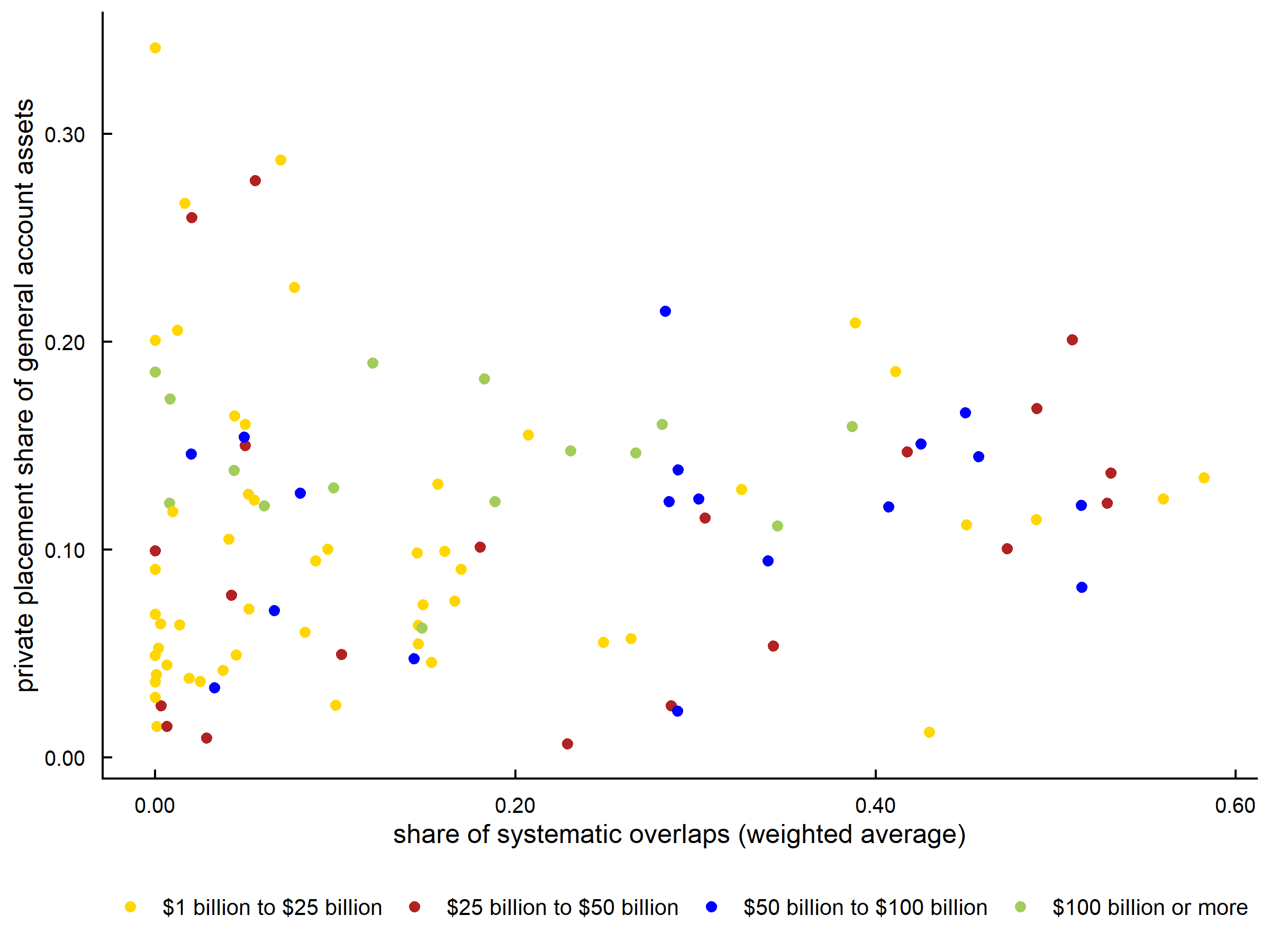
Nevertheless, insurers with the highest levels of systematic overlap tend to have smaller asset portfolios and do not hold an outsized share of their investments in private placements—and together, these two characteristics of their portfolios attenuate potential contagion risks. Figure 5 shows the share of private placements on the vertical axis and the share of systematic overlaps on the horizontal axis; the color of the dots corresponds to the size of the insurer’s general account assets. Insurers in the far right portion of the figure have the highest systematic overlap shares, but their other characteristics mitigate contagion risks. These insurers typically have less than $50 billion in total assets (yellow and maroon dots) and less than 15% of their assets in private placements, while larger insurers with $50 to $100 billion in assets (blue dots) in the right side of the figure typically have stable liabilities (those that cannot be easily withdrawn), which mitigates fire-sale risks. And the largest insurers, with $100 billion or more in assets (green dots), typically are concentrated in the left side of the figure with lower levels of overlap. Taken together, these patterns indicate that contagion and fire-sale risks discussed in Girardi et al. (2021) are limited.
5. Systematic life insurer portfolio overlaps and asset risks, 2024 year-end
Source: Authors’ calculations based on data from life insurers’ statutory filings with the National Association of Insurance Commissioners from S&P Global Market Intelligence.
Conclusion
Life insurers’ shift toward private placements raises natural concerns about interconnectedness and systemic risk. Our analysis suggests the picture is more nuanced than the headline shift implies. The scale of potential fire-sale spillovers from shared exposure, as measured by cosine similarity, has declined as insurers have spread their portfolio weights across a broader set of assets in a growing private placement market.
However, especially for smaller life insurers, the portfolio overlap due to private placements does not occur by chance. A growing share of smaller insurer pairs exhibit portfolio overlap that reflects a shared strategy and sourcing rather than coincidence. These insurers are more likely to face correlated selling pressure under financial stress, even as the magnitude of any individual shared position has diminished. The shift toward a market with less transparency and weaker price discovery highlights the importance of tracking these evolving network structures to better understand contagion risks across the life insurance industry.
Notes
1 Public corporate bonds are publicly traded securities, which must be registered with the Securities Exchange Commission (SEC) and require significant disclosures following the Securities Act of 1933, often referred to as the “truth in securities” law, as well as subsequent legislation. Private placements are unregistered securities that are sold to a limited pool of investors, primarily institutional investors, such as investment banks, pension funds, and insurers. Private placements allow companies to raise capital without needing to meet the legal and disclosure requirements for issuing equivalent public securities. For more discussion of life insurers’ shift from public corporate bonds toward private placements, see Fournier et al. (2024a) and Fournier et al. (2024b).
2 Authors’ calculations based on data from life insurers’ statutory filings with the National Association of Insurance Commissioners from S&P Global Market Intelligence.
3 For an overview of private credit market growth, see Avalos et al. (2025). Definitions of private credit and the assets included in aggregate values of private credit vary. Narrow definitions of private credit typically include business development companies (BDCs), private debt funds, middle-market collateralized loan obligations (CLOs), and forms of nonbank direct lending. Some private placements, specifically fund investments and asset-backed finance, may be included in aggregate measures of private credit. However, private placements issued by large companies and many project finance investments are typically not counted.
4 Given two vectors of portfolio overlaps and , cosine similarity is calculated using the formula .
5 Specifically, we derive the network using the stochastic degree sequence model (SDSM). SDSM is a bipartite configuration model (BiCM) that conditions on insurer-level and bond-level degree sequences when generating the null distribution of expected overlaps (see Gualdi et al., 2016). We keep connections significant at the 5% level, and the statistic we derive is the share of insurer pairs with significant connections; an insurer that has a significant connection with five out of ten insurers would have a systematic overlap of 0.50.
6 To reduce clutter, we only include life insurer groups holding at least $1 billion of public corporate bonds in figure 2 and life insurers holding at least $100 million of private placements in figure 3. A life insurer group is defined as the combined insurance operating companies of a parent company. For example, Athene’s operating companies are as follows: Athene Annuity & Life Company, Athene Annuity & Life Assurance of New York, Athene Life Insurance Company of New York, and Structured Annuity Reinsurance Company.
7 More formally, we apply the Fruchterman–Reingold force-directed layout algorithm to position insurers in two-dimensional space such that strongly connected nodes cluster together while weak links exert repulsive forces. This structure reveals centrality of actors in the network by their placement.
8 Resolution Life and Blackstone (2022). For an analysis of the role of asset managers in portfolio overlap, see Ozdagli and Ryfe (2025).
9 Authors’ calculations based on data from life insurers’ statutory filings with the National Association of Insurance Commissioners from S&P Global Market Intelligence. Over the period 2021–24, the number of life insurer groups holding private placements increased from 136 to 149 in our unbalanced sample. Thus, according to our analysis, the percent of insurers that Resolution Life shared a systematic overlap with increased from 38% in 2021 to 44% in 2024.
10 These trends also hold when using percentile rank in validated degree.