In February 2026, the Chicago Fed convened a roundtable discussion with about 20 owners of multifamily properties in Chicago’s North Side neighborhood of Rogers Park.1 The majority of roundtable participants also completed an optional survey that asked about their operations, costs, and future plans. Multifamily housing makes up a significant portion of Chicago’s naturally occurring affordable housing (NOAH) stock. NOAH is defined as unsubsidized, market-rate housing that is generally affordable for households with low and moderate incomes (LMI households). The degree of affordability of NOAH can depend on factors such as the age of the housing stock and its location, which influence market values. However, evidence shows that the supply of NOAH is declining in Chicago. In this article, we examine contextual data to better understand the multifamily housing sector in Chicago and more specifically in Rogers Park. We also summarize high-level insights from the roundtable discussion and the survey results.
The participants in our roundtable brought a range of perspectives and experiences to the discussion on multifamily properties and represented a wide range of ownership experiences in terms of portfolio size, but the majority of them were long-time owners, including some multigenerational owners. Emerging from the discussion were common themes centering on costs and profitability, especially around the operational challenges that multifamily property owners face. Drawing from their personal experiences, these multifamily property owners shared the following:
- Costs—including insurance premiums and taxes, as well as payments for utilities, equipment (e.g., boilers and heating, ventilation, and air conditioning, or HVAC, systems), and construction labor—are increasing faster than rents, reducing short-term profitability.
- Owners rolling over loans they originated earlier this decade at lower interest rates will face higher “carrying costs” for their properties.
- The availability of labor for maintenance, repairs, and rehabilitation is tight, and it is expected to remain so over the coming years.
- Higher insurance premiums, along with limited policy options and repair and maintenance stipulations (e.g., replacing roofs and installing security features), have made securing affordable property insurance increasingly difficult.
- Despite these challenges, owners are looking to both expand their portfolios and invest in their current holdings.
Read more about insurance trends at the Chicago Fed Insurance Research Center.
Multifamily rental housing stock trends in Chicago and Rogers Park
Chicago’s housing stock is dominated by multifamily housing. Buildings with two units or more make up 69% of the city’s entire housing stock (made up of both rental and owner-occupied units).2 In Rogers Park, a diverse and dense neighborhood on the far northeast section of Chicago, that percentage is even higher, at 92%.3 The neighborhood also has a greater share of renters than the city of Chicago as a whole: About 72% of all occupied housing units in the neighborhood are occupied by renters, much higher than the citywide share of 54%.4 Relative to the city, the neighborhood has a lower median household income, slightly lower rents, and a slightly greater share of cost-burdened renters.5 These characteristics make Rogers Park a compelling place for studying trends in multifamily rental housing, which plays an important role in the city’s naturally occurring affordable housing stock. In the rest of this article, we will focus on multifamily rental housing stock trends at the city and neighborhood level.
For more information on housing affordability trends in Chicago, watch the replay of the Chicago Fed’s Building for Affordability: Exploring Housing Supply Strategies in Chicago webinar. This webinar features research from DePaul University’s Institute for Housing Studies describing how since 2010, affordable rental units have decreased throughout the city of Chicago, particularly through the losses of two- to four-unit buildings in South Side and West Side neighborhoods (starting at time stamp 13:10 in the replay). Since 2012, the city has seen an increase in higher-income renters (starting at time stamp 9:10). These demand and supply factors have led to a decreasing share of “affordable” rental units available to households with low and moderate incomes (starting at time stamp 10:45).
The majority of Rogers Park’s rental housing stock is in buildings with ten or more units
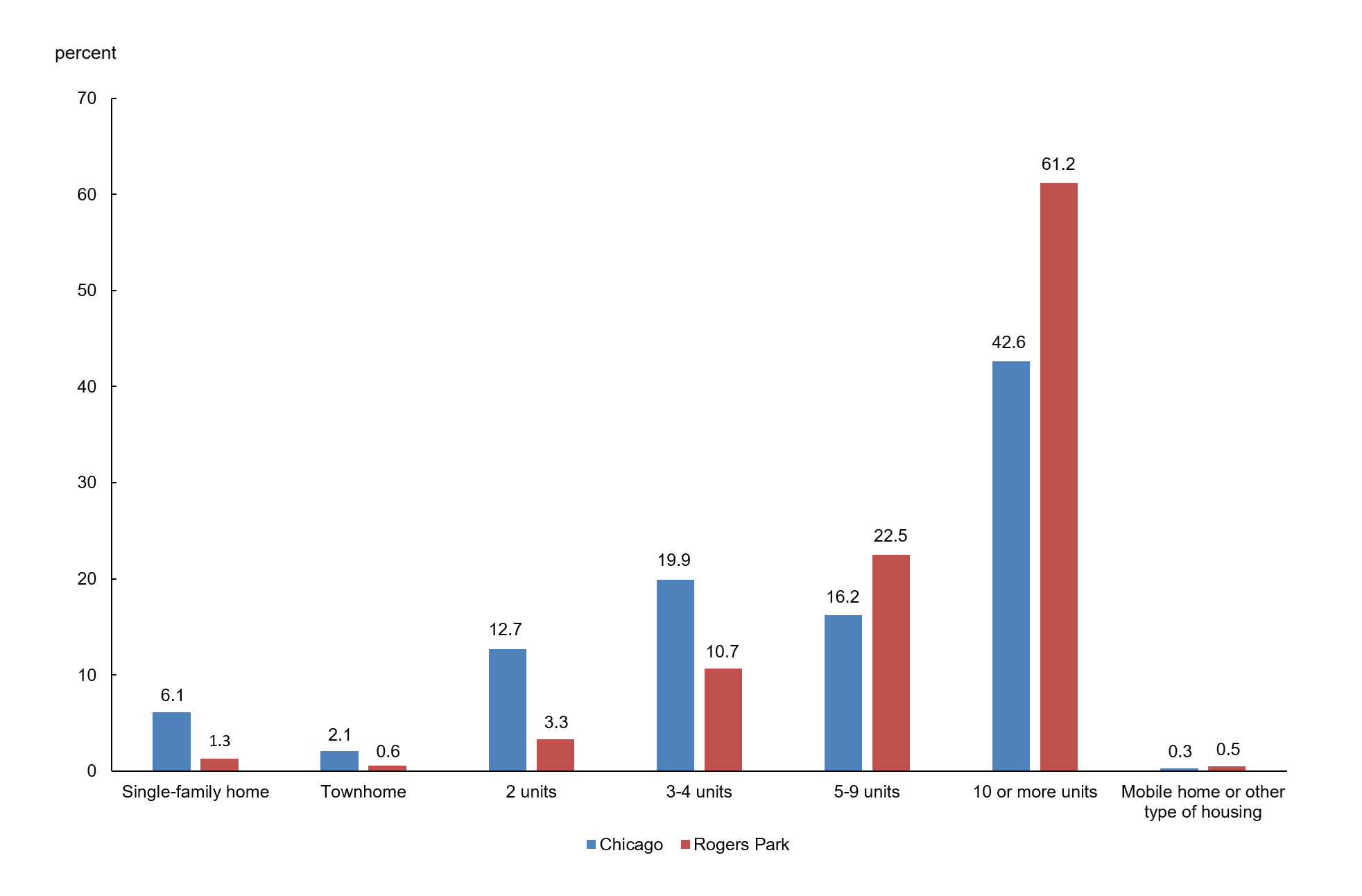
The rental housing stock in Rogers Park is concentrated in large multifamily buildings, which have ten or more units, making up almost two-thirds of the rental housing stock in the neighborhood (see figure 1, which displays 2020–24 five-year data from the American Community Survey, or ACS). Compared with the city of Chicago as a whole, Rogers Park has a lower share of small multifamily buildings, which have four or fewer units.
1. Rental housing stock in Chicago and Rogers Park, by units in structure, 2020–24
Source: Authors’ calculations based on data from the U.S. Census Bureau, 2020–24 American Community Survey, five-year estimates subject tables, table S2504: Physical Housing Characteristics for Occupied Housing Units, available online.
Rental housing stock growth in Rogers Park has been lower than in the entire city
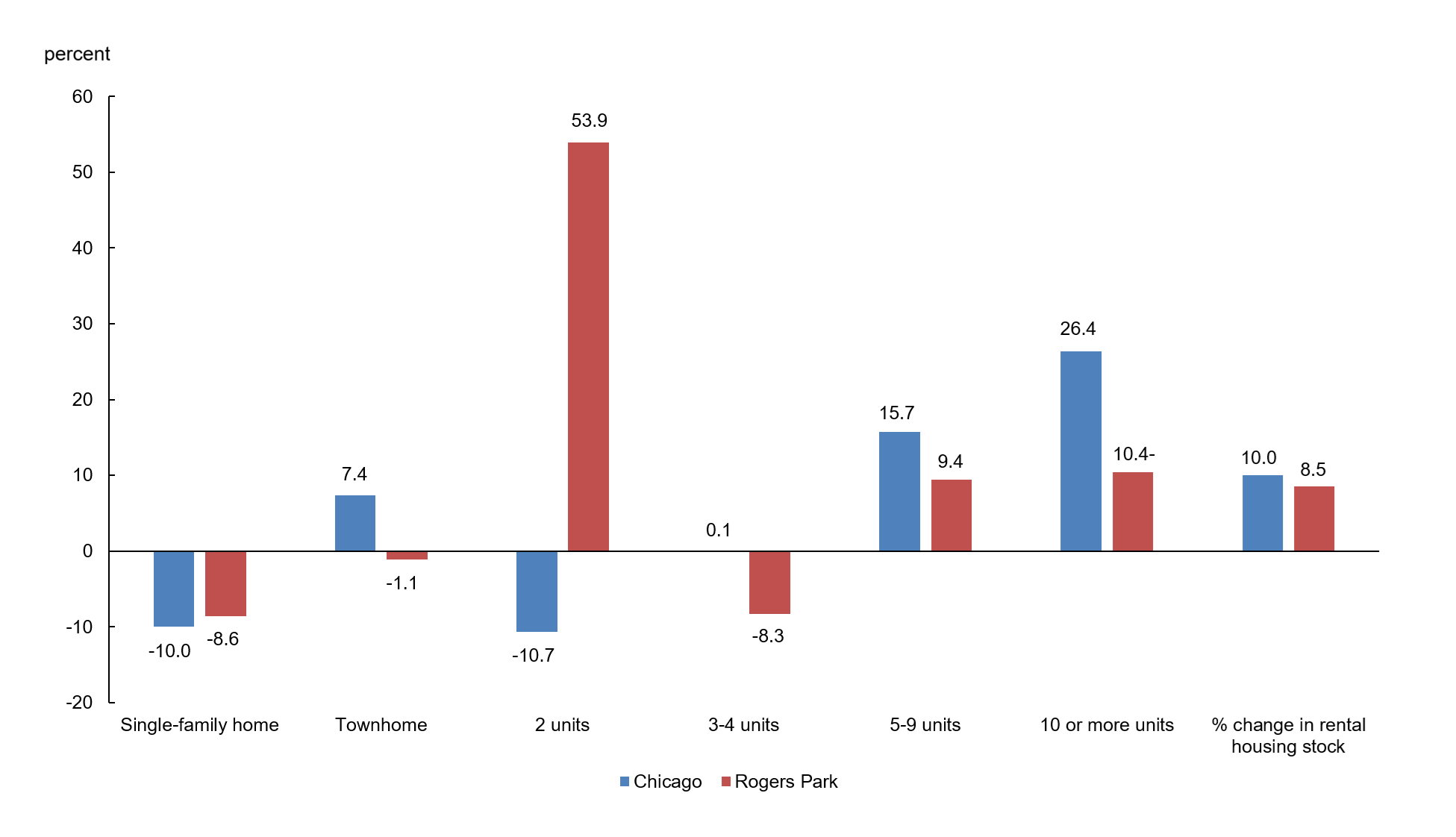
The ACS five-year estimates in figure 2 show that between 2010–14 and 2020–24, the total number of rental units increased by a larger percentage in Chicago (10.0%) than in Rogers Park (8.5%). Rogers Park also saw lower growth in rental units in multifamily buildings with five to nine units (9.4%) and in those with ten or more units (10.4%) than the city as a whole (15.7% and 26.4%, respectively). In contrast, the total number of rental units in two-unit buildings in Rogers Park increased by 53.9%, while that total in the entire city decreased by 10.7%.
2. Percent change in rental housing stock for Chicago and Rogers Park, by units in structure, 2010–14 to 2020–24
Sources: Authors’ calculations based on data from the U.S. Census Bureau, 2010–14 American Community Survey, five-year estimates subject tables, table S2504: Physical Housing Characteristics for Occupied Housing Units, available online, and 2020–24 American Community Survey, five-year estimates subject tables, table S2504: Physical Housing Characteristics for Occupied Housing Units, available online.
Roundtable participants describe cost challenges that create potential affordability pressures in the multifamily housing sector
Here we summarize the insights that roundtable participants shared during the discussion and through an optional survey. Seventeen roundtable participants answered a survey that asked them about the number and location of the buildings they owned and how much experience they had as multifamily property owners. The median number of buildings owned by survey respondents was seven, and the median number of units owned was 120. Each survey respondent owned at least one multifamily rental building in Rogers Park, and the majority reported also owning multifamily buildings in other Chicago neighborhoods, mainly on the North and Northwest Sides of the city. Respondents had a median of 40 years’ experience as a multifamily property owner, which for a few included the years that previous generations had operated as multifamily property owners.
Roundtable participants discussed challenges impacting the cost of operating and maintaining their properties, creating pressures on affordability in the NOAH rental market. Here we summarize what we heard from the participants in the roundtable discussion and the survey. This summary reflects what we heard and does not represent the views of the researchers, the Federal Reserve Bank of Chicago, or the Federal Reserve System.
- Costs, especially insurance premiums and taxes, are increasing more than rents, which is reducing short-term profitability. Specifically, during the roundtable discussion, participants told us the following:
- Increasing costs, including insurance premiums, taxes, as well as payments for utilities, equipment (e.g., boilers and HVAC systems), and labor is affecting profitability. While some cost increases have been particularly acute in recent years (e.g., property taxes and insurance premiums), these costs have been escalating for more than a decade.
- Costs are increasing more than what owners can cover with rent increases. Owners must balance rent increases with what tenants are able to pay to avoid the costs of finding new tenants. A couple of participants shared that annual rent increases of even 4% to 6% did not cover cost increases. Another participant stated that they expect that their net operating income will shrink in the short term (i.e., over the next few years) until residents have the capacity to absorb higher rents to catch up with higher costs.
Read more about the impacts of rising property insurance costs on rents in the multifamily housing market in an article titled “Rising property insurance costs and pass-through to rents for apartment buildings” by our colleagues at the Board of Governors of the Federal Reserve System.
- Increases in interest rates since 2021 mean that owners rolling over debt with a five-year term will face higher “carrying costs.” Specifically, during the roundtable discussion, participants told us the following:
- Many commercial property loans have five-year terms. Property owners who originated debt in 2021, when interest rates were low, are faced with increased interest costs when they roll over these loans in 2026. Participants reported that they are facing a jump in interest rates from as low as 3% to 6% or more, which will increase monthly mortgage payments.
- The availability of labor for maintenance, repairs, and rehabilitation is tight, and it is expected to remain so over the coming years. Specifically, during the roundtable discussion, participants told us the following:
- Ongoing immigration enforcement is affecting the supply of maintenance and other related labor for property management.
- Owners are struggling to replace long-term maintenance staff as they retire.
- Skilled workers knowledgeable about older buildings are increasingly expensive and hard to find. Local family businesses providing specialized services for building maintenance or equipment repair are selling their companies to new owners expected to charge higher prices or are so busy that they are not taking on new customers.
- Higher insurance premiums, along with repair and maintenance stipulations, and limited policy options have made securing affordable property insurance increasingly difficult. Specifically, during the roundtable discussion, participants told us the following:
- Natural disasters in other parts of the country are contributing to higher insurance costs locally.
- Coverage often comes with repair and maintenance stipulations that can feel financially burdensome.
- Consolidation in the insurance industry is limiting policy options for multifamily buildings. Owners of older buildings are finding it particularly difficult to secure affordable property insurance.
- Participants are looking to both expand their portfolios and invest in their current holdings. Specifically, the survey results indicated the following:
- About half of the respondents were interested in acquiring new properties in 2026. Those respondents looking to acquire new properties in 2026 said they are looking in neighborhoods with the capacity to support higher rents.
- The majority of respondents anticipated making major investments, renovations, or repairs to their current properties in 2026.
Conclusion
Multifamily property owners in Chicago’s North Side neighborhood of Rogers Park report challenges in keeping rents affordable in the face of rising costs and other economic headwinds. Both near-term and longer-term labor market trends, interest rate changes, and an increasingly challenging insurance market have the potential to increase costs for multifamily property owners, which over time could lead to rising rents for their tenants.
Notes
1 Members of the Rogers Park Builders Group participated in the roundtable discussion.
2 Authors’ calculations based on data from the U.S. Census Bureau, 2020–24 American Community Survey (ACS), five-year estimates subject tables, table S2504: Physical Housing Characteristics for Occupied Housing Units, available online. In the ACS data, multifamily buildings are in the following categories: two-unit buildings, three- to four-unit buildings, five- to nine-unit buildings, and buildings with ten units or more. Single-family homes, townhomes, and mobile homes or other types of housing are not considered multifamily buildings.
3 Authors’ calculations based on data from the U.S. Census Bureau, 2020–24 ACS, five-year estimates subject tables, table S2504, available online. To calculate the Rogers Park values reported throughout the article, we first identified the 12 census tracts that make up the neighborhood.
4 Authors’ calculations based on data from the U.S. Census Bureau, 2020–24 ACS, five-year estimates subject tables, table S2504, available online.
5 In its most recent Community Data Snapshot, the Chicago Metropolitan Agency for Planning (2026) uses ACS five-year estimates from the U.S. Census Bureau (2020–24) to estimate Rogers Park’s median household income at $60,916, which is less than the estimate of the city of Chicago’s median household income of $77,902. According to Zillow rent data (last updated on June 27, 2026) for zip code 60626, which encompasses most of Rogers Park, the average rent for apartments and condos there was $1,800; per Zillow rent data for the city of Chicago, this average was $1,915. A household is considered to be cost-burdened when they pay 30% or more of their income on housing costs. We estimate that in Rogers Park, 48% of rental households were cost-burdened and that in Chicago, 46% of rental households were cost-burdened, using data from the U.S. Census Bureau, 2020–24 ACS, five-year estimates subject tables, table S2503: Financial Characteristics, available online.