Homeowners insurance protects people’s homes from losses due to fire, natural disasters, and other risks. Mortgage lenders require borrowers to carry homeowners insurance. The price of homeowners insurance reflects a variety of factors: property and homeowner characteristics, natural disaster risks, and regulatory and market conditions, as well as contract terms, such as the coverage and deductible amounts. State law determines which risk factors insurers can use when setting insurance premiums and the approval process for any rate changes. In recent years, higher rebuilding costs from more expensive labor and construction materials, frequent and more-intense storms and natural disasters, and an increase in reinsurance costs have contributed to a rise in homeowners insurance premiums.1 Current and prospective homeowners, community organizations, and local governments may benefit from understanding how premiums for homeowners insurance affects housing affordability.
In this article, we share our analysis of homeowners insurance policies based on data and information from more than 330 insurers collected through the Property and Casualty Market Intelligence Data Call (PCMI Data) undertaken by the National Association of Insurance Commissioners (NAIC).2 The PCMI Data are a free (nonpaywalled) source of information on homeowners insurance policies for owner-occupied homes (excluding condos) aggregated to the zip code level for the years 2018 through 2022.
Our analysis focuses on homeowners insurance premium affordability and policy cancellations due to nonpayment of the premium in states that are part of the Chicago Fed’s Seventh Federal Reserve District.3 From our analysis, we find the following:
- In three of the five Seventh District states, nominal increases in homeowners insurance premiums exceeded the national average of about 25% between 2018 and 2022.
- Increases in homeowners insurance premiums outpaced median income growth (in percentage terms) in Illinois, Iowa, and Wisconsin, but not in Michigan and Indiana.
- In four of the five Seventh District states, households in zip codes with the highest median income, where homes tend to be more expensive, paid the highest homeowners insurance premiums. However, zip codes with the lowest median household income had a higher ratio of average premium to median income. This is consistent with homeowners with the lowest incomes spending, on average, the highest share of their income on homeowners insurance.
- Across the entire U.S., the rates of homeowners insurance cancellations for nonpayment were highest in zip codes with the lowest median household incomes. And the rates of nonpayment cancellations in Seventh District states tend to be higher than in the U.S. as a whole, especially in lower-income zip codes.
- Through a regression analysis,4 we find evidence that higher average homeowners insurance costs relative to median income are associated with higher rates of nonpayment cancellations and that this relationship is stronger in lower-income zip codes.
Details on the PCMI Data
The PCMI Data were created through a collaboration between the Federal Insurance Office (FIO) of the U.S. Department of the Treasury, the National Association of Insurance Commissioners, and state regulators.5 This data set reflects information from more than 330 insurers covering almost 250 million homeowners insurance policies over the period 2018–22 (approximately 50 million per year) for owner-occupied homes (excluding condos) with and without mortgages.6 It includes information on standard HO-3 and HO-5 homeowner insurance policies for owner-occupied homes. Both HO-3 and HO-5 cover damage to the dwelling property from listed perils, although HO-5 covers a broader set of perils and replacement coverage for belongings.7 The PCMI Data are at an annual frequency and include homeowners insurance premiums, the numbers of claims, the U.S. dollar value of claims, nonrenewals, and cancellations.8 The PCMI Data cover 80% of the homeowners insurance market by premiums for HO-3 and HO-5 policies nationally, and the included zip codes contain most of the households in the Seventh District states.9
Examining homeowners insurance costs and affordability with the PCMI Data
Using the PCMI Data, we examine issues of homeowners insurance costs and affordability in Seventh District states and across the nation. Specifically, we look at premium levels and percentage changes across states; homeowners insurance costs in high- and low-income zip codes; how much households spend on homeowners insurance relative to incomes; changes in homeowners insurance premiums and incomes; and cancellation rates of homeowners insurance for nonpayment. In addition, we estimate the relationship between the cost of homeowners insurance relative to income and the rate of nonpayment cancellation.
Premium levels and percentage changes across states
The PCMI data show large differences in average premiums for homeowners insurance across the five Seventh District states (Illinois, Indiana, Iowa, Michigan, and Wisconsin), as well as in the pace of premium increases during the 2018–22 sample period. In 2018, Wisconsin was the least expensive state for homeowners insurance among the Seventh District states, while Illinois was the most expensive; the average premium back then was $951 in Wisconsin, compared with $1,366 in Illinois (see figure 1). Average premiums across the Seventh District states were more than 20% below the national average in both 2018 and 2022, according to our calculations. The lower premiums reflect lower property values, as well as lower levels of natural disaster risk. The Seventh District states are exposed primarily to severe convective storm risk, including strong winds and hail, but they face little wildfire or hurricane risk. Importantly, the Seventh District states face only moderate hail risk, which has driven up insurance prices, especially in the middle of the country.10
1. Homeowners insurance premiums, by Seventh District state
| Average nominal premium in U.S. dollars | Change over the period 2018–22 | ||||
|---|---|---|---|---|---|
| State | 2018 | 2022 | U.S. dollar | Percent | |
| Iowa | 1,178 | 1,571 | 393 | 33 | |
| Illinois | 1,366 | 1,809 | 443 | 32 | |
| Indiana | 1,215 | 1,473 | 258 | 21 | |
| Michigan | 1,145 | 1,335 | 190 | 17 | |
| Wisconsin | 951 | 1,207 | 256 | 27 | |
| Seventh District states | 1,200 | 1,509 | 309 | 26 | |
| U.S. | 1,514 | 1,915 | 400 | 26 | |
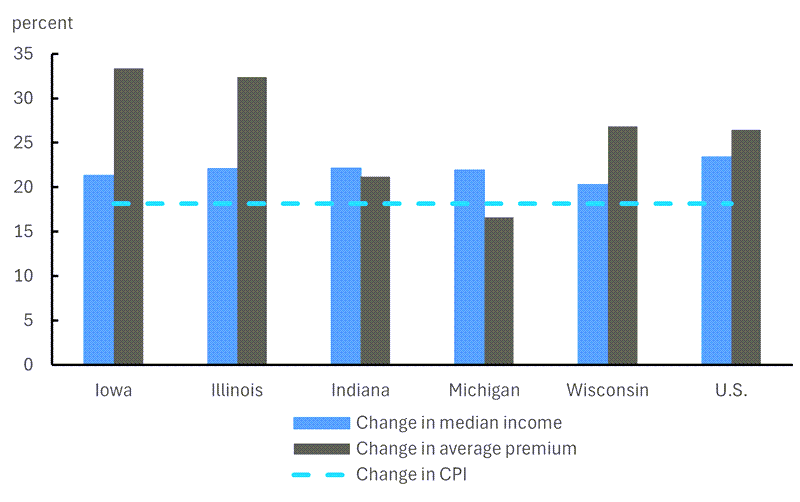
The average nominal premium increase for homeowners insurance in the Seventh District states between 2018 and 2022 was $309—which tracked the national average of about 26%; but across the five states, the premium changes varied.11 Iowa had the largest rate increase of 33%, and Illinois was a close second, with a gain of 32%. Meanwhile, Indiana (21%) and Michigan (17%) experienced slower premium growth (see figure 2). In fact, premium increases in Michigan did not keep pace with inflation, and insurance prices declined by 1% in real terms, with the largest real declines located in Detroit metro zip codes, according to our analysis.
2. Percent change in nominal homeowners insurance premiums and income in Seventh District states, 2018–22
Sources: Authors’ calculations based on data from the U.S. Census Bureau, American Community Survey, and the PCMI Data.
Insurance costs in high- and low-income zip codes
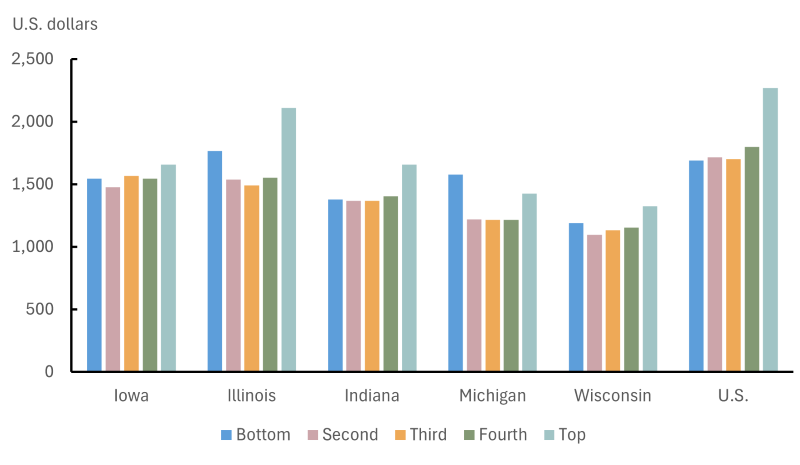
To explore how insurance costs affect different income groups, we split zip codes into within-state income quintiles based on their median incomes in each state from the 2018–22 American Community Survey (ACS); the bottom (lowest-income) quintile contains zip codes with median incomes of less than $60,000 or $70,000 (depending on the state), while the top (highest-income) quintile contains zip codes with median incomes typically greater than $90,000 or $100,000.12 Figure 3 shows the average homeowners insurance premiums in each state in 2022 by income quintile.
3. Average homeowners insurance premiums in Seventh District states, by income quintile, 2022
Sources: Authors’ calculations based on data from the U.S. Census Bureau, American Community Survey, and the PCMI Data.
In figure 3, we see that households in the top income quintile (teal bars) often pay the highest premiums in each state—reflecting in part higher home values. But importantly, households in the bottom income quintile (blue bars) never pay the lowest premiums—and in Michigan they pay the highest premiums and in Illinois and Wisconsin, the second highest. These pricing differences may reflect that insurers consider other factors besides home values when setting premiums, such as household characteristics, including household members’ credit scores. Blonz et al. (2026) find that individuals with subprime credit pay 30% higher homeowners insurance premiums than individuals with super-prime credit.
How much is spent on homeowners insurance relative to incomes
In figure 4, we shed light on the relative cost of homeowners insurance using the ratio of the average premium to median income in 2022 for each Seventh District state and nationally by using within-state zip code income quintiles (see note 12). A higher ratio of premium to income suggests households spend more of their income on insurance and provides a measure of insurance affordability. Compared with the national average, households in Seventh District states typically spend less of their income on homeowners insurance. And across all five Seventh District states, households in the lowest-income zip codes (i.e., those in the bottom income quintile) spend more of their income on homeowners insurance than households in higher-income zip codes, highlighting the affordability pressures that these households may face.
4. Percent ratio of average homeowners insurance premium to median income in Seventh District states, 2022
| Income quintile | Iowa | Illinois | Indiana | Michigan | Wisconsin | U.S. |
|---|---|---|---|---|---|---|
| Bottom | 2.3 | 2.9 | 2.4 | 3.2 | 2.0 | 2.8 |
| Second | 2.0 | 2.1 | 2.0 | 1.9 | 1.5 | 2.3 |
| Third | 2.0 | 1.8 | 1.8 | 1.7 | 1.4 | 2.1 |
| Fourth | 1.8 | 1.6 | 1.7 | 1.4 | 1.3 | 1.9 |
| Top | 1.5 | 1.5 | 1.5 | 1.2 | 1.1 | 1.7 |
The ratio of the average premium to median income provides our best measure of homeowners insurance affordability as it captures the extent to which households’ budgets are impacted by insurance prices. Michigan stands out as a state with significant homeowners insurance affordability pressures: Households in the lowest-income zip codes of Michigan spent 3.2% of their income on homeowners insurance in 2022—more than double the share of income that households in the highest-income zip codes (i.e., those in the top income quintile) of that state spent and more than the national average share for the bottom income quintile (2.8%). By our metric, Illinois also had homeowners insurance affordability issues in 2022, as the lowest-income households there spent a larger share of income on insurance than the national average among such households and almost double the share of income that the highest-income households in Illinois spent. Among the Seventh District states in 2022, Wisconsin was the most affordable one for homeowners insurance according to our metric: Across all income quintiles, households in Wisconsin spent a lower share of their income on homeowners insurance than those in the other Seventh District states.
Changes in homeowners insurance premiums and incomes
Between 2018 and 2022, changes in homeowners insurance affordability, as measured by the average cost of insurance relative to median income, were not uniform across Seventh District states. The variation in insurance affordability changes was primarily driven by differences in premium increases rather than differences in income growth. Median incomes in Seventh District states generally grew more slowly than in the U.S. as a whole over the 2018–22 period. In percentage terms, incomes increased by more than premiums did in Indiana and Michigan, resulting in lower insurance premiums relative to incomes; by contrast, premiums increased by more than incomes did in Iowa, Illinois, and Wisconsin, resulting in higher insurance premiums relative to incomes (see figure 2).
We also observe that the changes in the cost of homeowners insurance relative to income varied across income quintiles in the Seventh District states and the entire nation. In figure 5, we show the percent change in the ratio of average homeowners insurance premium to median income for each zip code income quintile in each state between 2018 and 2022.13 Nationally, households in the bottom income quintile spent 5% less of their income on insurance in 2022 than in 2018. The improvement in affordability among the lowest-income households in the U.S. as a whole was bolstered by strong income growth of 28% during this span, while average premiums grew by just 22% for the bottom income quintile. In Michigan, improvements in insurance affordability reflect slower premium growth, which increased by just 15% for the lowest-income households, compared with income growth of 24%. For households in Iowa and Illinois, insurance became less affordable across income quintiles, primarily driven by large premium increases. But for those in Wisconsin, slower income growth, especially in zip codes in the bottom income quintile, was the main driver of increases in the cost of insurance relative to income.14
5. Percent change in the ratio of average homeowners insurance premium to median income in Seventh District states, 2018–22
| Income quintile | Iowa | Illinois | Indiana | Michigan | Wisconsin | U.S. |
|---|---|---|---|---|---|---|
| Bottom | 7 | 5 | –4 | –6 | 8 | –5 |
| Second | 9 | 10 | –3 | –5 | 4 | –1 |
| Third | 11 | 13 | 0 | –2 | 6 | 2 |
| Fourth | 14 | 12 | 1 | –3 | 7 | 4 |
| Top | 13 | 8 | 1 | –2 | 7 | 7 |
Homeowners insurance cancellation rates for nonpayment
The cancellation of a homeowners insurance policy for nonpayment occurs when the policyholder fails to make a scheduled premium payment. This may reflect a household’s inability to afford coverage. According to our calculations using the PCMI Data, 2.0% of homeowners insurance policies in Seventh District states were cancelled for nonpayment between 2018 and 2022—more than the 1.6% for the entire U.S.;15 however, the nonpayment cancellation rate in Seventh District states trended down from 2.3% in 2018 and 2019 to 1.9% in 2022, while this rate ticked up slightly in the entire U.S. over this span.
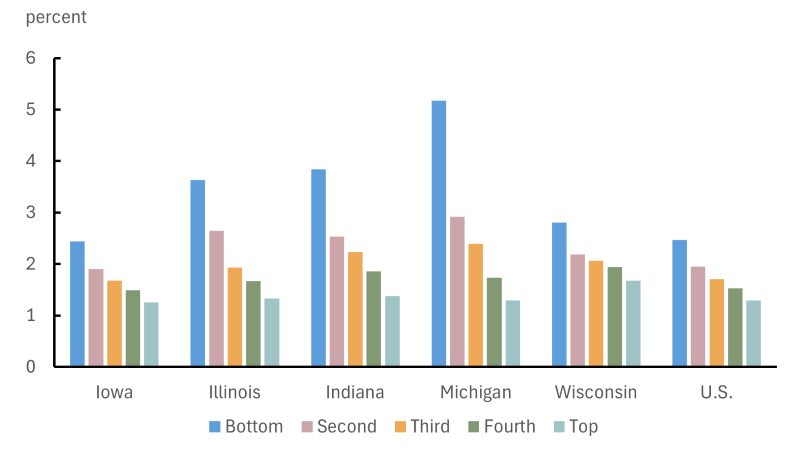
In figure 6, we see that nonpayment cancellation rates in Seventh District states tend to be higher than the U.S. average between 2018 and 2022. Only in Iowa were cancellation rates across all income quintiles lower than the national average rates, while in Wisconsin cancellation rates sat just above the national average rates. In Illinois, Indiana, and Michigan, cancellation rates in the lowest-income zip codes vastly exceeded the national average. This is surprising given the relatively lower cost of insurance in 2022 for Seventh District states as shown in figure 3. In these states, we also observe a stark difference in cancellation rates between the top and bottom income quintiles: In Michigan, for instance, households in the lowest-income quintile (blue bar) averaged a cancellation rate above 5% over the 2018–22 period, while households in the highest-income quintile (teal bar) averaged a rate of 1.3%. This difference in cancellation rates between the bottom and top income quintiles was seen in all five Seventh District states, and it highlights affordability pressures that lower-income households may face when trying to purchase homeowners insurance. Higher cancellation rates may also be indicative of homeowners forgoing insurance entirely. A University of Michigan survey found that Detroiters were more likely to be mortgage-free than the national average and cited the high cost of insurance as the leading reason for forgoing coverage (Nothaft and Stragand, 2025).
6. Average cancellation rates of homeowners insurance for nonpayment of premium, by income quintile, 2018–22
Sources: Authors’ calculations based on data from the U.S. Census Bureau, American Community Survey, and the PCMI Data.
Estimating the relationship between homeowners insurance cost shares (of income) and nonpayment cancellations
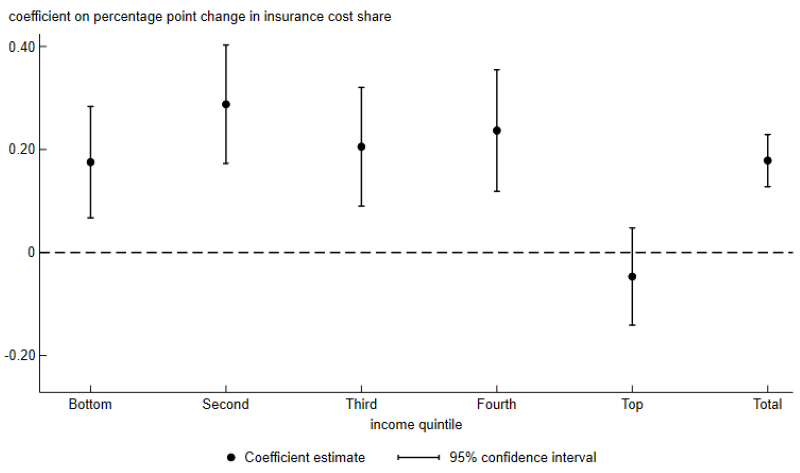
We complement the prior analysis by running a pair of regressions (see note 4) to test the relationship between homeowners insurance cancellations for nonpayment and average insurance costs relative to median income in communities across the nation. In the first regression, we compare the levels of nonpayment cancellation rates and share of income spent on insurance during the 2018–22 sample period (figure 7), and in the second regression, we compare the year-over-year changes in these two measures between 2018 and 2022 (figure 8).16 We run the regressions on a national sample of zip codes (see note 15) and separately for zip codes in each state’s income quintiles (see note 12) to see how the relationship between nonpayment cancellation rates and insurance premiums as a share of income varies across the different zip code income quintiles.
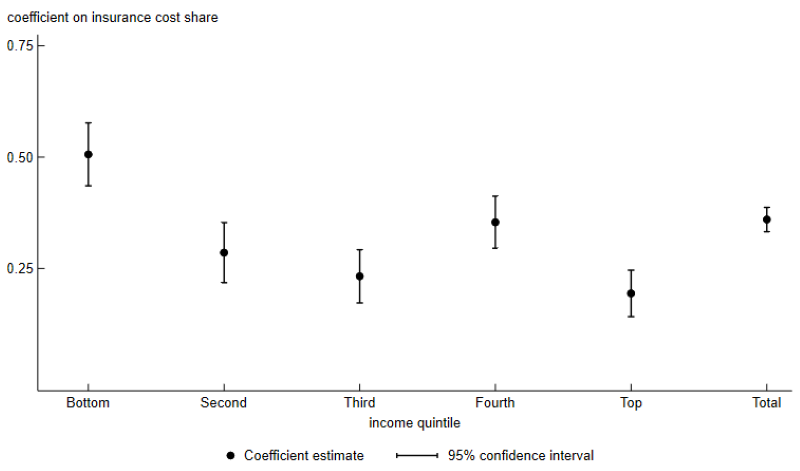
Figure 7 shows the correlation estimates between average premiums as a percent of median income and nonpayment cancellation rates in the zip code during the period 2018–22. For the full sample, the coefficient on average premiums as a percent of median income is 0.36: This implies that in zip codes where households spend 1% more of their income on insurance, nonpayment cancellation rates are 0.36 percentage points higher. When we split the sample by zip code income quintiles, we observe that the relationship is stronger in the lowest-income quintile than in the highest-income one. Specifically, the coefficient for the bottom income quintile is 0.51, compared with 0.19 for the top income quintile. The difference in coefficients highlights how higher levels of insurance costs relative to income are more important for determining nonpayment cancellation rates in lower-income zip codes. This likely reflects the ability of higher-income households to cover unexpected expenses. The Federal Reserve’s 2022 Survey on Household Economics and Decisionmaking (SHED) found that only 63% of adults could cover an emergency expense of $400 with cash or its equivalent; in addition, according to SHED, among adults with a bachelor’s degree or more, 84% could cover an emergency $400 expense, compared with 49% among adults with at most a high school degree or GED (General Educational Development Test) and 28% among adults with less than a high school diploma.
7. Estimating the relationship between homeowners insurance cost shares and nonpayment cancellations, 2018–22
Sources: Authors’ calculations based on data from the U.S. Census Bureau, American Community Survey, and the PCMI Data.
Turning to figure 8, we look at how year-over-year changes in average premiums relative to median income correlate with year-over-year changes in nonpayment cancellation rates during the period 2018–22. For the full sample, a 1 percentage point increase in average premiums relative to median income is associated with a 0.18 percentage point increase in nonpayment cancellation rates. And similar to the coefficients from regression 1 (for the variables in levels), we observe that the coefficients from regression 2 (for the variables in changes) tend to be larger in the lower-income zip codes than in higher-income ones. Specifically, we observe the largest coefficient of 0.29 for the second (to lowest) income quintile. However, the coefficient of 0.18 for the bottom income quintile matches the full sample average, which may reflect the already high level of nonpayment cancellation rates that are less affected by additional cost increases. The top income quintile has a statistically insignificant coefficient, further providing evidence that higher-income households can absorb insurance premium shocks. Together, the results from figures 7 and 8 demonstrate that increases in insurance costs relative to income are associated with higher rates of nonpayment cancellations and that such increases are particularly impactful in lower-income zip codes.
8. Estimating the relationship between changes in homeowners insurance cost shares and changes in nonpayment cancellations, 2018–22
Sources: Authors’ calculations based on data from the U.S. Census Bureau, American Community Survey, and the PCMI Data.
Conclusion
The PCMI Data allow us to analyze changes to insurance costs for single-family homeowners at the local level. In our analysis, we show that homeowners insurance premiums have increased across many Seventh District states, which are located in the heart of the Midwest, and that insurance costs are most burdensome for households living in neighborhoods with lower median incomes. Both higher levels of average premiums relative to median incomes and increases in this ratio are associated with higher nonpayment cancellation rates. Since 2022 (when the PCMI Data sample we used ends), this burden has only increased as insurance prices have risen by over 40%.17 The rise in homeowners insurance costs may lead to no-win choices for long-time homeowners who can neither afford their premiums nor the cost of repair if they lower their premiums by increasing their deductible (or, for those without a mortgage, forgo insurance altogether). New home buyers may be priced out of certain markets because of high homeowners insurance premiums. Ultimately, to improve homeowners insurance affordability, the underlying key cost drivers must be addressed.
Notes
1 Reinsurance allows insurers to offload potential future losses on their underwritten policies by paying a premium; i.e., reinsurance essentially acts as insurance for insurers. Reinsurance prices tend to rise following large loss years, as reductions in capital make funding more expensive. For information on reinsurance prices through 2024, see the Howden Group (2024, in particular figure 1).
2 The Federal Insurance Office issued a January 2025 report that refers to these data as the “PCMI Data,” as the data were “collected through the Property and Casualty Market Intelligence Data Call (PCMI Data Call) by the NAIC on behalf of participating U.S. states” (U.S. Department of the Treasury, Federal Insurance Office, 2025, p. 5). Both this report and the PCMI Data were first announced in a January 2025 press release from the U.S. Department of the Treasury. The PCMI Data are also available here.
3 Throughout this article, we consider zip codes in the entirety of Illinois, Indiana, Michigan, and Wisconsin, though only major portions of these four states and all of Iowa officially make up the Seventh Federal Reserve District, served by the Chicago Fed.
4 Linear regressions are statistical processes that measure the degree of correlation between two variables—an independent (predictor) variable and a dependent (response) variable—while holding constant the other independent variables; the estimated coefficient from a regression represents the mean change in the dependent variable for a one-unit change in the independent variable.
5 U.S. Department of the Treasury, Federal Insurance Office (2025, pp. 1, 8).
6 U.S. Department of the Treasury, Federal Insurance Office (2025, pp. 5–6).
7 These definitions are based on various online resources, including the NAIC definitions.
8 Through the PCMI Data Call, the NAIC collected additional information that was not released publicly, including policies in force, the U.S. dollar value of insured coverage, the U.S. dollar value of deductibles (split by standard, wind/hail, and hurricane deductibles), and counts of policies with deductibles. Further details on all the collected data are available online from the NAIC.
9 U.S. Department of the Treasury, Federal Insurance Office (2025, pp. 1). Some zip codes (generally those with low populations) are not included in the data set because of confidentiality concerns (e.g., not enough policies were written in those places to make it sufficiently difficult to identify their respective policy owners).
10 See this map of hail risk based on data from the FEMA (Federal Emergency Management Agency) National Risk Index (further details on the index are available online). See also Copley (2025).
11 Average premiums are calculated by weighting average zip code premiums by the number of households in each zip code in each state using the household counts in American Community Survey (ACS) five-year estimates from the U.S. Census Bureau. The 2018 estimate is based on 2014–18 ACS five-year estimates. The 2022 estimate is based on 2018–22 ACS five-year estimates.
12 For each of the 50 states and the District of Columbia, income quintiles are determined using 2018 ACS five-year estimates of zip code median incomes of owner-occupied households. These within-state income quintiles split the zip codes of each state into five equal groups: bottom, second, third, fourth, and top quintiles. This means the median income thresholds for each quintile varies across states. For example, in Illinois the bottom quintile comprises zip codes with median incomes less than or equal to $54,550 and the second quintile, zip codes with median incomes $54,551–$62,312; yet in Michigan, the bottom quintile comprises zip codes with median incomes less than or equal to $48,274 and the second quintile, zip codes with median incomes $48,275–$55,972. For national statistics, within-state income quintiles are also used. This means that each zip code is grouped into the same income quintile for state-level and national statistics; in other words, the income quintile that we assign a zip code of a given state in both sets of state-level and national statistics is based on the income distribution of zip codes in that state.
13 The change in median household income reflects the percentage difference between the 2018–22 ACS five-year estimates and 2014–18 ACS five-year estimates.
14 In this paragraph, all the numerical values for income growth and premium changes for specific income quintiles in Seventh District states and in the nation as a whole are from our calculations based on ACS data and the PCMI Data.
15 The national sample for nonpayment cancellation rates comprises zip codes from 49 states and the District of Columbia. Texas is excluded from all nonpayment cancellation statistics because no such data are provided for zip codes in that state.
16 See the appendix for detailed descriptions of the regression specifications, coefficients, and summary statistics.
17 Research from the Dallas Fed found average monthly premiums rose from $146 in 2022 to $205 in 2025—and according to our calculations, that amounts to an increase of 40.4%.
Appendix
We run a regression where nonpayment cancellation rate in the zip code () in year () (), which is the dependent variable, is regressed on average premium relative to median income, or the insurance cost share (), which is the independent variable. We include in the regression zip code controls for log median income, total number of households, percent change in households, and income quintile dummies. We also include year and state fixed effects ( and ). We run this regression on zip codes with at least 500 households from 2018 through 2022 and exclude any zip codes that do not report nonpayment cancellations during the sample period. We run the regression for all zip codes in the sample and then separately by within-state income quintile. The specification for regression 1 is shown in this equation:
where , , , and denote parameters (coefficients) to be estimated from the data and is the error term.
In a separate regression, the change in nonpayment cancellation rates between year and () is the dependent variable and percent change in insurance cost share on a year-over-year basis () is the independent variable. As in the equation for regression 1, we include zip code controls and year and state fixed effects. We run this regression on zip codes with at least 500 households from 2018 through 2022 and exclude any zip codes that do not report nonpayment cancellations during the sample period. We run the regression for all zip codes in the sample and then separately by within-state income quintile. The specification for regression 2 is shown in this equation:
The full regression results and summary statistics for both regressions are available in figure A1.
A1. Regression results and summary statistics
| Regression 1 | Regression 2 | ||||||||||||
|---|---|---|---|---|---|---|---|---|---|---|---|---|---|
| Insurance cost share: Average homeowners insurance premium / median income (%) | Nonpayment cancellation rate (%) | ∆ in insurance cost share: Percentage point ∆ in average homeowners insurance premium / median income | Percentage point ∆ in nonpayment cancellation rate | ||||||||||
| Income quintile | Coefficient estimate | Mean | SD | Mean | SD | Coefficient estimate | Mean | SD | Mean | SD | |||
| Bottom | 0.51*** | 2.59 | 1.10 | 2.62 | 1.75 | 0.18*** | –0.011 | 0.27 | –0.01 | 1.15 | |||
| Second | 0.29*** | 2.14 | 0.91 | 2.17 | 1.42 | 0.29*** | 0.012 | 0.21 | –0.02 | 0.96 | |||
| Third | 0.23*** | 1.91 | 0.86 | 1.86 | 1.26 | 0.21*** | 0.020 | 0.17 | –0.01 | 0.81 | |||
| Fourth | 0.35*** | 1.76 | 0.77 | 1.64 | 1.08 | 0.24*** | 0.025 | 0.15 | 0.00 | 0.71 | |||
| Top | 0.19*** | 1.60 | 0.82 | 1.31 | 1.13 | –0.05 | 0.022 | 0.13 | 0.00 | 0.54 | |||
| Total | 0.36*** | 1.96 | 0.94 | 1.86 | 1.39 | 0.18*** | 0.015 | 0.19 | –0.01 | 0.83 | |||