When television shows feature makeovers, there is typically a big “reveal,” a moment where all the shiny new bits are shown off at once.
The Chicago Fed’s Charles L. Evans Money Museum is taking a different approach this year, one that allows it to remain open almost non-stop as it reworks and refreshes some longstanding exhibits, debuts a new special exhibit celebrating the iconic American highway Route 66, and celebrates its own 25th birthday.
Titled A Century of Route 66: Driving Culture and Commerce, the new exhibit kicked off this season of rejuvenation at the free museum, typically open from 10 a.m. to 5 p.m. on weekdays and located on the first floor of the Federal Reserve Bank of Chicago building at Jackson Boulevard and Lasalle Street in Chicago’s Loop.
The exhibit marks the 100th anniversary of the roadway, long celebrated in American culture for its ability to take people from Point A, Chicago, to Point Z, Los Angeles, with way more than 24 other letters worth of interesting sights along the way.
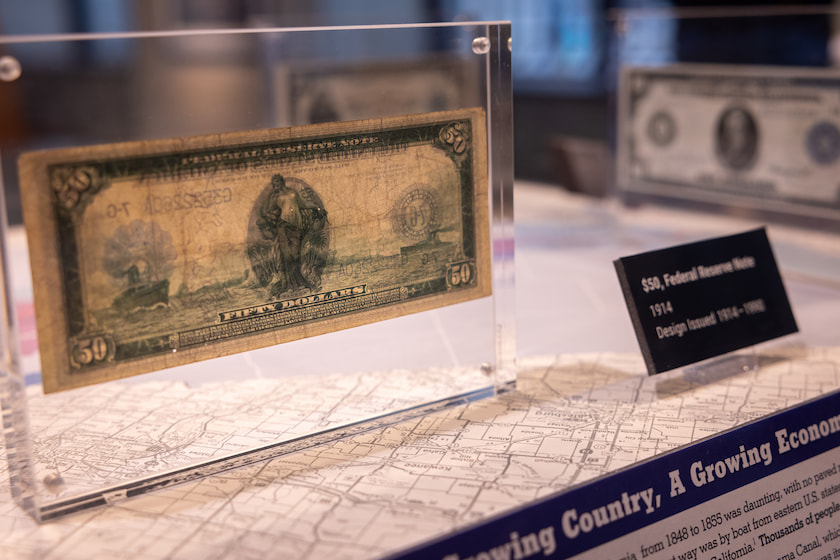
Noting that the museum is located on one of the very first blocks of Route 66, the exhibit—which opened in May—builds outward from there to explore the highway’s role in such cultural touchstones as “The Grapes of Wrath,” both novel and film. It shows off transportation-themed early currency from the Bank’s collection of historic bills and spotlights intriguing transportation history from the five states in the Chicago Fed’s midwest District.
“One hundred years ago, when Route 66 opened, the cash in your pocket would have looked different. At our exhibit, you can see some of the money people were using throughout the history of Route 66, including the $50 U.S. bill that featured ships until 1990,” said Matthew Ramirez, the Bank museum specialist who led development of A Century of Route 66.
Following closely in June are new looks and content for exhibits on how payments work in the U.S. and how the Federal Reserve, as the U.S. central bank, implements monetary policy, one of the key roles assigned by Congress to the Fed.
“Payments and monetary policy have changed a lot over the past ten years,” said Jennifer Bridge, the Bank’s museum team lead. “It is important to refresh these and other exhibits to provide visitors with accurate information and an engaging experience.”
The new payments exhibit explores the dramatic, 21st-centurty shifts in the ways people and businesses pay for goods and services. The transition from paper checks dominating non-cash payments to today’s digital and instant options has been profound. The Fed, the exhibit notes, has been key to this shift, developing new ways to make payments and improving old ones while continuing to circulate cash through the system.
Monetary policy relates to the headline people hear most often about the Fed: Did the Federal Open Market Committee increase or decrease a key short-term interest rate at its most recent policy meeting? Like the new payments exhibit, the monetary policy display uses updated, interactive storytelling to explain the tools and the thinking behind the Fed’s formulation of monetary policy.
As summer progresses, the Money Museum will mark its quarter-century with a series of banners mounted on light poles along Jackson Boulevard, which is also the path of Route 66.
Opened in July of 2001 as a way for the Chicago Fed to help the public learn about money and the mission of the Bank and the Federal Reserve, the Money Museum has undergone periodic updates through the years, but the current array of work is the most comprehensive since its founding.
Closed to the public during the Covid-19 pandemic, the museum in 2025 welcomed over 54,000 visitors from across the globe, its highest total this decade. In recent years, the Money Museum has been a regular on Tripadvisor's list of the top 10 percent of attractions worldwide.
As people note this year’s improvements to the museum experience, they should understand that more changes are on the near horizon, officials said. In addition to looking at other exhibit updates, the museum is modernizing its technology and studying best ways to use its gallery space to reflect the Chicago Fed’s ongoing commitment to transparency, accessibility, and public education.