On July 20, 2026, the U.S. President invoked section 338 of the Tariff Act of 1930 to issue three distinct presidential proclamations targeting Canadian exports in response to discriminatory trade barriers on U.S. alcoholic beverages, dairy products, and motor vehicles. These proclamations establish an additional 50% ad valorem duty that stacks directly on top of standard tariffs, antidumping/countervailing duties, and standard customs fees. In total, these actions affect 569 categories of goods, as defined by eight-digit subheadings in the Harmonized Tariff Schedule of the United States (HTSUS), capturing nearly $24 billion, or 5.5% in total annual Canadian import value.
Section 338 authorizes the U.S. President to impose retaliatory tariffs up to 50% ad valorem on imports from countries that discriminate against U.S. commerce. The new tariffs take effect on August 19, 2026 (30 days post-issuance). Unlike temporary emergency trade measures, section 338 duties carry no statutory expiration date and remain active until explicitly modified or revoked.
The alcoholic beverages proclamation (Harmonized Tariff Schedule (HTS) heading 9903.03.12) cites provincial liquor board restrictions (e.g., in Ontario and Quebec) that remove or limit U.S. wine, beer, and spirits from retail channels. It covers 61 eight-digit HTSUS codes, including those for beer, wine, whiskies, rum, vodka, gin, liqueurs, cider, ethyl alcohol, and grape spirit/essential oils. It also covers some non-alcoholic-beverage items, such as wooden packaging and field/ice hockey equipment.
The dairy proclamation (HTS heading 9903.03.13) responds to Canada’s tariff rate quota (TRQ) structure for cheese and dairy, stating Canada affords European Union (EU) suppliers preferential market access compared to U.S. exporters under the United States–Mexico–Canada Agreement (USMCA). It covers 52 eight-digit HTSUS codes, including those for milk powders, concentrated whey, caseinates, and lactose. It also covers nondairy items, such as molasses, hop pellets, nonalcoholic beer, peppermint oil, and specialized food/peptone preparations.
The motor vehicles proclamation (HTS heading 9903.03.14) responds to Canada’s United States Surtax Order (Motor Vehicles 2025), which levied 25% tariffs on nonoriginating content and imposed automaker-specific quota reductions. It covers 456 eight-digit HTSUS codes (making up the vast majority of the tariff basket from the July 2026 proclamations). Its highly diversified scope extends far beyond vehicles to reach retaliatory trade volume targets, encompassing agricultural products, cotton apparel, leather goods, fine art, antiques, worked diamonds, jewelry, furniture, and sporting goods.
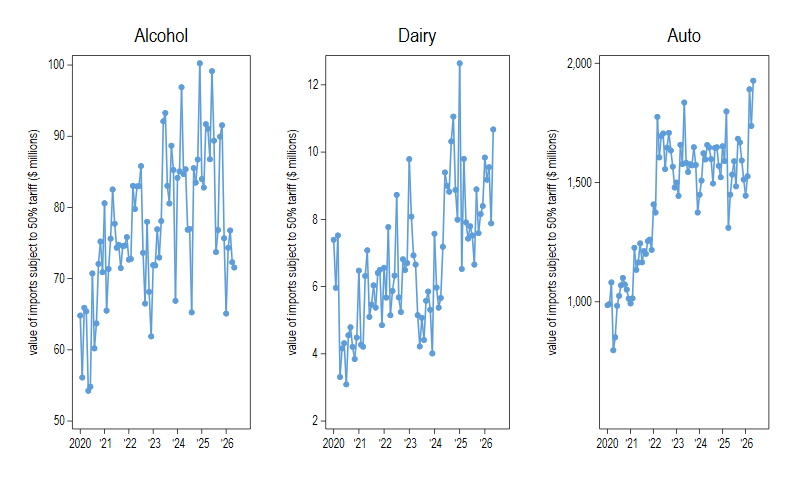
Using the HTSUS codes provided in annex I of each of the three proclamations (click on each one’s hyperlink in the preceding paragraphs and then scroll down in each online file), we calculated the recent monthly import values subject to the new 50% tariffs and plotted them in figure 1. Based on May 2026 trade data, the new duties would apply to $72 million in imports under the alcoholic beverages proclamation, $11 million under the dairy proclamation, and $1.93 billion under the motor vehicles proclamation.
1. Imports from Canada subject to the 50% tariff, by specific July 2026 proclamation
Source: Authors’ calculations based on data from the U.S. International Trade Commission, DataWeb.
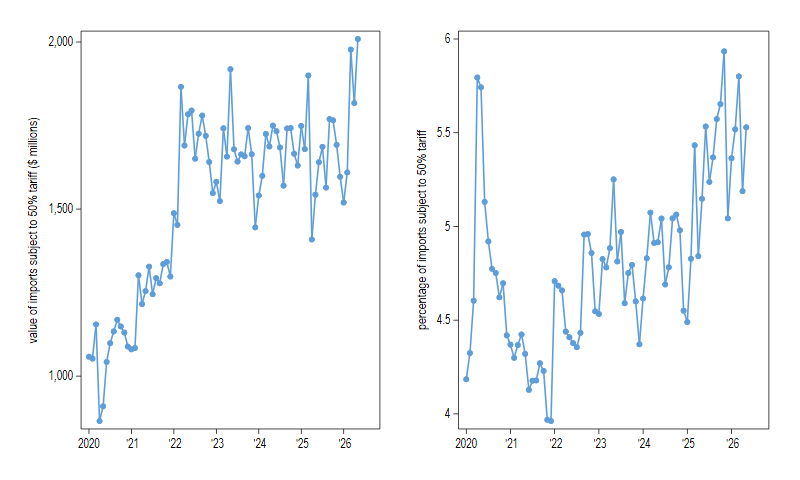
To determine the aggregate impact, we combined the affected import values across all three proclamations. Total affected import values and the percentage of total imports from Canada are shown in figure 2. In total, $2.0 billion in May 2026 imports from Canada would be subject to the new 50% tariffs, representing 5.5% of total imports from Canada to the U.S. for that month. On an annualized basis, this equates to approximately $24 billion in affected Canadian trade.
2. Imports from Canada subject to the 50% tariff, by the combined July 2026 proclamations
Source: Authors’ calculations based on data from the U.S. International Trade Commission, DataWeb.