Read our AgLetter Insights Q&A with author David Oppedahl for further insights into Seventh District farmland values and agricultural credit conditions described in this issue of AgLetter.
Farmland values
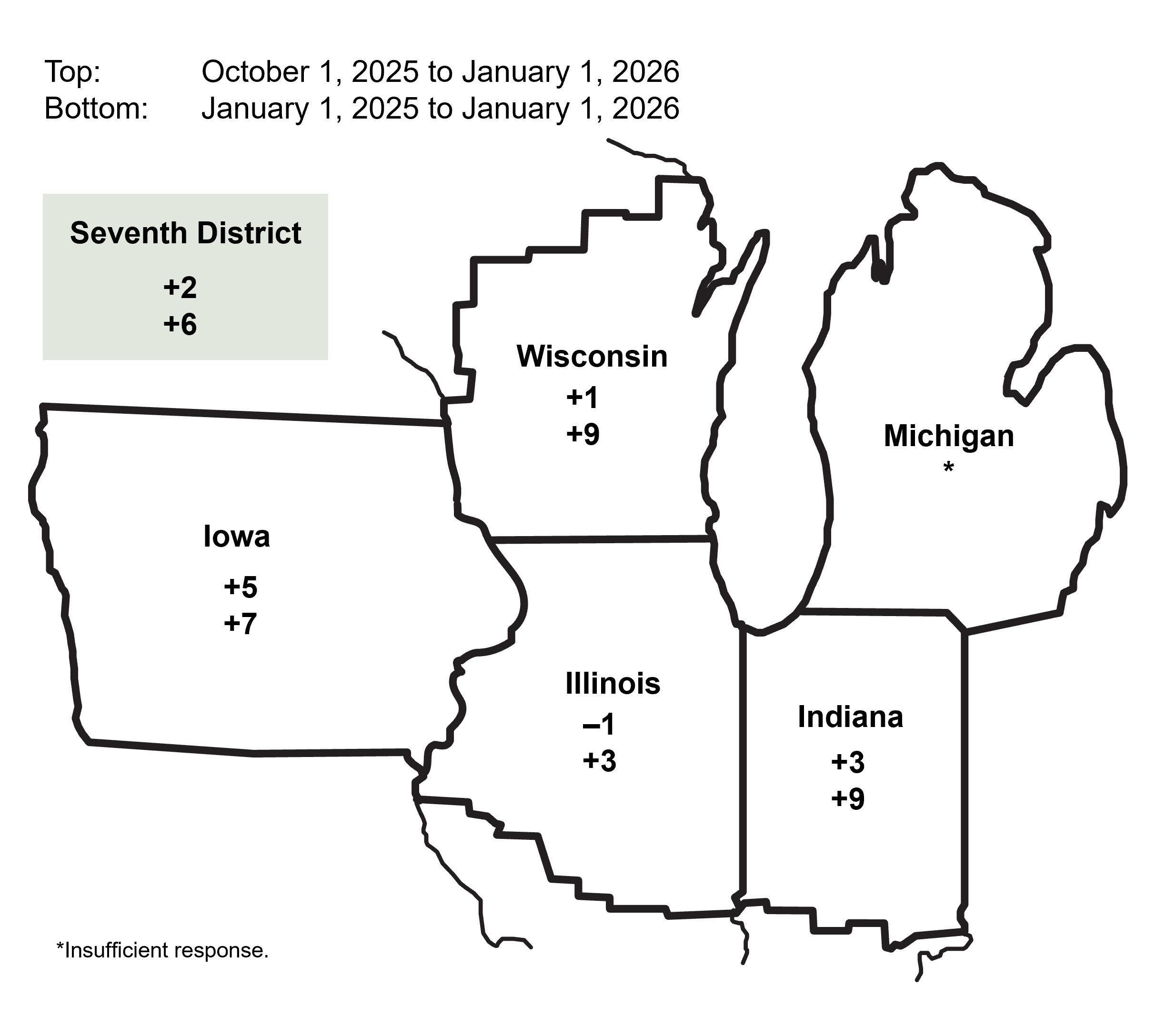
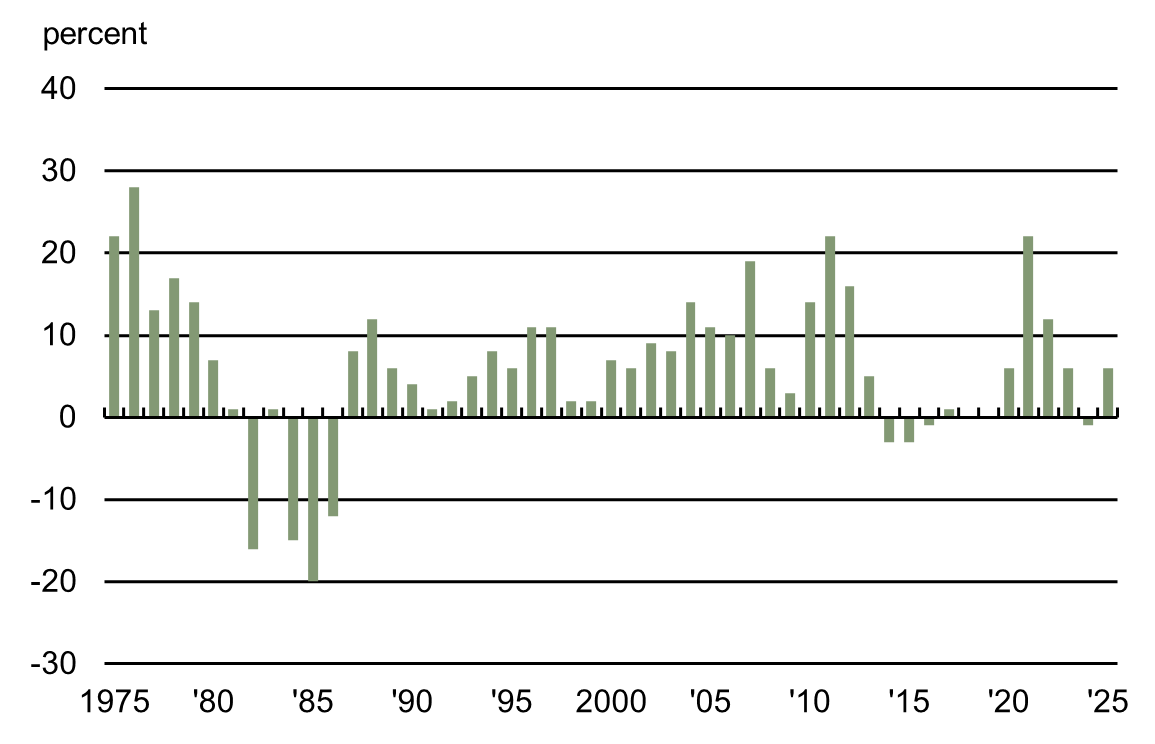
An annual increase of 6% in the Seventh Federal Reserve District’s agricultural land values in 2025 reversed the modest decrease in 2024. Values for “good” farmland in the District moved up 2% in the fourth quarter of 2025 from the third quarter, according to 102 respondents from agricultural banks who completed the January 1 survey (figure 1). Illinois, Indiana, and Iowa had single-digit annual increases in their farmland values for 2025, following annual decreases for 2024. Wisconsin also had an annual increase in agricultural land values for 2025, which was slightly higher than last year’s increase. From 2014 through 2019, the yearly changes in District farmland values were somewhat negative to flat. In contrast, there were annual increases in farmland values from 2020 through 2025, except for in 2024, when there was a small decline (see figure 2).
1. Percent change in dollar value of “good” farmland
2. Annual change in Seventh District farmland values
Credit conditions
Agricultural credit conditions continued to deteriorate in the fourth quarter of 2025. The share of the District’s farm loan portfolio assessed as having “major” or “severe” repayment problems was 5.6% in the fourth quarter of 2025—the highest it’s been since the second quarter of 2020. Repayment rates for non-real-estate farm loans were lower in the October through December period of 2025 compared with a year ago, and the renewals and extensions of these loans were higher (see figure 3). In the final quarter of 2025, demand for non-real-estate farm loans relative to a year ago was up for the ninth consecutive quarter, while the availability of funds for agricultural lending relative to a year earlier was down for the 11th consecutive quarter.
The breakdown of the index numbers for the fourth quarter of 2025 follows:
- The index of demand for non-real-estate farm loans was 135 for the fourth quarter of 2025; 47% of survey respondents observed higher loan demand compared with a year ago, while 12% observed lower demand.
- The index of funds availability was 83 for the fourth quarter of 2025; 20% of survey respondents noted that their banks had less funds available to lend than a year ago, while 3% noted they had more.
- The index of loan repayment rates for non-real-estate agricultural loans in the fourth quarter of 2025 was 69; 32% of responding bankers noted lower rates of loan repayment than a year ago, while 1% noted higher rates.
- The index of loan renewals and extensions of non-real-estate farm loans was 134 in the fourth quarter of 2025; 35% of survey respondents reported more of them than a year earlier, while 1% reported fewer.
At 79.6% in the fourth quarter of 2025, the District’s average loan-to-deposit ratio was higher than that of the previous 25 quarters (and over 2 percentage points lower than the level desired by responding bankers). Notably, 30% of survey respondents’ banks tightened their credit standards for farm loans in the fourth quarter of 2025 compared with a year earlier, while 69% of the respondents’ banks kept their credit standards essentially unchanged. With that said, 77% of responding bankers noted that their banks did not raise the amounts of collateral required for customers to qualify for non-real-estate farm loans during the final quarter of 2025 relative to a year ago, while 23% noted their banks required larger amounts. Agricultural interest rates edged down from the end of the third quarter to the end of the fourth quarter of 2025 and were last lower at the end of the third quarter of 2022.
3. Credit conditions at Seventh District agricultural banks
| Latest period | Prior period | Year ago | |
|---|---|---|---|
| 2025:Q4 | 2025:Q3 | 2024:Q4 | |
| Indexesa | |||
| Loan demand | 135 | 127 | 129 |
| Funds availability | 83 | 90 | 90 |
| Loan repayment rates | 69 | 64 | 64 |
| Loan renewals and extensions | 134 | 134 | 130 |
| Average loan-to-deposit ratiob | 79.6 | 76.9 | 76.7 |
| Interest rates on farm loansc | |||
| Operating loans | 7.11 | 7.47 | 7.78 |
| Feeder cattle loans | 7.25 | 7.57 | 7.88 |
| Real estate loans | 6.63 | 6.82 | 7.19 |
Looking forward
There were fewer responding bankers (7%) who projected agricultural land values to go up in the next quarter (in this case, the first quarter of 2026) than those who projected them to go down (20%). Moreover, survey respondents at the start of 2026 decisively predicted capital expenditures by farmers would once again be lower in the year ahead than in the year just ended for land purchases or improvements, as well as for buildings and facilities, machinery and equipment, and trucks and autos. In addition, farm real estate loan volumes were narrowly forecasted to be smaller in the first three months of 2026 compared with the same three months of 2025. Nevertheless, non-real-estate loan volumes (specifically for operating loans, feeder cattle loans, and loans guaranteed by the U.S. Department of Agriculture’s Farm Service Agency) were forecasted to be larger in the first three months of 2026 compared with the same three months of a year earlier. Over this time frame, lending for dairy, farm machinery, and grain storage construction was expected to decline relative to a year ago.
According to survey respondents at the beginning of 2026, 3.8% of their farm customers with operating credit in the year just past were not likely to qualify for new operating credit in the year ahead (above the survey’s level at the start of 2025). This survey result, combined with the rise in loans with repayment problems and somewhat tighter credit standards, suggests District agricultural credit conditions may deteriorate further in the year ahead. As a banker from Illinois commented, “2026 is going to be a challenge for many producers with higher input prices.” Yet, the outlook still offers some hope for Midwest farmers, particularly given stronger farmland values, government support of farm operations, and lower recent agricultural interest rates.