Read our AgLetter Insights Q&A with author David Oppedahl for further insights into Seventh District farmland values and agricultural credit conditions described in this issue of AgLetter.
Farmland values
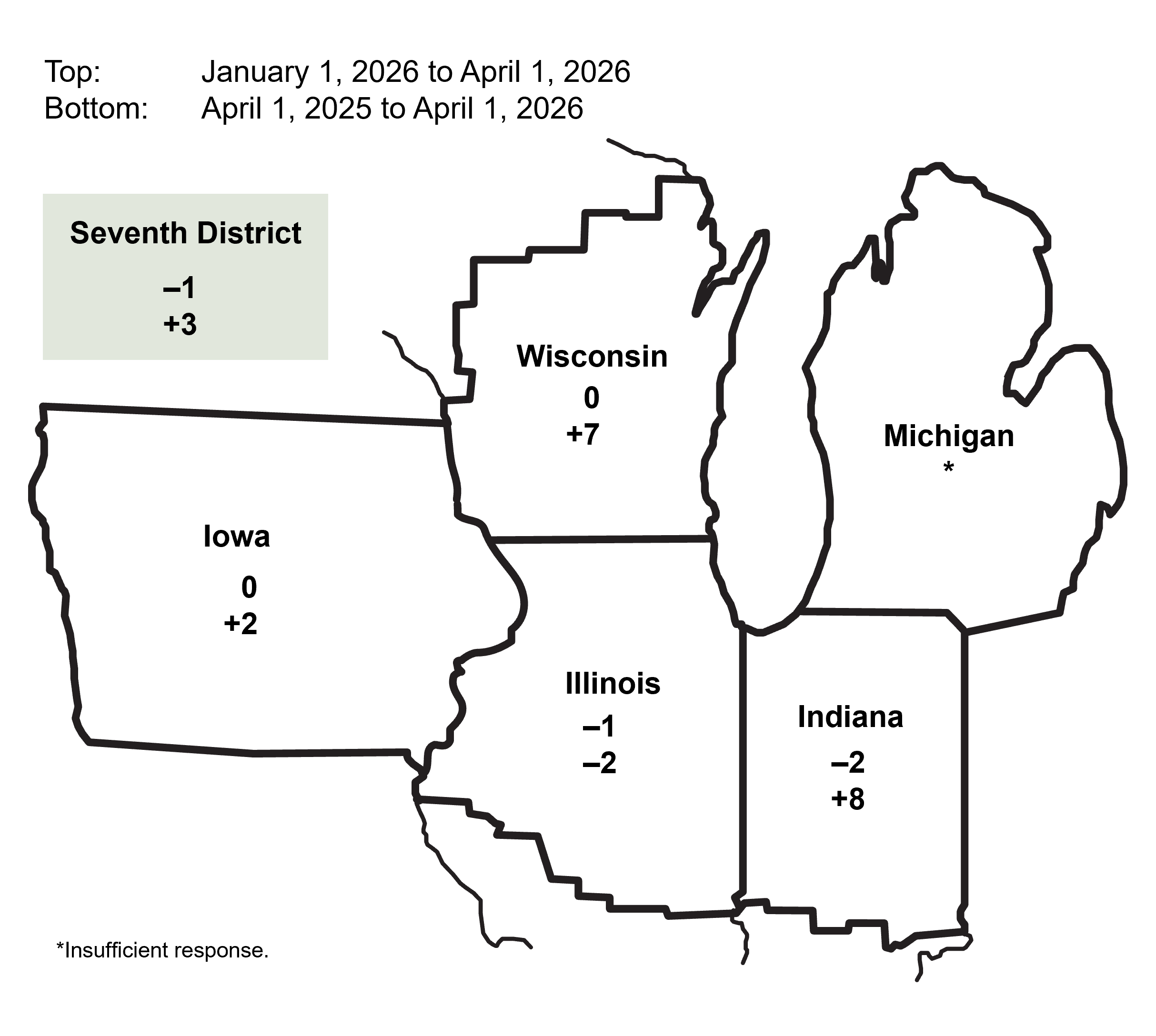
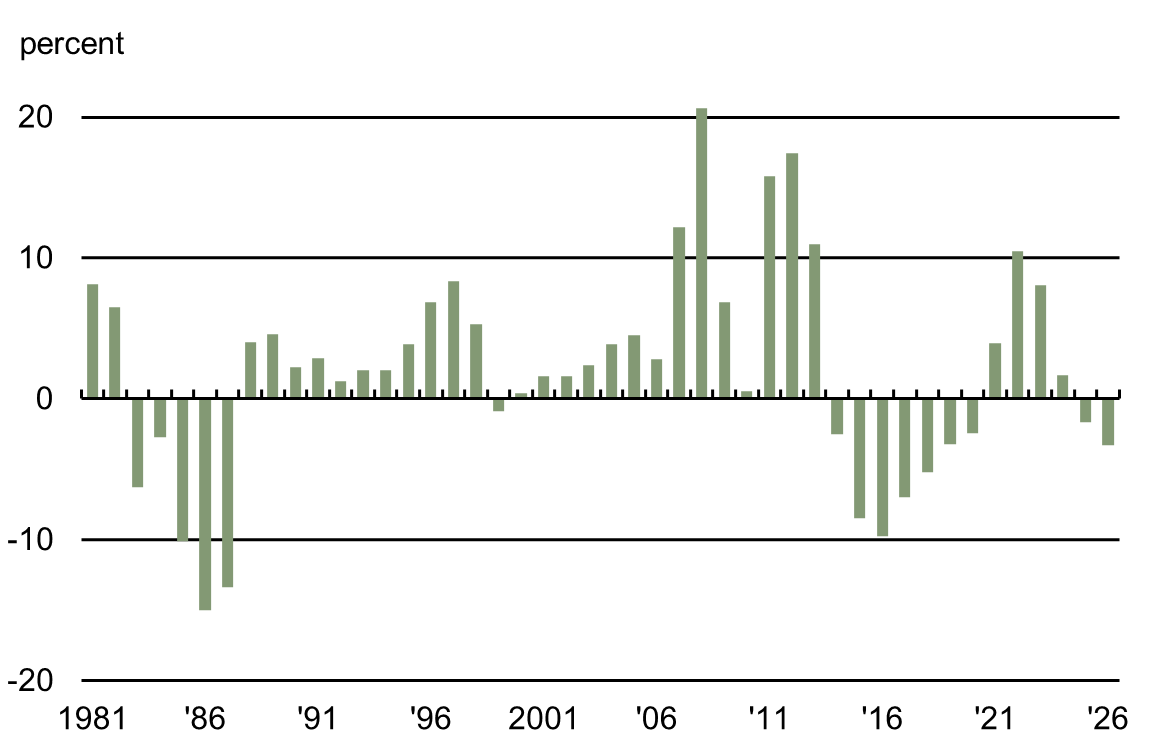
In the first quarter of 2026, the Seventh Federal Reserve District’s agricultural land values saw a 3% increase from a year ago. Yet “good” farmland values dipped 1% from the fourth quarter of 2025 to the first quarter of 2026, according to the survey responses of 104 District agricultural lenders (see figure 1). Demand to purchase farmland was lower in the three- to six-month period ending with March 2026 than in the same period ending with March 2025 (11% of survey respondents reported higher demand to purchase farmland and 22% reported lower demand). Also, the amount of farmland for sale was down during the winter and early spring of 2026 compared with a year earlier. Likewise, the number of farms and the amount of acreage sold were down in the winter and early spring of 2026 relative to a year ago. Annual cash rental rates for District farmland saw a decrease of 3% in 2026—their second consecutive decrease after increases from 2021 through 2024 (see figure 2). For 2026, average annual cash rents for farmland were up 2% in Indiana, but down 1% in Illinois, 4% in Iowa, and 1% in Wisconsin (not enough survey responses were received from lenders in Michigan to report a numerical change for that state).
1. Percent change in dollar value of “good” farmland
2. Annual percentage change in Seventh District farmland cash rental rates
Credit conditions
District agricultural credit conditions weakened during the first quarter of 2026. Repayment rates for non-real-estate farm loans were lower in the January through March period of 2026 compared with a year ago, and the renewals and extensions of these loans were higher (see figure 3). In the first quarter of 2026, demand for non-real-estate farm loans relative to a year ago was up for the tenth consecutive quarter, while the availability of funds for agricultural lending relative to a year earlier was down for the 12th consecutive quarter.
The breakdown of the index readings for the first quarter of 2026 follows:
- At 141, the index of demand for non-real-estate farm loans indicated strong demand in the first quarter of 2026; for that quarter, 50% of the responding lenders noted higher loan demand compared with a year ago and 9% noted lower demand.
- The index of funds availability was 90; 10% of the responding lenders reported their institutions had more funds available to lend in the first quarter of 2026 than a year earlier, while 20% reported their institutions had less.
- At 63, the index of repayment rates for non-real-estate farm loans was down from a year ago for the tenth consecutive quarter; 38% of responding lenders observed lower rates of repayment for the first quarter of 2026 relative to the first quarter of 2025, while 1% observed higher rates.
- The index of loan renewals and extensions stood at 136 in the first quarter of 2026 (its highest value since the second quarter of 2020); 38% of the survey respondents reported higher levels of loan renewals and extensions over the January through March period of 2026 compared with the same period last year, while just 2% reported lower levels of them. Furthermore, responding lenders reported that, on average, 17% of their farm borrowers had more carryover debt (loans not paid off at the end of the growing season and subsequently carried over into the next one) in 2026 than in 2025.
At 79.8%, the average loan-to-deposit ratio in the first quarter of 2026 was up a bit from the previous quarter and was nearly 3 percentage points below the average level desired by responding lenders. The amount of collateral required by agricultural lending institutions across the District was somewhat higher than a year earlier. By the end of the first quarter of 2026, the District’s average interest rates on farm operating and feeder cattle loans had edged down from the prior quarter, while its average interest rate on farm real estate loans had risen slightly.
3. Credit conditions at Seventh District agricultural banks
| Latest period | Prior period | Year ago | |
|---|---|---|---|
| 2026:Q1 | 2025:Q4 | 2025:Q1 | |
| Indexesa | |||
| Loan demand | 141 | 135 | 143 |
| Funds availability | 90 | 83 | 94 |
| Loan repayment rates | 63 | 69 | 61 |
| Loan renewals and extensions | 136 | 134 | 133 |
| Average loan-to-deposit ratiob | 79.8 | 79.6 | 76.9 |
| Interest rates on farm loansc | |||
| Operating loans | 7.08 | 7.11 | 7.73 |
| Feeder cattle loans | 7.12 | 7.25 | 7.76 |
| Real estate loans | 6.74 | 6.63 | 7.09 |
Looking forward
According to an Iowa lender, “cash flow projections for many operations are at or below breakeven for 2026 and many borrowers are using up working capital to fund those cash flow shortfalls.” Unsurprisingly, survey respondents forecasted that the overall volume of non-real-estate farm loans would rise in the District during the April through June period of 2026 relative to the same period of 2025 (41% of the responding lenders expected a higher volume of such loans, while 8% expected a lower volume). In particular, operating loans, feeder cattle loans, and loans guaranteed by the Farm Service Agency were anticipated to have higher volumes relative to a year earlier, while farm machinery, grain storage construction, and dairy loans were anticipated to have lower volumes. Survey respondents narrowly forecasted a decline in the District’s farm real estate loan volume in the second quarter of 2026 from a year earlier.
In the first quarter of 2026, 56% of survey respondents considered farmland to be overvalued, while just 1% considered it undervalued. Even so, over 80% of the responding lenders expected farmland values to be unchanged in the second quarter of 2026; 9% of respondents forecasted agricultural land values to decrease, and 8% forecasted them to increase.
Note: Beginning the first quarter of 2026, the published AgLetter results are based on survey responses from commercial banks and Farm Credit System institutions located in the Seventh Federal Reserve District; all results prior to the first quarter of 2026 are based on survey responses from commercial banks only.
Save the Date
The Federal Reserve Bank of Chicago will hold a hybrid conference about the uses and destinations of midwestern crops on October 16, 2026. Additional information about this event will become available online in the coming months.