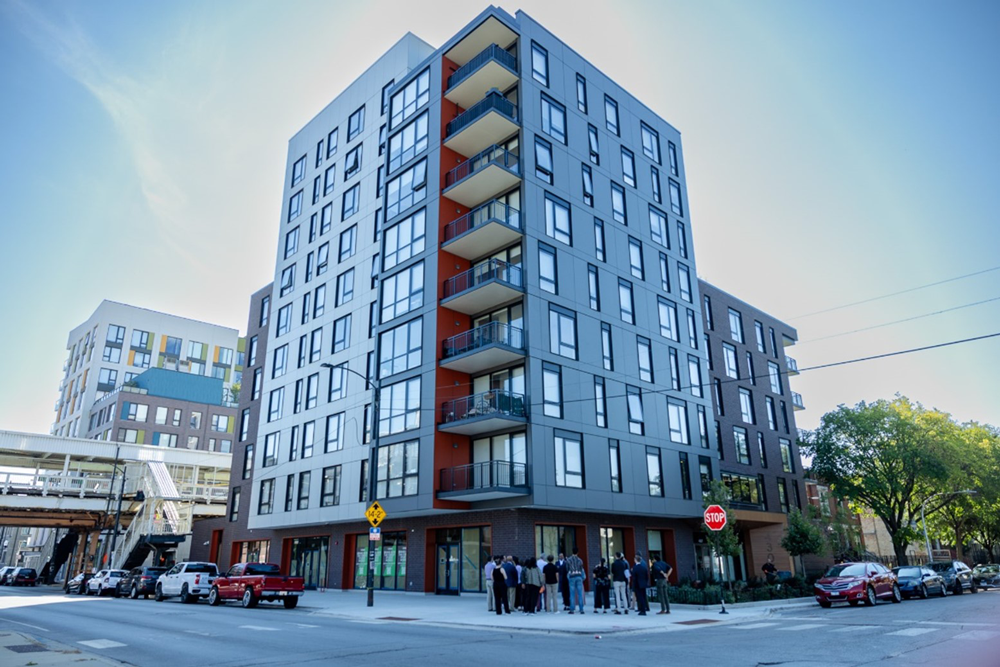
Over the past year, employers and leaders of community-serving organizations across Chicago have shared with us their common belief that an increase in the housing supply is needed to support employment and price stability in our metro area. In particular, our contacts have expressed their concerns about a lack of affordable housing in the city and their desire to better understand the challenges and opportunities in building such homes here. Thus, in September 2025, the Chicago Fed’s Community Development team convened several Chicago-based developers, as well as experts from local government and the housing policy sector, to visit and discuss a handful of recently completed housing projects and ongoing housing developments across the city. At this convening, partly held on bus rides between sites across Chicago, participants also talked about possible paths for the city’s housing market, in light of the current obstacles and solutions they explored together.
As part of this convening in Chicago, participants visited an office-to-residential conversion in the Loop, new apartment buildings on the South Side, and active construction sites in both affluent and low- to moderate-income (LMI) neighborhoods. Each of these developments had set aside a certain percentage of units to be affordable for those who met specific income requirements—which varied from 30% to 60% of a given area’s median income.1 The percentage of units designated as affordable also varied project to project, with a range of 20% to 87% of total units. The number of total units within each development also varied, from ten units to 635.
During the convening, three key themes emerged:
- Neighborhood context shapes the approach to building affordable housing.
- For affordable housing developments, there is often a tension between increased reporting and compliance requirements that come with public subsidies and the policy goals of creating new housing.
- Opportunities exist for new affordable housing construction—for instance, by building near transit hubs and by making mixed-use spaces (such as retail space and residences)—according to developers, but these opportunities will likely require them to think more strategically about what individual communities want or need.
Neighborhoods have different compositions and, thus, different affordable housing needs
Housing markets are, by their very nature, local. Incomes, current housing stock, amenities, and community perceptions are all factors that can and should affect what is built in any area, many of the experts said. One developer explained that there are parts of Chicago where residents feel there is enough affordable housing already, so they would prefer that more market-rate units be built instead. This new market-rate housing stock may come in the form of apartments with better amenities or more nearby transportation options than other existing housing in a particular neighborhood—which might draw back people who grew up there but moved to another part of Chicago. Other areas of the city, often those that are experiencing higher housing demand and rising rents, are seeing more interest from local residents in affordable housing being built in their neighborhoods, so that they are not priced out.
The cost of development and the amount that owners are able to charge in rent also vary across the city. There is no one-size-fits-all solution when it comes to developing affordable housing, and throughout the day, the speakers reminded the group that what might be affordable in one neighborhood will not be in another.
Affordable housing developers can face complex regulatory compliance challenges
Participants discussed the extent to which the City of Chicago’s regulations and customs, including union labor requirements and alders’ veto power over development in a ward, complicate the process. The 2021 changes in the city’s Affordable Requirements Ordinance, including reductions in the percent of units that could be substituted for with “in-lieu” fees, were also discussed. These fees allow developers to pay into a pot of money designated for future affordable housing development instead of building these units on site. Experts discussed whether this change makes it more difficult to build affordable housing in high-demand areas or if it has caused an increase in the number of affordable units being built in more expensive and quickly growing neighborhoods. No firm consensus on this issue was reached by the end of the convening.
Like many affordable housing developments, the projects that the participants visited required varied capital sources. Funding sources included Tax Increment Financing dollars, Historic Preservation Tax Credits, the Low Income Housing Tax Credit, Equitable Transit-Oriented Development (ETOD) grants, and Multi-Family Development Assistance. These additional sources often come with their own regulations and compliance requirements. For example, one speaker noted that Historic Preservation Tax Credits, while providing an essential source of funding, come with requirements to maintain some features of historical importance, which can add significantly to development costs.
Relying on these sources of public funding can add more construction costs and reporting requirements, yet they can help foster affordable housing development. In the best scenarios, most experts noted, these subsidies help projects become profitable developments, incentivizing organizations to create additional housing stock.
Developers often need to be strategic about where and how to build new housing
One key theme that emerged from conversations throughout the day was that developers are thinking strategically to address housing needs in the neighborhoods they’re working in. One project was located right off the Chicago Transit Authority (CTA) Green Line, making it eligible for Equitable Transit-Oriented Development funding. This project was in an area that had 150 vacant lots in the surrounding area before it started, according to the developer. After the first two phases of the project were completed, he said, only 11 of these lots remained vacant. The developer noted that when there hasn’t been much construction in an area, one well-thought-out project can spur further investment from others.
Others in Chicago are working on office-to-residential conversions, which can help address housing shortfalls as vacant office space grows but come with their own set of challenges. One developer explained that converting a building in the Loop often costs much more than development in other parts of the city—even before you factor in how tough it is to turn an office tower into residences. The developer cited challenges with fitting a construction elevator in a small alley as an example of a type of cost that his firm faced within the Loop.
Another developer noticed that there was a need for ground floor retail space in the neighborhood that local residents could use. In a recently finished apartment building that the developer built, there are two residential units directly connected to a storefront, allowing tenants to live and work in the same place.
Developers explained that new construction works best when it includes community input and is focused on meeting community needs.
Conclusion
Housing development is highly locally dependent and often requires many funding sources and strategic planning. Despite these complicating factors, there are many examples of successful construction projects, including affordable housing developments, across the city of Chicago. The sites that the participants visited and discussed highlight common obstacles of developing housing projects in different parts of Chicago, as well as some solutions that developers and city officials have come up with to overcome them.
The Federal Reserve Bank of Chicago serves the Seventh Federal Reserve District. For more on the Chicago Fed’s community development and outreach efforts (including convenings like this one), visit our webpage.
Notes
1 In each case, a unit is considered affordable when its rent does not exceed 30% of the applicable household’s income.