The United States is entering a new demographic era driven by population aging. While just over 2% of Americans are age 85 or older today, that share is projected by the U.S. Census Bureau to roughly double by 2040 as the baby boom generation advances into its late seventies and eighties.1 Declining fertility, longer life expectancy, lower immigration, and the aging of large cohorts mean that older adults will represent a growing share of the population in communities across the country.
Population aging carries clear macroeconomic implications. As the age structure shifts, labor force growth slows, potentially weighing on economic output and productivity (Maestas et al., 2023). Older households are more likely to experience uncertain health shocks and face long-term care expenses, which can reshape saving and spending decisions late in life (De Nardi et al., 2010). Generally, with population aging, consumption patterns change—away from durables and toward services such as medical care and utilities (Cravino et al., 2022). Furthermore, public finance pressures intensify as more adults become eligible for Social Security, Medicare, and, eventually, Medicaid-financed long-term services and supports.
While there are several broad channels through which population aging will impact the economy, the particular economic consequences of aging will depend on how and where older Americans live. The vast majority of adults in their sixties and seventies live independently, often in homes they have occupied for decades. But beginning around age 80, the likelihood of needing assistance with daily activities rises sharply and living arrangements begin to diverge: Some older adults remain in the community with help from family or paid caregivers, others move into assisted living settings, and a smaller—but costly—share transition into nursing homes.
These residential choices matter because they determine who provides care, how much that care costs, whether family caregivers remain attached to the labor force, and which public programs ultimately finance support. They shape demand for housing, transportation, long-term care workers, and local tax bases. And because aging is uneven across U.S. regions, they may contribute to widening economic differences between states and metropolitan areas.
In this article, we examine where older Americans live and why those patterns are central to understanding the economic impact of population aging. We first look at the living arrangements of older people (generally those age 72 and older) and document differences by age group, gender, race/ethnicity, and geography. We then discuss the possible effects on local economies via changes to labor markets, consumption patterns, and public finances.
This is part 1 of a three-part series on the landscape of elder care in the United States. In part 2, we document the costs of elder care associated with each type of living arrangement and examine the quality of care, narrowing in on nursing homes for which we have the most comprehensive data. In part 3, we further study nursing homes, examining geographic variation in access to them and their market concentration.
How older Americans live
To understand the economic implications of aging for the country, it helps to start with where older adults live. To document residential patterns for adults age 72 and above, we use the aggregate tables data from the National Health and Aging Trends Study (NHATS)—a nationally representative survey of Medicare beneficiaries age 65 and older spanning the period 2011–21.2
We define three broad living arrangements for older Americans that reflect differing levels of support.3
- Community living includes traditional private homes, retirement communities, and independent senior housing and represents the most autonomous setting.
- Assisted living facilities provide help with daily activities but typically do not offer 24-hour skilled nursing care.
- Nursing homes offer the highest-intensity, medically supervised care.
Over the past decade, older Americans have become increasingly likely to remain in the community. The share of Americans who were age 72 and older in community living settings rose from 88% in 2011 to 92.7% in 2021; over the same period, the share of these Americans in nursing homes declined from 4.4% to 1.9% and the share of them in assisted living decreased from 7.6% to 5.3%.4 While these changes may partially reflect shifts in age composition over time, existing research documents a secular decline in institutionalization rates at each age (for people age 70 and older) between 1980 and 2017 (Butcher et al., 2022, figure 2). This documented broader shift away from institutional care (i.e., assisted living and nursing home care) toward community-based care may reflect improvements in overall health, enhanced home-based supports, and shifting policy priorities and personal preferences toward “aging in place.”
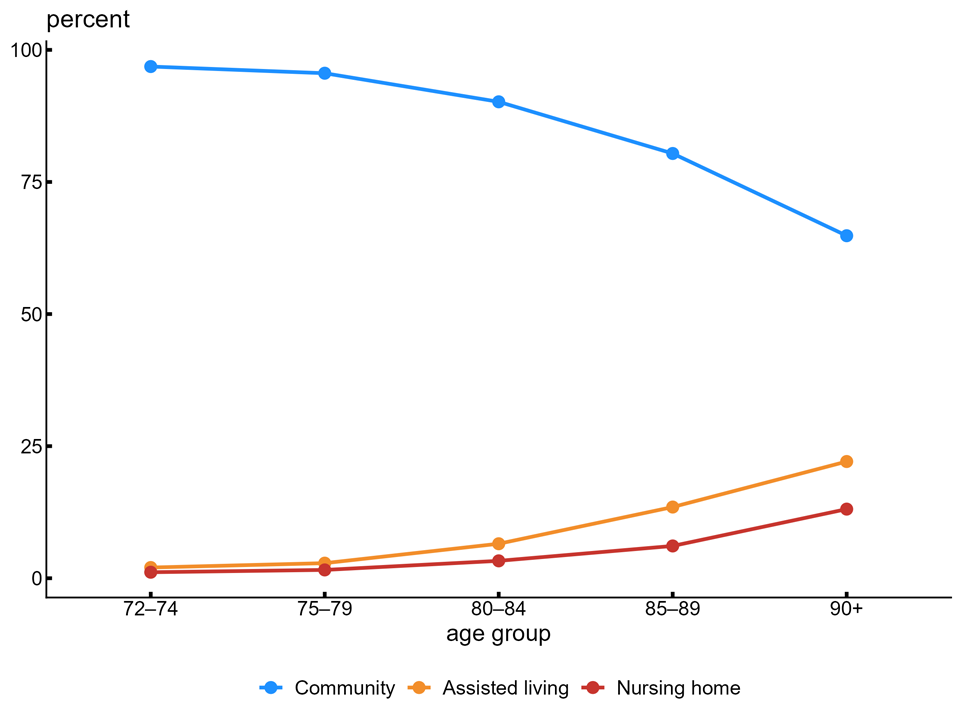
Residential patterns of older Americans also vary by age. Figure 1 shows the percentage of adults in each of the three broad living arrangements by age group, averaged over the 11-year NHATS sample period.5 As people get older, they are less likely to live in community settings and more likely to live in assisted living facilities or nursing homes. This may reflect demand for higher-intensity care or a shortage of financial resources for in-home care.
1. Prevalence of living arrangements, by age group, 2011–21
Source: Authors’ calculations based on data from the National Health and Aging Trends Study.
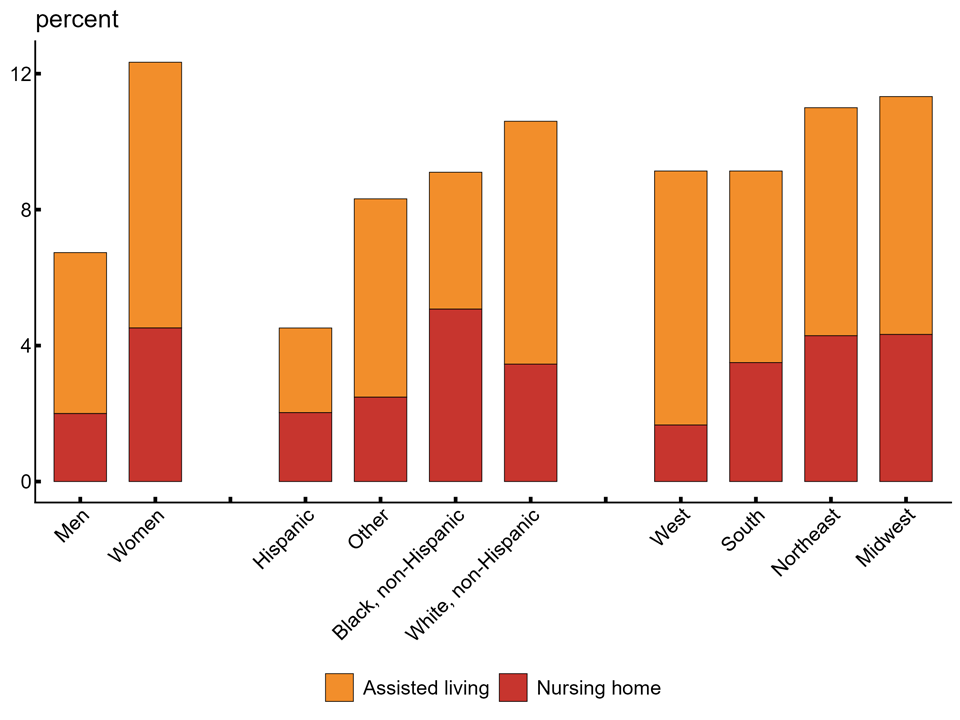
These trends for older Americans also differ by gender, race/ethnicity, and region of the U.S. In figure 2, we show the share of each demographic group and geographic region living in non-community-based settings, again using the NHATS aggregate tables data. The height of the bar corresponds to the total share in non-community-based settings, with the red portion corresponding to the share in nursing homes and the orange portion corresponding to the share in assisted living.
2. Prevalence of non-community-based living arrangements, by demographic group and region, 2011–21
Source: Authors’ calculations based on data from the National Health and Aging Trends Study.
Women are more likely than men to reside in assisted living facilities or nursing homes, reflecting longer life expectancy and the fact that they are more often the surviving spouses. Because spouses are a primary source of informal care for older people, surviving spouses are especially vulnerable and research shows that losing access to a spousal caregiver significantly increases nursing facility use (Fadlon et al., 2026). White, non-Hispanic older adults have higher assisted living rates than Black, non-Hispanic older adults, who are more likely to live in nursing homes. Hispanic older adults are the least likely to reside in either setting, consistent with more frequent multigenerational living arrangements.
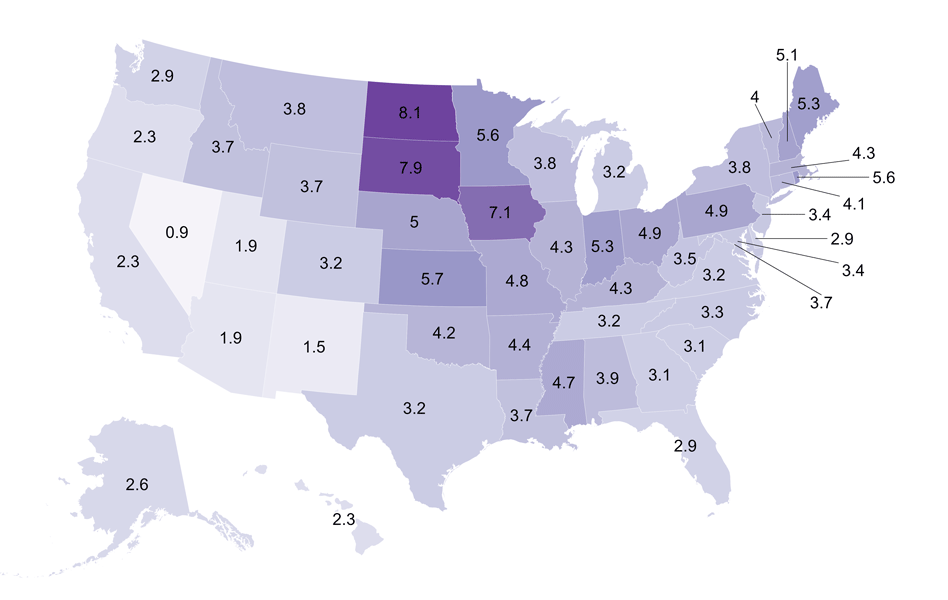
Regional variation also exists: The Northeast and Midwest have higher non-community-based residence rates than the South and West, with the West having the lowest nursing home share. Using an alternative data source, we show in figure 3 the share of adults age 72 and older living in institutions (most likely in nursing homes) by state over the period 2019–23; this figure further illustrates that the highest institutionalization rates are concentrated in the central part of the country. These geographic differences likely reflect a combination of demand-side factors (e.g., elderly migration, population age, health, and preferences) and supply-side factors (e.g., availability of facilities and regulations). We further explore nursing home access in part 3 of this series.
3. Percentage of the population age 72 and older living in institutions, by state, 2019–23
Source: Authors’ calculations based on data from the U.S. Census Bureau, 2019–23 American Community Survey, five-year estimates, from IPUMS USA.
Together, these patterns highlight that living arrangements—like the effects of aging itself—are heterogeneous, reflecting differences in health, income, family structure, cultural norms, and local care markets. In the subsequent sections, we discuss how this heterogeneity in living arrangements has important implications for the broader economy.
Broader implications of older Americans’ living arrangements
Population aging is shifting the balance between those who require care and those who provide it. One way to quantify this shift is through the elderly dependency ratio—the number of adults age 65 and older for every 100 working-age people (i.e., those age 15–64). Nationally, the ratio has risen steadily over the past two decades and is projected to continue increasing as the baby boom generation moves into their eighties. Higher elder dependency ratios imply fewer potential workers available to support the needs of a growing older population, placing pressure on labor markets, caregivers, and public budgets.
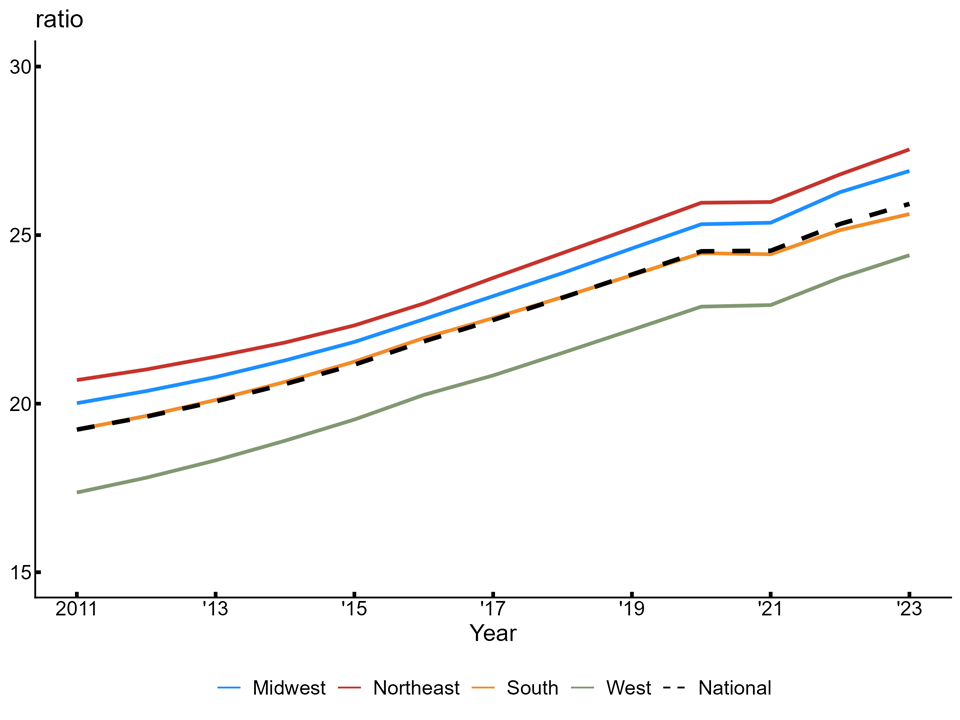
Figure 4 illustrates this trend: Nationwide, the elderly dependency ratio has increased from about 19 in 2011 to over 25 in 2023, and all U.S. regions experienced similar increases. Figure 5 further highlights the substantial geographic variation in this measure: The Northeast and Midwest had the highest elderly dependency ratios in 2023, while the West had comparatively lower elder dependency ratios, likely reflecting a combination of geographic heterogeneity of immigrant inflows and differential working-age versus retirement-based migration patterns into and out of other regions of the U.S. These differences matter because regions aging more quickly will experience the economic consequences of elder care demand sooner and more intensely.
4. Elderly dependency ratio, by region, 2011–23
Source: Authors’ calculations based on data from the U.S. Census Bureau, 2007–11 through 2019–23 American Community Survey, five-year estimates, from IPUMS USA.
5. Elderly dependency ratio, by state, 2019–23
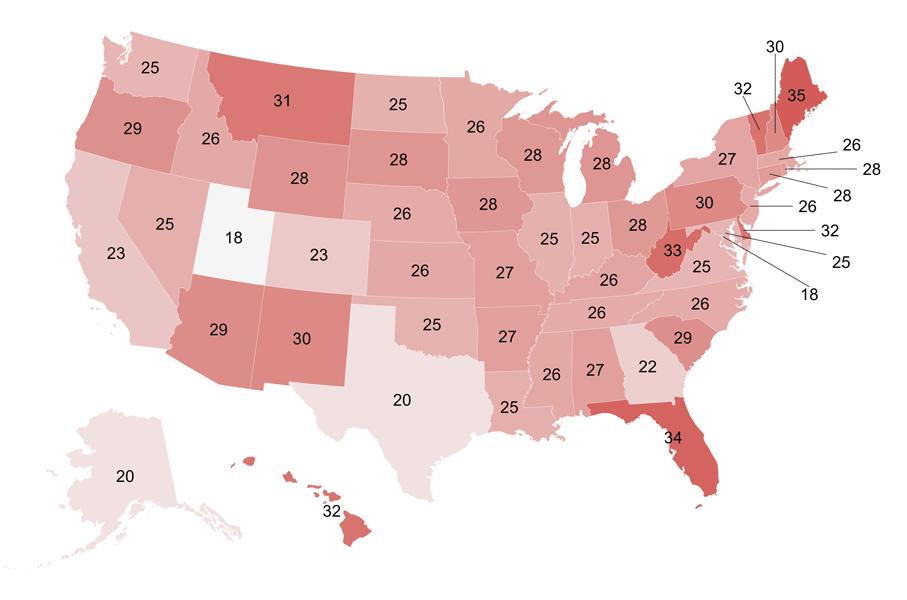
Source: Authors’ calculations based on data from the U.S. Census Bureau, 2019–23 American Community Survey, five-year estimates, from IPUMS USA.
But the elder dependency ratio alone does not determine economic outcomes. The macroeconomic effects of aging depend on how older adults live, i.e., whether they remain in the community, move into assisted living, or require nursing home care. Living arrangements shape who provides care, how much it costs, and which labor markets and public programs bear the burden.
This section outlines three key channels through which living arrangements for older Americans affect the economy: labor markets, consumption patterns, and public finance.
Labor market implications
Population aging directly affects the supply of labor, but living arrangements determine the magnitude and distribution of those effects. As the share of Americans age 80 and older rises, more individuals will leave or reduce participation in the workforce because of health limitations, leading to slower labor force growth overall. However, there is a second, less visible labor market channel: caregiving.
Because most older adults live in community settings, much of the support they receive is provided informally by family, friends, or neighbors rather than by paid professionals. According to the American Time Use Survey, about 14% of U.S. adults provided unpaid elder care during 2023–24. Moreover, decades of research show that caregiving responsibilities fall disproportionately on women—especially daughters (see, e.g., Johnson and Lo Sasso, 2006). These caregiving demands can reduce labor force attachment, lower work hours, limit job mobility, and depress lifetime earnings. As aging in place becomes more common, the economic value of unpaid caregiving—and the associated opportunity cost in forgone labor—will continue to grow.
At the same time, formal long-term care represents one of the fastest-expanding segments of the U.S. labor market (Colato et al., 2024). Employment in home health and personal care services has increased by more than 50% since 2010, while nursing home employment has generally remained flat or declined, reflecting both the Covid-19 pandemic disruption and the shift away from institutional care. The composition of local labor markets also matters for living arrangements. For example, research shows an increase in the share of lower-education foreign-born people in the labor force leads to a reduction in institutionalization among older adults by making home-based services more available and less costly (Butcher et al., 2022; and Almuhaisen et al., 2024)—with positive effects on overall health (Grabowski et al., 2026). In general, the long-term care workforce is predominantly female, disproportionately non-White, and concentrated in relatively low-wage occupations with high turnover and limited benefits (Chidambaram et al., 2024). As demand for caregiving services increases, labor shortages may place upward pressure on wages in these sectors, with implications for service availability, state Medicaid budgets, and ultimately prices.
Consumption patterns and local economic structure implications
Living arrangements also shape the types of goods and services older adults consume and where their spending goes. The overwhelming majority of older Americans now remain in the community, which means most age-related spending occurs outside institutional settings. Aging in place increases demand for home modifications, transportation services, meal delivery, personal care, medical equipment, and home health providers.
Assisted living communities affect local economies in a different way. They combine housing, hospitality, and elder care services. As these facilities expand—particularly in fast-aging regions—they can become important local employers and sources of property tax revenue, influencing housing markets and land use.
Nursing homes, by contrast, are labor-intensive, highly regulated, and disproportionately financed by public programs. Regions with higher nursing home utilization may therefore experience a different mix of labor demand, wages, and supplier industries than those with a larger assisted living or home-care footprint.
These patterns have broader implications for regional economic development. Communities with older populations may observe slower growth in sectors tied to young families—such as K–12 education or child-focused retail—while seeing rising employment in caregiving, transportation, and medical services.
Fiscal and public finance implications
Where older adults live also affects which public programs finance their care. Although nearly all Americans age 65 and older are covered by Medicare, the program generally does not pay for long-term custodial care. As a result, Medicaid becomes the main public program that pays for long-term care, especially in nursing homes. Roughly two-thirds of nursing home residents rely on Medicaid, often after spending down personal assets to meet eligibility thresholds.
This financing structure creates significant fiscal exposure for state governments, especially as the population age 80 and older grows. Nursing home care is among the costliest categories within Medicaid, and expenditures vary widely across states depending on demographics, payment rates, and the availability of alternatives such as assisted living or home- and community-based services (HCBS). In some states, nursing home spending for older adults accounts for a large share of total Medicaid outlays; in others, the program spends more on HCBS, reflecting policy efforts to support aging in place.6
As more older adults remain in the community, Medicaid’s financial burden may shift rather than shrink. Home-based services can be less expensive per enrollee but may involve more beneficiaries, particularly if families cannot meet rising caregiving demands. Meanwhile, regional labor shortages in long-term care can drive higher wages and reimbursement rates, further influencing state budgets. Because Medicaid is jointly financed by state and federal governments, these trends also have federal budget implications, affecting long-term projections of mandatory spending.
At the local level, aging populations can reshape fiscal conditions in several ways. On the revenue side, a growing share of older residents can impact the local tax base as these residents often receive favorable property tax rates and exemptions and retirees typically generate less income and sales tax revenue than working-age households, though these effects vary significantly by state (Felix and Watkins, 2013). On the expenditure side, local governments may face pressure to adapt infrastructure and services, such as transportation and meal delivery services, to an older population. Such funds can come from local funding streams (Koumoutzis et al., 2021) or via federal formula grants channeled through states, including those authorized under the Older Americans Act and the Social Services Block Grant. Taken together, these dynamics can tighten local budgets precisely as the community most dependent on public services grows.
Conclusion
In this article, we presented several important findings about the living arrangements of older Americans. First, we showed that the vast majority live in community settings, a share that has grown steadily over the past decade or so as nursing home utilization has declined. However, we emphasized that these living arrangements vary with age, gender, race/ethnicity, and region, which we noted is a combination of both demand- and supply-side forces. We then provided a related discussion on the broader economic implications, focusing on those for the labor market, consumption and local economic structure, and public finance.
Understanding where older Americans live is only the starting point. As the population ages, the nation will face growing questions about the affordability of long-term care, the quality of services delivered in different settings, and whether older adults can access the level of care they need. In part 2 of this series, we document state-level variation in the price and quality of elder care. In part 3, we conclude the series with an economic analysis of nursing home market concentration and how that is associated with price and quality at a more local level.
Details for Kelli Marquardt and Aryan Safi are available on their Chicago Fed online profiles (accessed by clicking their respective names in the byline). Anthony Lo Sasso is the Robert F. and Sylvia T. Wagner Professor of Public Affairs in the La Follette School of Public Affairs at the University of Wisconsin–Madison.
Notes
1 See table 2 of the U.S. Census Bureau, 2023 National Population Projections Tables: Main Series.
2 All NHATS data we use in this article are from Freedman and Cornman (2023), which is the companion chart book to the archived 2011–21 NHATS trends dashboard.
3 NHATS has four distinct groupings of living arrangements for older Americans. We combine the NHATS groups of “traditional community” and “retirement communities or senior housing” into a single category that reflects community living. We refer to the NHATS group “residential care setting other than nursing home” as assisted living—a category that reflects mid-level support. Nursing homes are defined and grouped the same way in both NHATS and our analysis.
4 Authors’ calculations based on data from the National Health and Aging Trends Study (see note 2 for further details on the data source). The shares in 2021 do not total to 100% because of rounding.
5 Using an alternative data set—the U.S. Census Bureau’s American Community Survey (accessed via IPUMS USA)—we find similar age-group and time-trend patterns in nursing home residence, supporting the generalizability of these results.
6 Authors’ analysis based on data from the Centers for Medicare & Medicaid Services, Long Term Services and Supports Users and Expenditures publications, and KFF, Total Medicaid Spending.