Getting a four-year college degree is widely understood to be beneficial for most people. There are exceptions of course, but on average, people with bachelor’s degrees enjoy higher earnings,1 greater job satisfaction,2 and longer lives.3 In addition to the personal benefits people receive from getting a bachelor’s degree, there can often be benefits for others. For example, most patent holders, entrepreneurs, and researchers hold four-year college degrees and likely use skills developed in college to create new inventions, products, and knowledge.4 There is also evidence that places with a higher-educated population tend to be more prosperous, both in terms of earnings per worker and economic growth.5 In this article, we examine evidence on the relationship between the share of a place’s population with a bachelor’s degree and employment growth. We find that more-educated places grow more quickly and highlight a recent study that finds the relationship is causal. We also show that it’s rare for a place that’s ranked low in educational attainment to move up in national ranking.
Historically, places with higher education levels have faster employment growth
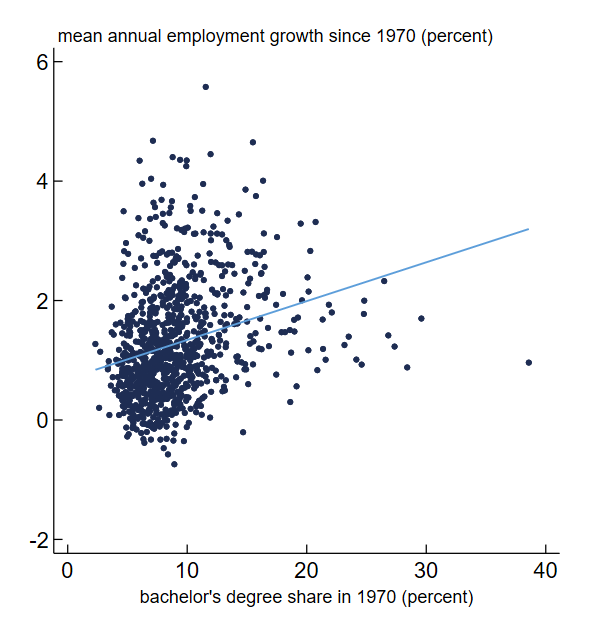
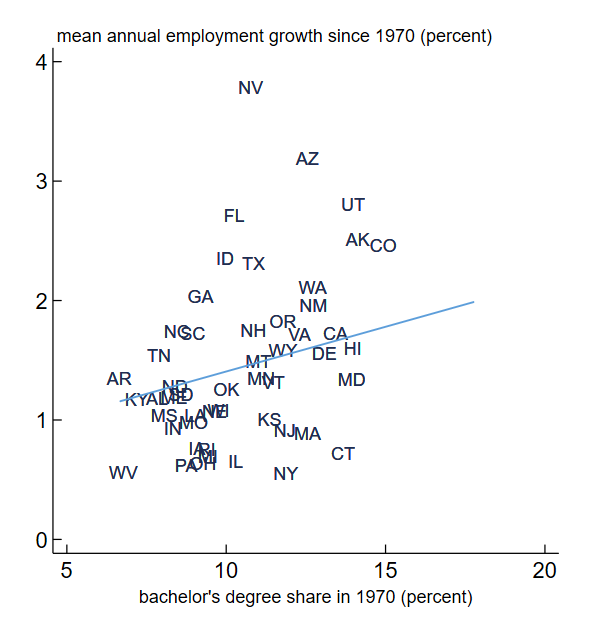
We start by looking at how employment growth since 1970 relates to educational levels in 1970 among states and metropolitan and micropolitan statistical areas (metro and micro areas) in the U.S.6 In figure 1, we plot the share of population that had a bachelor’s degree in 1970 against average annual employment growth rates from 1970 through 2023.7 Panel A is for metro and micro areas, where each dot represents one of 925 areas. The fit line shows that the relationship is positive: Places with higher bachelor’s degree share in 1970 tended to grow faster over the subsequent 53 years. On average, an increase of initial bachelor’s degree share by 5 percentage points predicts 0.3 percentage points faster annual employment growth. That’s a big boost: For a place with the average employment growth rate (about 1.5% per year), a gain of 5 percentage points in bachelor’s share would mean a roughly 20% faster growth rate. The relationship is very similar in panel B, where we look across states. In this case, a gain of 5 percentage points in initial bachelor’s degree share predicts 0.4 percentage points faster employment growth and about 27% faster growth for the average state (which also grew at about 1.5% per year).
1. Bachelor’s degree share in 1970 predicts 1970–2023 employment growth
A. Metro and micro areas
B. U.S. states
Sources: Authors’ analyses based on data from the U.S. Census Bureau, Decennial Census of Population and Housing and American Community Survey.
Bachelor’s degree share is not the only important reason some areas have grown faster than others, which would be the case if all the dots in figure 1 were close to the fit line. Instead, generally speaking, there’s a large spread of values for places with similar 1970 bachelor’s degree shares. For example, among metro and micro areas where the bachelor’s degree share was around 10% in 1970, the fit line predicts an average annual employment growth rate of about 1.3% during the 1970–2023 period, but actual rates ranged from –0.2% to 4.4%. And among states with bachelor’s degree share near 10%, Florida and Nevada actually grew much faster in terms of employment than Illinois and Ohio. Behind these differences are other key sources of faster employment growth, such as a favorable industry mix (e.g., overrepresentation in software publishing or underrepresentation in manufacturing), desirable environmental characteristics (e.g., warm winter temperatures and proximity to shoreline or mountains), and low homebuilding costs. Important sources of faster employment growth in Florida and Nevada are likely desirable environmental characteristics and low homebuilding costs, while a major source of slower employment growth in Illinois and Ohio is likely their concentration in manufacturing.
A recent study finds that there is a causal relationship between higher education levels and growth
While it’s possible that the correlation shown in in figure 1 is causal (that is, U.S. metro and micro areas with higher bachelor’s degree shares in 1970 grew faster because their populations were more educated), it’s also possible that bachelor’s degree share in 1970 is instead correlated with another factor that was the true cause of subsequent growth differences.8 But a 2023 working paper by Luisa Gagliardi, Enrico Moretti, and Michel Serafinelli9 provides evidence that metro areas (not necessarily going by the U.S. Census Bureau definition) with a higher bachelor’s degree share have indeed grown faster because they have a higher bachelor’s degree share. The study considers nearly 2,000 metro areas in six high-income countries (including the U.S.) that were manufacturing hubs10 in the mid to late twentieth century and traces how total employment in these hubs evolved as manufacturing employment declined. Most manufacturing hubs’ economies struggled, but Gagliardi et al. (2023) find that 34% of hubs actually grew faster than their nation’s average growth rate over the analysis period. The main result of the study is that manufacturing hubs with higher initial bachelor’s degree shares generally fared better than those with lower shares.
Gagliardi et al. (2023) present evidence from a natural experiment: Bachelor’s degree share tends to be higher in metro areas that are nearby four-year colleges founded at least 20 years before the period of analysis, and crucially, the location of these four-year colleges is likely to be partially random.11 If distances to these colleges are random, then faster employment growth in manufacturing hubs situated nearby such colleges is likely to be because those places had higher bachelor’s degree shares. While it’s possible there is a different reason for the relationship, we believe the natural experiment provides compelling evidence that local investments in higher education can raise education levels and speed up an area’s economic growth.
Investments in higher education have risen everywhere since 1970, but it’s been rare for low-educated places to become high-educated ones
As we noted in the opening section, it’s widely understood that investments in higher education are good for individuals and society, and in the previous section, we discussed a study that finds investments in higher education are good for regional economies as well. A clear implication for policymakers is that spending on higher education systems often pays off. This can help explain why investments in higher education have been rising over time, as reflected by the steady increase in the overall share of the U.S. population over age 25 with a bachelor’s degree, which, according to the data we used (see figures 1 and 2), was about 11% in 1970 and 36% in 2023.12
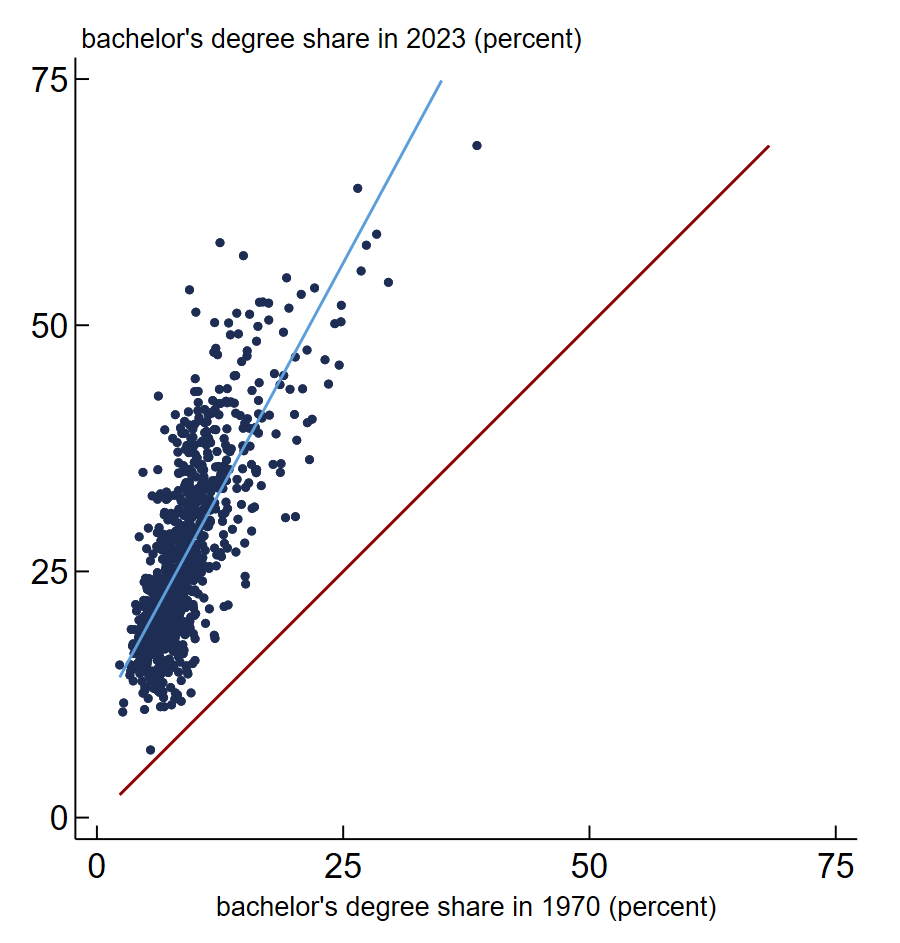
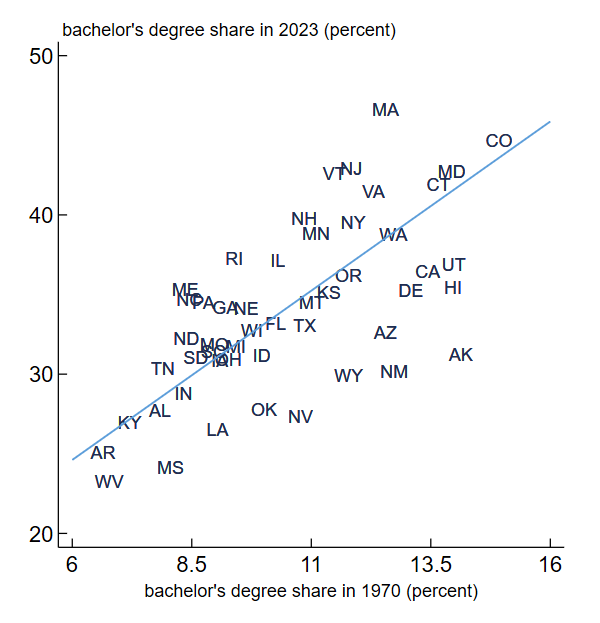
In fact, we find that bachelor’s degree share increased from 1970 through 2023 in every place we analyze. We show this in figure 2, which plots bachelor’s degree share in 1970 on the horizontal axis and bachelor’s degree share in 2023 on the vertical axis for metro and micro areas (panel A) and for states (panel B). The blue line in both panels is a fit line, similar to those in figure 1. Panel A also includes a 45-degree red line, which distinguishes between places where bachelor’s degree share increased between 1970 and 2023 and places where it decreased. Every dot is above the line, so bachelor’s degree share increased everywhere. In panel B, we’ve zoomed in so that values for individual states are distinguishable, pushing the 45-degree red line out of view. But it is also the case that bachelor’s degree share increased in every state.
2. A geographic area’s bachelor’s degree share in 1970 predicts its bachelor’s degree share in 2023
A. Metro and micro areas
B. U.S. states
Sources: Authors’ analyses based on data from the U.S. Census Bureau, Decennial Census of Population and Housing and American Community Survey.
While bachelor’s degree share has gone up everywhere, one thing that clearly sticks out from figure 2 is how strongly the four-year college degree share in 1970 predicts the four-year college degree share in 2023. According to our analyses, the correlation coefficient is 0.77 for metro and micro areas and 0.74 for states. There are several potential reasons for the high positive correlations. One is that certain places may be fundamentally more attractive to people with bachelor’s degrees and others more attractive to people without degrees. For example, several of the highest bachelor’s degree share places are small metro areas that are dominated by large universities. Such places may be especially appealing to college-educated people. Another reason may be that different industries concentrate in different places, and some industries employ a higher share of bachelor’s degree holders than others. A third potential reason is that some places have very desirable natural amenities, limited housing, and high rents, which people with bachelor’s degrees are more likely to be able to afford. A fourth is that colleges rarely move once they’ve been established somewhere. And a fifth is that some places may put a higher priority on higher education investments than others.
Despite the strong correlation, there are some examples of metro and micro areas that have considerably changed rank in bachelor’s degree share since 1970, both positively and negatively. For example, while bachelor’s degree share increased by 22 percentage points across metro and micro areas on average, Asheville, NC, saw a 32 percentage point increase and Bend, OR, a 30 percentage point increase. For these two places, it is likely that natural amenities attracted people with bachelor’s degrees. In contrast, several Texas metro areas, including Midland, Amarillo, and El Paso, saw much smaller increases in bachelor’s degree share, ranging from 10 to 14 percentage points. These places have a large share of employment in energy extraction and manufacturing—two industries with many jobs that do not require bachelor’s degrees.
While exceptions do exist, the implication of the strong correlations in figure 2 is that historically, it’s been quite rare for a relatively low-educated place to transform into a high-educated one. Put differently, it’s uncommon to find a place whose bachelor’s degree share ranking has changed considerably. This suggests that it would be difficult for a local government in a slow growth place to make the size of investment needed to significantly raise its bachelor’s degree share and potentially transform it into a fast growth place.
Notes
1 See, e.g., Barrow (2024) and Card (1999).
2 See, e.g. Altonji et al. (2023).
3 See, e.g., Case and Deaton (2023).
4 See, e.g., Shambaugh et al. (2017) and U.S. Census Bureau (2021).
5 See, e.g., Berger and Fisher (2013) and Glaeser et al. (1995).
6 Metropolitan statistical areas are geographic areas that consist of one or more counties associated with at least one urban cluster with a population of 50,000 or more, plus the neighboring counties with strong commuting patterns into that core area. Micropolitan statistical areas are geographic areas that consist of one or more counties associated with at least one urban cluster with a population of at least 10,000, but fewer than 50,000, plus the neighboring counties with strong commuting patterns into that core area. These definitions are based on those from the U.S. Census Bureau glossary.
7 We calculate average annual employment growth as .
8 For example, suppose the real reason for the positive correlation in figure 1 is that places with nicer weather disproportionally drew highly educated people to them before 1970, so that nice-weather places had higher bachelor’s degree shares in 1970. Then, suppose that from 1970 through 2023, nice weather continued to drive population growth. In this case, the true source of faster employment growth for places that had higher bachelor’s degree shares in 1970 would be nice weather, not higher education levels.
9 See Gagliardi et al. (2023).
10 Gagliardi et al. (2023, p. 2) define manufacturing hubs as metro areas “that in the year of their country’s manufacturing peak have a manufacturing employment share in the top tercile of their country’s distribution.”
11 The main assumption Gagliardi et al. (2023) make is that having a nearby four-year college affects employment growth solely because of the education level of the local populace—and not because, for instance, the college hires a lot of people. To make it more likely that distance to nearby colleges can be treated as random, the researchers require that the colleges included in the study were founded at least 20 years before the analysis period, which reduces the chance that they were founded for reasons related to declining manufacturing or other factors that matter for employment growth.
12 Public investments in education have been rising over time as well. An Urban Institute study finds that from 1977 to 2021, spending on higher education by state and local governments increased by 168%. However, enrollment in higher education grew at an even faster rate, which means that per-pupil spending by state and local governments has declined some.