


Financial sector firms are currently navigating a period of rapid technological change that includes the adoption of artificial intelligence, around-the-clock trading activity through the use of digital assets and tokenization, and increased reliance on third-party technology service providers. While these developments offer significant benefits, they also introduce new operational risks that firms will need to manage. Operational risk events, in turn, have the potential to disrupt the financial system more broadly; as I will elaborate later, trust among stakeholders and time to troubleshoot can be key mitigants to such possible spillover effects. To further explore these issues, the Federal Reserve Bank of Chicago decided to convene a second seminar on operational resilience this November for industry participants across jurisdictions to share key insights and lessons from recent resilience exercises and identify emerging best practices.
Industry participants often revisit the approach to operational resilience efforts, both at the firm and system level. However, some guiding principles are evergreen. When we gathered for our first operational resilience seminar almost two years ago, I highlighted three key ingredients for robust resilience of operations in the central clearing ecosystem:1
- the importance of good “translators” at individual firms,
- the need for wide industry coordination during and even ahead of crises, and
- the value of researchers and policy professionals learning through real-world, practical experiences and not just through models and data analyses.
The nature of operational risk may be shifting, but these ingredients remain relevant.
As some of you might recall, I defined translators as employees at your firm that can quickly identify, understand, and communicate operational issues with other staff across multiple domains, including the trading, technology, and legal fields. They help speed up the process of troubleshooting complex problems. Translators are needed now more than ever, especially given the growth in use of tokenization and distributed ledger technology. To implement new technologies effectively and safely, employees need to understand multiple technology platforms and the various business and risk-management needs through the entire trade life cycle.
Within the central clearing ecosystem, tokenized securities and cash have been considered as a potential means of ensuring safe movement of margin collateral on a 24/7 basis.2 This, the theory goes, would help meet growing industry demand for an always-on trading environment.
But is a tokenized asset the best or only way to accomplish safe movement of value on weekends? When central counterparties (CCPs)3 and their clearing members adopt tokenized approaches, how do they ensure the settlement finality that they are used to in traditional payments systems? The translators at your firm can help navigate this.
Meanwhile, coordination and information sharing among financial firms to identify and manage risks that are common to all remain essential. Risks from third-party technology providers are an example of where information sharing and coordination could help improve system resilience. An outage by a single provider at a CCP can impair its routine business functions and affect its clearing members. However, the risk runs the other way, too. Some critically important service providers may not be used by the CCP, even though they are used by many of its clearing members. An outage at those third-party providers could also impair the CCP. These firms can create what we call operational risk blind spots for central counterparties.
Finally, there is a lot that the research and policy community can learn from real-world experiences. A recent event serves as a case study in how operational risk events in centrally cleared markets have the potential to cause systemic impacts, including effects on the implementation of monetary policy. As I’ll argue, this case study highlights some key mitigants to such events—namely, trust that’s already been established between two parties to a transaction and the time given to troubleshoot.
As has been reported publicly, in late June 2026 a faulty trade submission to a large U.S. central counterparty prevented it from settling its payment obligations at the close of the day. The CCP had funds owed from clearing members, but it could not deliver funds it owed to clearing members.
What does this have to do with the Federal Reserve and monetary policy?
Following the passage of the Dodd–Frank Act in 2010, several large CCPs and payments-related firms were identified as systemically important institutions. Per the Dodd–Frank Act, these designated financial market utilities, or DFMUs, are allowed to maintain deposit accounts at the Fed, are subject to the Fed’s supervisory oversight, and are allowed to receive loans from the Fed in unusual or exigent circumstances.
Given the central bank’s safety and liquidity, DFMUs tend to keep most of the cash they collect in margin from their clearing members and their members’ clients in a deposit account with the Fed. The CCP involved in the late June 2026 incident described earlier—which is also a DMFU—left a large cash balance in its deposit account at the Fed as a result of that operational risk event.
A risk event like this has implications for the implementation of monetary policy. An increase in DFMU deposits is also an increase in what’s known as a nonreserve liability on the Fed’s balance sheet. Assuming assets stay unchanged, on days when nonreserve liabilities increase, banking system reserves decline one-for-one.4 Figure 1 illustrates the mechanics of this at a high level.
1. Changes in Federal Reserve balance sheet when CCP deposits increase
| Assets | Δ | Liabilities | Δ |
|---|---|---|---|
| U.S. Treasury securities | Currency | ||
| Agency MBS | Nonreserve liabilities | ↑ | |
| Standing repo operations | Banking system reserves | ↓ | |
| Discount window | Equity and capital |
Declines in banking system reserves may leave some market participants short on cash. To resolve this issue, they may seek to borrow cash in the market. An increase in demand for money can push up short-term interest rates, something the Fed cares very much about. It is the main monetary policy target that the Fed seeks to control. This late June 2026 event illustrates that there is a clear link between an operational risk event in the central clearing ecosystem and markets that are important to the Fed for monetary policy implementation.
At the Fed, we often say that the financial system plumbing matters for financial stability, but it’s important to recognize that this plumbing also matters for effective implementation of monetary policy.
In our case study of the late June 2026 incident, the settlement of funds was ultimately delayed by just one day, and the very large one-day increase in DFMU account balances at the Fed and the corresponding drain in banking system reserves didn’t move market rates. Some have suggested that in this instance the Fed’s ample reserves framework contributed to limited spillover effects. In an ample reserves regime, the banking system operates with a cushion of reserves, and so it can withstand fluctuations in reserve levels without an impact on market rates. Figure 2 illustrates the supply and demand curves in an ample reserves regime. In this scenario, the vertical supply curve moved to the left, but since it intersected with the flat part of the demand curve, effective market rates, such as the effective federal funds rate (FFR), did not change.5
2. Illustration of banking system reserves supply and demand curves in an ample reserves regime
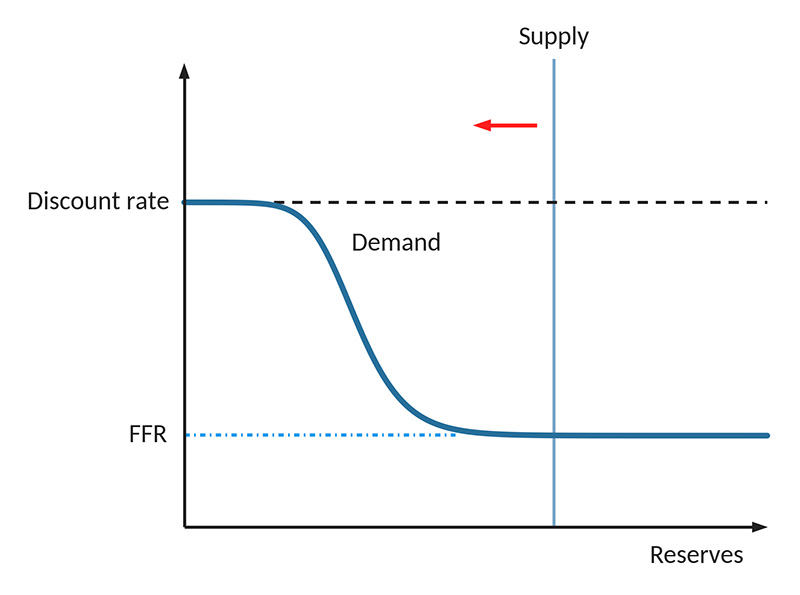
Source: Author’s adaptation based on Ihrig and Wolla (2026, figure 1).
However, that potential for impact from an incident like the one from late June 2026 exists, and it’s one of the reasons I am emphasizing the need for translators, for coordination, and for learning through real-world experience as we all work toward making operational resilience even more robust.
I want to offer an additional potential explanation for why there were not major spillover effects in financial markets in our case study: trust. Market participants trusted that the problem would be resolved and that the money would show up the next day. I’m sure you have all been in a pinch with another institution you depend on; at some point you tell yourself, “I trust them to fix it.” Trust isn’t given to every institution. It is earned through steady performance and reliable, long-standing relationships.
Trust then opens the door to time. When a big operational issue arises between you and another market participant, the first thing you say to your boss is, “I need time to figure it out.” And your boss may respond, “There is no time.”
If it’s up to you to resolve the issue, you may ask the other party for some time. And they will give you that time if they trust you. And that’s what happened in the scenario I described earlier: The CCP was given more time to deliver the cash.
I trust you—I'll give you more time. That posture can help resolve the narrow issue, and it can also prevent it from escalating into something systemic.
What if the next operational risk event that hits centrally cleared markets and drains banking system reserves involves a market participant that has a more limited track record? Will market participants give that same trust and time, or will they look for more funding in the market or at the Fed to give themselves a buffer?
More broadly, what does it mean to allow more time to solve a problem when markets are running 24/7 and there are no breaks in the operational day? How is trust in a network of firms affected if the operational risk event is related to a cyberattack? It will be important to continue to learn from one another how to address these types of questions as artificial intelligence, digital assets, and third-party providers continue to reshape the operational resilience needs of the financial system.
Cindy Hull is the director of the Federal Reserve Bank of Chicago’s Financial Markets Group. This article is adapted from remarks she gave at Operational Resilience in Exchange Traded and Cleared Markets—a seminar sponsored and hosted by the Chicago Fed on November 5, 2026.
Notes
1 See Steigerwald (2013) for a primer on central clearing.
2 See, e.g., DeCarlo (2026). The definitions for margin (initial and variation) and several other key terms related to central counterparty clearing are in Committee on Payment and Settlement Systems and Technical Committee of the International Organization of Securities Commissions (2012, annex H).
3 A central counterparty is a financial institution that stands between buyers and sellers in a transaction, guaranteeing performance of contracts. See Steigerwald (2013) for more on central counterparties, plus their clearing members.
4 Reserves are cash funds deposited by banks and other depository institutions with the Federal Reserve (plus the money in their vaults). According to Alfonso et al. (2025), reserves at the Federal Reserve are held by U.S. banks, domestic branches of foreign banking organizations, and credit unions, with the majority held by U.S. banks.
5 A Q&A on the federal funds rate from the Board of Governors of the Federal System (which includes a definition) is available online; details on the effective federal funds rate are available online from the New York Fed.


