A recent mandate by the U.S. Securities and Exchange Commission (SEC) aims to improve the resilience and transparency of markets for U.S. Treasury cash securities and repurchase agreements (repos) by requiring transactions for both be cleared and settled through an authorized central counterparty (CCP).1 I explore the implications of this mandate for Treasury markets and central clearing in a two-part Chicago Fed Letter series. Part 1 is a primer on Treasury futures and the Treasury cash–futures basis trade—two key features of the Treasury markets that could also be affected by the mandate.2
In part 2, I discuss the possible role of adopting or expanding CCP cross-margining programs—which recognize offsetting exposures to similar risks across the two related markets for Treasury futures and repos—given the increase in collateral, or initial margin (IM), implied by the new SEC mandate otherwise.3 Without adoption or expansion of cross-margining, the higher amounts of IM that clearing members (or their clients) will need to post at CCPs to clear Treasury securities (the underlying instruments of Treasury futures) and repos might reduce market participation, efficiency, and liquidity. But to effectively discuss the potential role of cross-margining, I must first explain how Treasury futures and the Treasury basis trade work.
As of May 2025, leveraged funds4 held Treasury futures worth more than $1 trillion in notional value, according to my calculations using data reported by the Commodity Futures Trading Commission, or CFTC (see figures 1 and 2, which I discuss in more detail later). Holdings of Treasury futures at this scale indicate that the Treasury basis trade has evolved from a niche arbitrage opportunity into a cornerstone of Treasury market structure that underpins the liquidity and efficiency of the world's largest government bond market. The basis trade is a strategy where market participants simultaneously purchase Treasury securities while selling corresponding futures contracts. At its core, the basis trade translates the substantial demand for Treasury futures from asset managers into liquidity for the underlying cash securities. Through this critical linkage between these derivatives and securities markets, basis traders enhance overall market depth, reduce bid–ask spreads, and support the price discovery process that keeps Treasury futures aligned with their underlying securities.
In the next section, I explain what Treasury futures are, why they’re useful, and how they function. Then I describe the primary participants in the Treasury futures market and what motivates their participation. Next I discuss in greater detail the Treasury basis trade and the role of leverage in the trade. I conclude that despite concerns around leverage, the basis trade has become a structural feature of the Treasury market, supporting liquidity in both Treasury futures and Treasury securities and influencing the broader functioning of fixed-income markets.
What are Treasury futures?
A Treasury futures contract is an agreement to purchase or sell a Treasury security at a set date in the future. These are highly liquid instruments, used by a wide variety of market participants to manage interest rate risk and pursue a range of investment strategies. From other research,5 I infer that deeper, more liquid Treasury futures markets reduce the term premiums investors demand; they also facilitate more robust price discovery (Brandt et al., 2007) and attract a broader investor base.6 All of this ultimately allows the U.S. government to issue debt at more favorable interest rates.7 Treasury futures also serve as essential tools for large institutional investors to efficiently manage liquidity and risk.8 Overall, the interconnectedness of Treasury futures and cash security markets creates a positive feedback loop, as enhanced liquidity in the derivatives market strengthens the functioning of the cash market (and vice versa). Moreover, the enhanced liquidity supports more-stable, lower-cost public financing.
Most Treasury futures contracts are physically settled. That is, a participant who holds a short position9 through contract expiration needs to deliver a security matching the type specified in the contract. Conversely, a participant who holds a long position (see note 9) needs to make a payment and accept delivery of the relevant security. The contract allows a seller to deliver a security from a spectrum of securities whose maturity (term of the bond or note) and coupon (interest payable on the bond or note) can vary substantially at the time of the contract’s expiration. That way, sellers can easily find a security to deliver—which in turn makes the Treasury futures market more liquid and, in some cases, more liquid than the underlying cash securities (Baker at al., 2018). In practice, market participants typically trade Treasury futures contracts that expire quarterly and most participants “roll” forward (shift their positions from the current expiration quarter into the next expiration quarter) prior to expiration.
To make all deliverable securities (the deliverable basket) close to equivalent in the eyes of contract buyers, Treasury futures contracts specify conversion factors (multipliers standardizing the value of various Treasury securities). Conversion factors adjust the price that contract buyers pay based on the maturities and the coupons of the Treasury securities they receive. In practice, conversion factors are imperfect. Contract sellers can find Treasury securities that are cheaper to deliver than others even after applying the conversion factors. The securities that are the cheapest to deliver are called just that—cheapest-to-deliver (CTD) securities.
Who typically goes long on Treasury futures contracts?
Market participants prefer Treasury futures over cash securities for their market depth and capital efficiency (the amount of capital expended relative to the profits earned). Asset managers use Treasury futures for efficient portfolio duration management and capital allocation, often choosing them over securities and repos for these benefits. The specific benefits of Treasury futures are as follows:
- Market liquidity. Treasury futures contracts are generally more liquid than Treasury cash securities for two reasons. First, these contracts are traded anonymously on a centralized exchange. Second, these contracts facilitate individual transactions that can be satisfied by a range of Treasury securities with different maturities and coupons, so they help concentrate trading activity. In contrast, Treasury securities trading activity may happen in various trading venues, including over-the-counter markets. And cash Treasury markets feature hundreds of different Treasury securities with various maturities and coupon amounts, which are not interchangeable.
- Lower reported accounting costs. While both futures and repo transactions can provide similar levels of leverage, fund managers can report lower costs when using futures. This is the case for 40-Act funds—in particular, fixed-income exchange-traded funds (ETFs). Futures’ implicit interest costs are not included in 40-Act funds’ reported ratio of expenses to assets held (also referred to as “expense ratios”), allowing them to compete on costs with other funds.10
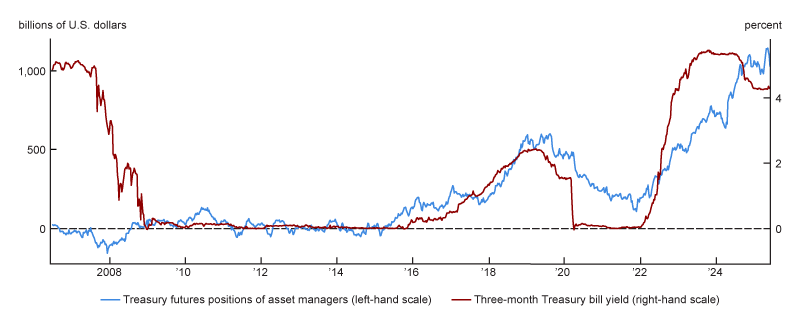
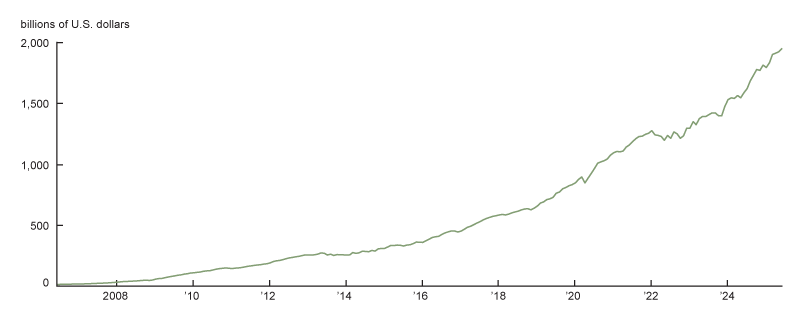
Panel A of figure 1 shows that, with the exception of periods of when interest rates were relatively low (as represented by the three-month Treasury bill yield), the long Treasury futures positions held by asset managers have grown substantially since 2008 and these positions have recently eclipsed $1 trillion in notional value. Moreover, the demand for Treasury futures from asset managers can be linked to the growth of fixed-income mutual funds, which use Treasury futures (rather than Treasury securities) for investment exposure. Importantly, many of these funds manage retirement assets, including 401(k) plans and individual retirement accounts (IRAs), making their use of Treasury futures a key component of household financial security. In particular, ETFs investing in fixed-income markets—which commonly rely on Treasury futures—have grown substantially in the past two decades. To illustrate this growth, the assets under management (AUM) of U.S. fixed-income ETFs are depicted in panel B of figure 1.
1. Treasury futures positions of asset managers and assets under management of U.S. fixed-income ETFs, 2006–25
A. Total Treasury futures positions of asset managers and the three-month Treasury bill yield
B. Total assets under management of U.S. fixed-income ETFs
Sources: Author’s calculations based on data from Bloomberg L.P.
Who typically goes short on Treasury futures contracts?
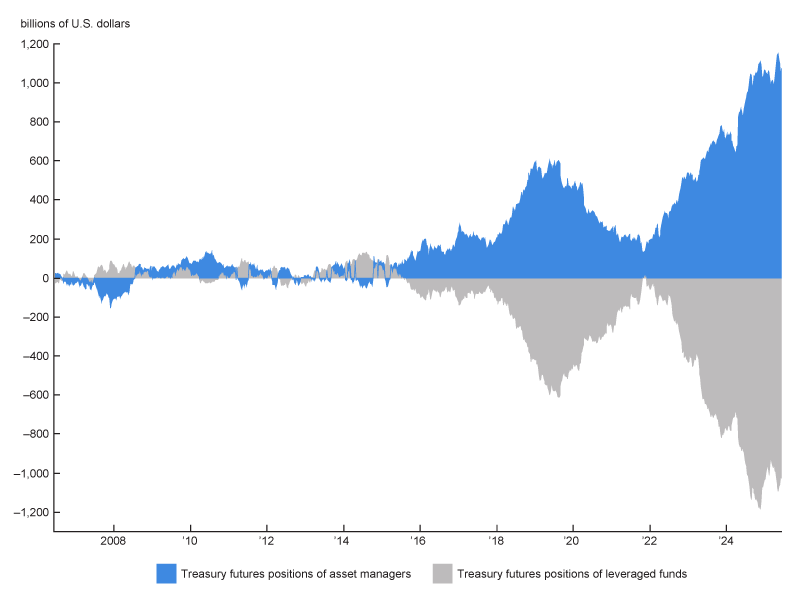
To meet the demand for long positions in Treasury futures from institutional investors shown in figure 1, leveraged funds (as identified by the CFTC) that specialize in arbitraging the value differences between Treasury securities and futures provide liquidity to asset managers by shorting Treasury futures. The growth (in notional value) of short positions in Treasury futures has aligned with the growth in asset managers’ long positions in them, as mentioned by Kashyap et al. (2025). The growth of the long and short positions is depicted in figure 2. These long and short positions are not perfectly matched because they reflect only a subset of market participants, but based on a 2024 presentation to the U.S. Department of the Treasury, the changes in positions of asset managers and leveraged funds are over 90% correlated (see figure 25 in that presentation).
2. Total Treasury futures positions of asset managers and leveraged funds, 2006–25
Source: Author’s calculations based on data from Bloomberg L.P.
What is the Treasury basis trade?11
The Treasury basis trade exploits the small difference between the futures price and the CTD security price (namely, the basis) before settlement.12 The purchase of the Treasury security is sometimes financed with a Treasury repo, which I will discuss later. Market participants can take advantage of this security–futures price difference to make money by putting on a basis trade. In a basis trade, market participants will go long on the financial instrument that is relatively cheaper (typically the Treasury security) and short on the financial instrument that is more expensive (typically the Treasury futures contract).13 Importantly, the CTD security used in the basis trade is usually an off-the-run Treasury security.14 Since off-the-run securities are not the most recently issued bond or note, they tend to be less liquid than the latest issues, i.e., on-the-run Treasury securities. Market participants that conduct the basis trade increase demand for off-the-run securities. Therefore, as the size of the basis trade increases, market experts expect it will further increase demand for off-the-run Treasury securities and help improve liquidity in the market for them. Using the short Treasury futures of leveraged funds as a proxy for the basis trade, I estimate that the size of the basis trade is over $1 trillion in notional value as of May 2025 (see figure 2).
How are leverage and collateral currently involved in the basis trading strategy?
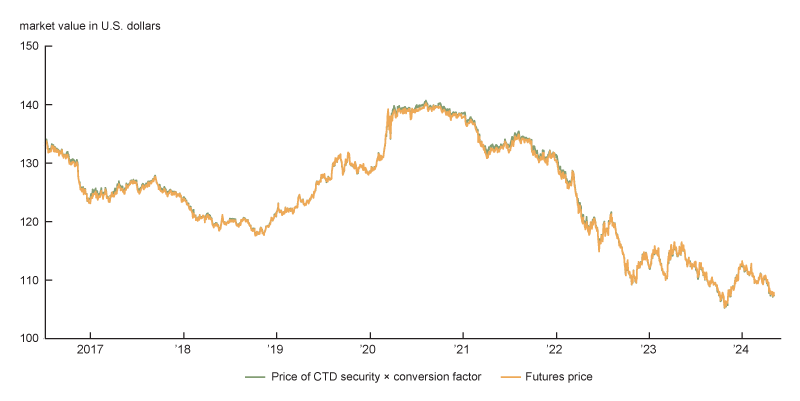
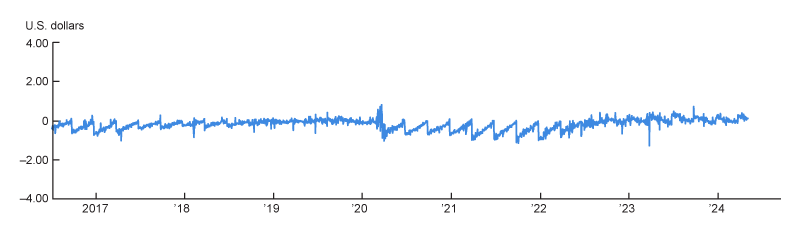
The basis trade is effectively hedged against market risk because price changes in Treasury securities and futures are highly correlated. To illustrate this, figure 3, panel A shows the high correlation between the market values of the ten-year Treasury futures contract and the CTD Treasury security adjusted by the conversion factor. Because the price difference (i.e., spread) between the Treasury futures contract and the CTD Treasury security is usually small (see, e.g., figure 3, panel B), revenue-earning opportunities are limited without the use of leverage. Futures contracts require only 1% to 3% of the contract value as collateral in the form of initial margin, allowing market participants to leverage 33:1 to 99:1 by pledging collateral.15 Market participants can obtain leverage by lending the CTD security for cash through the repo market.16 In a repo transaction, the lender of cash may require the loan to be overcollateralized (i.e., the lender may require a haircut on the value of the security) to mitigate losses if the borrower were to default. For instance, if the borrower has a security worth $100, then the lender might only lend $98, which represents a 2% haircut. However, because the CTD security is hedging a futures contract (or vice versa), when a market participant uses a single financial intermediary (or its affiliate) to manage the risk of the basis trade’s two legs (i.e., the futures leg and the CTD security leg financed by a repo), the intermediary may not require a haircut on the security financed by a repo given the limited market risk.
3. Ten-year Treasury futures and corresponding CTD Treasury security, 2016–24
A. Treasury future price versus CTD Treasury security price times the conversion factor
B. Spread between the Treasury futures price and CTD Treasury security price times the conversion factor
Source: Author’s calculations based on data from Bloomberg L.P.
Conclusion
The complex dynamics of the Treasury futures market reflect a structural relationship between asset managers, who seek long exposure for portfolio duration and liquidity management, and leveraged hedge funds, which meet that demand by taking the short side and hedging the short position with the basis trade. The basis trade strategy—designed to capture small pricing discrepancies between cash securities and futures—plays a large and important role in supporting liquidity across both Treasury futures and off-the-run Treasury securities.
The utilization of leverage in the strategy has raised concerns that during periods of sharp price movements, basis traders may be forced to unwind positions. Such deleveraging may amplify market stress and pose financial stability risks, particularly given the scale and opacity of some financing arrangements. Nevertheless, the basis trade remains a key mechanism for aligning the prices of Treasury securities and futures and facilitating market depth. The continuation of the basis trade helps ensure that Treasury futures remain a reliable tool for risk management and that the broader Treasury market functions efficiently, especially as issuance volumes grow.
In this way, the basis trade is not just a tactical strategy, but it is a structural feature that contributes to the resilience and accessibility of the Treasury market, so long as its reliance on leverage is prudently managed to avoid systemic risks. The recent mandate by the SEC aims to improve the resilience and transparency of Treasury markets by requiring Treasury securities and repos be cleared and settled through an authorized CCP by year-end 2026 and mid-2027, respectively. In part 2 of this series, I focus on how the SEC’s Treasury clearing mandate could also affect Treasury futures and the basis trade by presenting potential scenarios involving different levels of required initial margin at CCPs. The mandate implies that higher amounts of collateral will need to be posted by clearing members (or their clients) at CCPs. In part 2, I discuss the possible role of adopting or expanding CCP cross-margining programs, which may help maintain current levels of Treasury market participation, efficiency, and liquidity.
I thank Brett Solimine for his research data assistance. I also thank Luca Benzoni, Cindy Hull, Tom King, and Michael O’Connell, all of the Chicago Fed, Florian Huchede, of Cboe Global Markets, Larry Weithers, who recently retired from DRW, Nick Chase and Mike Fruin, of Prime Trading, Jennifer Imler, of SMBC Nikko Securities Americas, and Marta Poleszczuk, of Wellington Management Company, for helpful comments and discussions.
Notes
1 The SEC has mandated central clearing for virtually all secondary cash Treasury security and Treasury repo transactions by December 31, 2026, and June 30, 2027, respectively (there are certain exemptions, such as trades involving central banks or sovereign entities). A central counterparty is a financial institution that stands between buyers and sellers in a transaction, guaranteeing performance of contracts. See Steigerwald (2013) for a primer on central counterparties and central clearing.
2 Futures are a type of derivative. In the Treasury basis trade, the basis (or price differential) is between a cash Treasury security and a Treasury futures contract with similar characteristics (coupon, maturity, etc.).
3 The definitions for margin (initial and variation) and several other key terms related to central counterparty clearing are available online from the Basel Committee on Banking Supervision.
4 According to the U.S. Commodity Futures Trading Commission (CFTC), leveraged funds are “typically hedge funds and various types of money managers.”
5 See, e.g., Adrian et al. (2025) and Commodity Futures Trading Commission, Market Risk Advisory Committee, Market Structure Subcommittee (2024, p. 2).
6 U.S. Treasury futures are widely accessible to traders from around the world, as these contracts are traded on one of the largest centralized derivatives marketplaces (maintained by the CME Group). Treasury securities are relatively less accessible to traders across the globe: Even though small investors can use TreasuryDirect to purchase securities from the primary market, that avenue is only available to U.S. investors (generally speaking); foreign investors have to rely on disparate, noncentralized (over-the-counter) markets to purchase Treasury securities.
7 Commodity Futures Trading Commission, Market Risk Advisory Committee, Market Structure Subcommittee (2024, p. 10).
8 Iorio et al. (2024) explain the use of Treasury futures for liquidity and duration management by institutional investors.
9 Some in the market may refer to this as “going short” or “short selling.” The SEC explains short and long positions in the context of buying and selling stocks, but these definitions also apply to buying and selling other financial instruments, including Treasury securities and futures.
10 Named after the Investment Company Act of 1940, 40-Act funds are investment funds, such as mutual funds. See Commodity Futures Trading Commission, Market Risk Advisory Committee, Market Structure Subcommittee (2024, p. 9).
11 Within the Federal Reserve System, Ramaswamy et al. (2025) and Glicoes et al. (2024) have also recently discussed the Treasury basis trade.
12 Because a Treasury futures contract settles with the physical delivery of a Treasury security, the prices of the cheapest-to-deliver security and the futures contract must converge at expiration.
13 See Timothy J. Lord, 1990, “Treasury bond and note futures,” in The Handbook of U.S. Treasury & Government Agency Securities: Instruments, Strategies and Analysis, rev. ed., Frank J. Fabozzi (ed.), Chicago: Probus Publishing, pp. 349–399, and Galen Burghardt and Terry Belton, 2005, The Treasury Bond Basis: An In-Depth Analysis for Hedgers, Speculators, and Arbitrageurs, 3rd ed., New York: McGraw Hill, chapter 1.
14 An off-the-run (or “seasoned”) Treasury security is any Treasury security of a particular maturity issued before the most recent issuance. An on-the-run Treasury security is the most recently issued security of a particular maturity.
15 For futures, the initial margin requirements at CCPs are intended to cover changes in valuation with 99% or higher probability. The leverage ratio (e.g., 33:1 or 99:1) is the total position relative to the margin requirement.
16 Given the short time horizon of one day (i.e., t + 1) to settle the purchase of the CTD security, I am not including the financing or transaction cost of purchasing the CTD security. Moreover, it is common for leveraged funds to immediately finance the CTD security purchase in the repo market.