Hoover Institution Monetary Policy Conference 2026
Austan Goolsbee, president and CEO of the Chicago Fed, delivered prepared remarks and participated in a panel discussion on May 8 at the 2026 Hoover Institution Monetary Policy Conference in Stanford, California. Federal Reserve Vice Chair for Supervision Michelle Bowman, Federal Reserve Governor Christopher Waller, and San Francisco Fed President Mary Daly were also on the panel. The moderator was Paola Sapienza, J-P Conte Family senior fellow at Hoover. President Goolsbee's remarks and a replay of the discussion are below.
President Goolsbee's Remarks
A year and a half ago, I gave a talk here in this very room for the Stanford Institute for Economic Policy Research (SIEPR), in which I argued that, although the productivity data are noisy, there had been an increase in the productivity growth rate. Some attributed this increase to one-time level shifts coming out of Covid or work-from-home, but I argued it looked to be tech/AI related and, if so, it might be sustained for several years. And I said then that if it did prove to be a sustained increase, it would make us richer, but there could be tension when it comes to interest rates and monetary policy.
Well, that productivity growth has been sustained since then, and the AI hype has grown even more. So I am back out here with some more specific follow-up thoughts on how an increase in productivity growth, like what we experienced in the 1990s or in the last few years or what might come from AI, might affect monetary policy decisions.
A lot of the current discussion has referred back to the 1990s, when IT and the internet caused a surge in productivity growth. The annual productivity growth rate rose more than a full percentage point above its prior trend. Fed Chair Alan Greenspan decided that higher productivity growth meant lower inflation and therefore interest rates could be lower without overheating the economy.
Today I want to consider in some detail the conditions under which this argument holds and hope to convince you that it makes a big difference whether you are talking about an unexpected increase in productivity, which arrives without warning, or an expected increase in productivity that will come in the future. They can have opposite implications for the interest rate.
The 1990s Backdrop
Let’s start by drilling down a little more about the 1990s episode in a way that is relevant for this discussion. The productivity growth acceleration in the mid-1990s was not clear in real time. It had not shown up in the data. Alan Greenspan argued that because there were strong corporate profits, declining unemployment, rising wages, and falling inflation, it must mean faster productivity growth, and on that basis, he argued against raising rates.
But by the late 1990s, the productivity data had clearly confirmed his hunch, and Greenspan began arguing that if people expected a rise in structural productivity, even if valid, it could pull forward aggregate demand before the gains arrived and it would at some point need to be met by tighter policy in order to prevent inflation. The Fed raised rates six times in less than a year in 1999–2000.
Unexpected Productivity Surges
So back at the Chicago Fed, we wanted to think about whether a productivity boom today that looked like the one in the 1990s would mean the same thing for monetary policy.
We started with a basic New Keynesian representative agent model that features both sticky wages and sticky prices, calibrated to match the empirical slope of the Phillips curve and an average duration of one year between wage changes. Monetary policy here follows a standard Taylor rule that tracks the natural rate of interest (r*) and responds to inflation and an output gap. We weren’t being sophisticated; we just wanted to understand some stylized cases.
We added an increase in productivity of 1 percentage point per year for ten years (the length was arbitrary) and asked what happens to inflation, output, and the natural rate.
Importantly, the entire productivity growth surge here is a surprise. The graph shows in black the actual productivity growth and in yellow what people expect each year. The productivity growth just lands on the economy each year, and each year people are surprised.
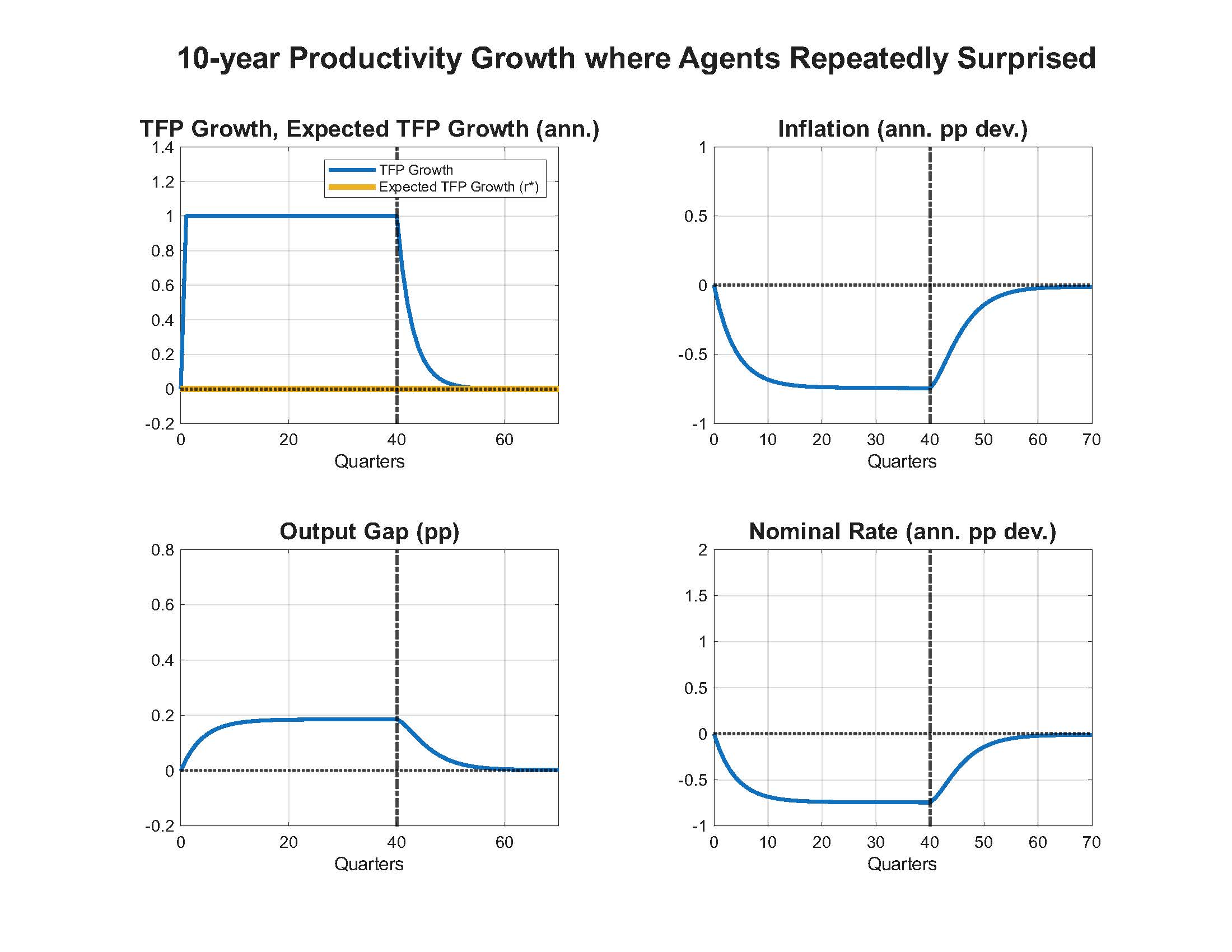
As you would expect from a productivity surge, inflation falls. With stickiness, wages are slow to catch up with the higher productivity, so marginal costs fall and production ramps up. The productivity surge raises output higher than potential and generates the positive output gap. But you can see in the lower right graph that the low inflation more than offsets the increase in the output gap and the standard Taylor rule calls for lowering the nominal rate.
In terms of magnitudes, the model suggests that a 1 percentage point increase in productivity growth should lead to an interest rate cut of about 75 basis points through the duration of the surge.
To me, this feels like a Greenspan-in-the-mid-1990s scenario. An unexpected productivity surge reduces inflation, and the proper Fed response is to lower rates.
Expected Productivity Surges in the Future
Now consider an identical ten-year productivity surge, but this time people fully expect it. The black line and the yellow line are the same. When everyone knows it’s coming, inflation still falls about as much as it did before, output heats up just the same, but something very different happens with the interest rate. The nominal rate doesn’t fall. It rises. What’s happening is straightforward: Since everyone knows there will be productivity growth coming in the future and they will be rich, they try to pull from the future to increase their spending today. It’s just a wealth effect. Consumers’ lifetime income is higher, so they try to raise their consumption now. But most of the productivity miracle is still on the way. Capacity hasn’t expanded yet. Shifting from the future to spend now threatens to overheat the current economy, so the central bank needs to raise the return on savings and get people to reduce spending. If it didn’t, the economy would overheat today and inflation would blow up. The natural rate rises, and the standard Taylor rule says the central bank must raise the nominal rate.
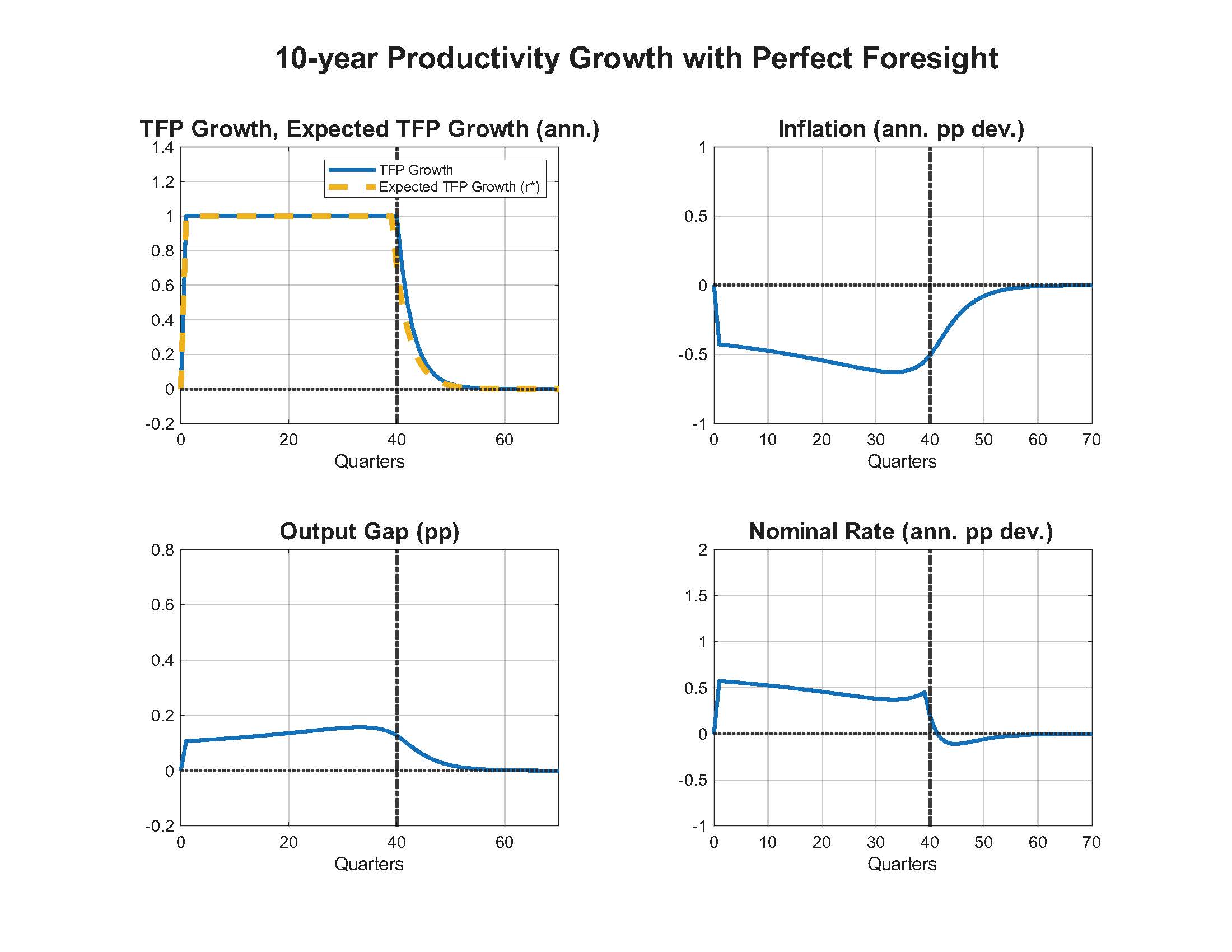
In terms of magnitudes, fully anticipated productivity growth of 1 percentage point per year over ten years leads to an interest rate increase of about 50 basis points for the length of the surge.
As an aside, one of the first pieces to emphasize the point that news about future productivity growth might force a higher nominal rate even if inflation is lower was Simon Gilchrist and John Leahy’s paper in the Journal of Monetary Economics back in 2002. As most of you know, before John passed away suddenly, he was about to start as the research director at the Chicago Fed. It’s heartbreaking to think of how much we could have benefited from his insight these days.
What I like about these finger exercises is that they make clear the mechanisms and suggest what policymakers should look for. Be on watch for things that look like pulling activity from the future into the present. Wealth effects on consumer spending—some of it may be right here among your neighbors in Palo Alto. Higher investment in data centers driven by rising stock market valuations driving up the cost of land, electricians, computer chips, etc. for non-AI industries. All of these may suggest productivity growth pushing the ideal interest rate higher, not lower.
But more importantly, measure how much productivity people expect to be coming. The bigger the share of a productivity boom that is still on the way, the more likely rates will need to rise now. Ezra Karger from the Chicago Fed led a survey of economists, tech people, and the general public about the future implications of AI and found that the median person in each group expects a significant boost to annual productivity growth coming for the next ten years. The OECD and McKinsey project similar. That would mean the lion’s share of the productivity boom is still to come and would likely mean substantial incentives to pull forward spending.
The Cost of Waiting
Let me also note that if the central bank decides not to have an opinion about natural rates and instead just waits until there is actual inflation and overheating before acting, things can backfire.
Take the same model as before with a fully expected ten-year productivity surge, but now have a central bank that doesn’t pay attention to the way productivity changes the natural rate and does not incorporate it in its Taylor rule. The central bank doesn’t offset the wealth effect of higher expected productivity. It only responds once it sees inflation and the output gap open up.
The results are in the orange line here in the figures. Of course, once inflation and a big positive output gap show up, the Taylor rule dictates raising nominal rates. You can see that the wait-for-it strategy has much higher inflation and a much more overheated economy than when the natural rate is taken into account. And in the end, the central bank has to raise nominal rates by more than if it had tracked the natural rate from the beginning.
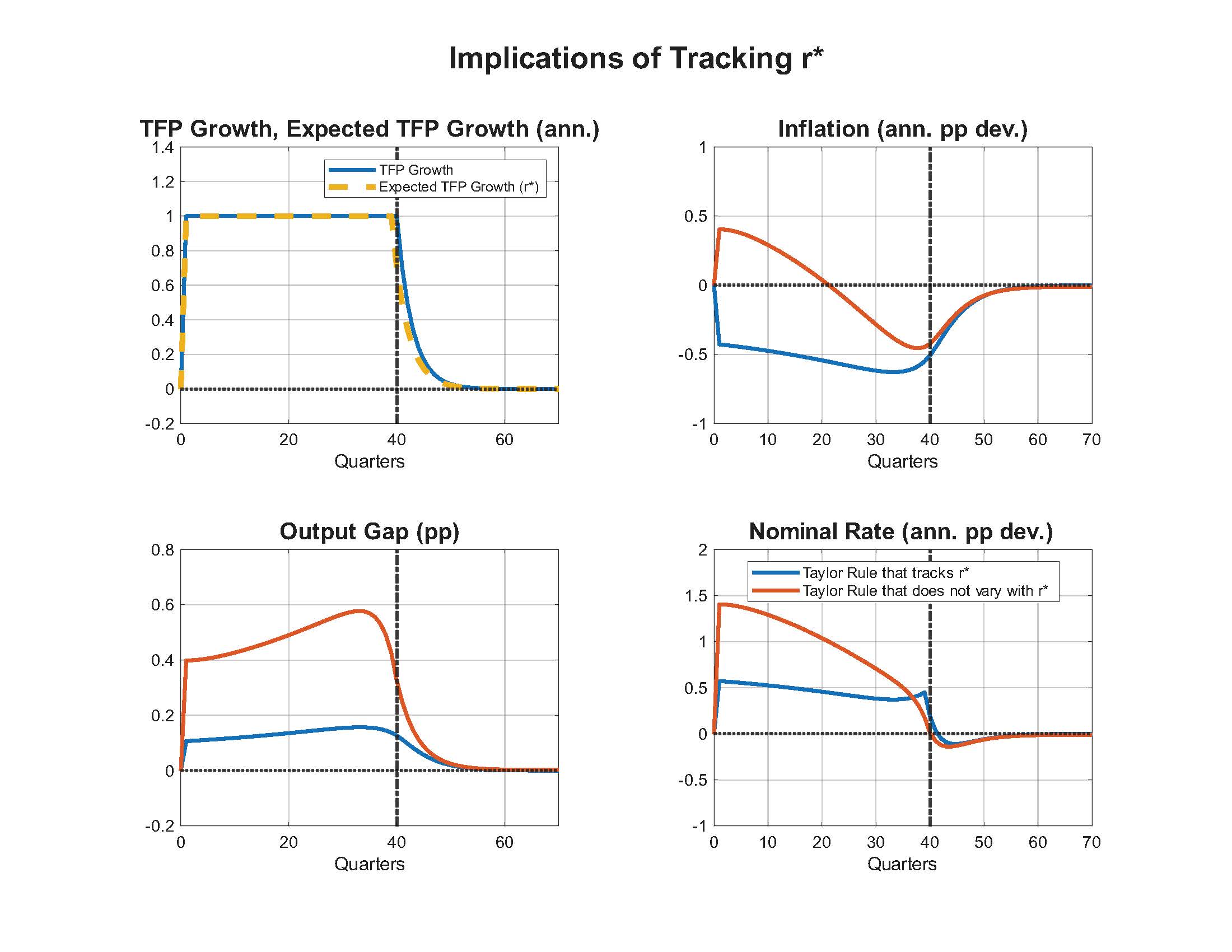
So there’s a mixed message here. Productivity growth is a boon for the economy. We want it. What it means for interest rates, though, is more subtle. It depends very much on whether the productivity growth is expected to come in the future. If it happens unexpectedly, rates should probably fall. But the more it is expected to come in the future, the more it induces shifting activity from the future, and the more likely it is to drive up rates now to prevent overheating. If the central bank reacts too slowly, it makes the problem worse.
And note: I didn’t say one single word about bubbles.
Notes
1 See, for example, Greenspan’s discussion in the Humphrey-Hawkins testimony delivered to Congress during the Fed’s rate hiking cycle in 1999 and 2000 for his thinking on this point.
4 OECD (2025) and McKinsey & Company (2023).