The Chicago Fed Labor Market Indicators (LMI) combine public and private sector labor market data with official statistics from the U.S. Bureau of Labor Statistics (BLS). By separately analyzing the flows of workers into and out of unemployment, the LMI provides useful context for understanding movements in the BLS unemployment rate over time. In this article, we use the LMI to take a closer look at the current “low-hire, low-fire” nature of the U.S. labor market from this worker perspective.
Background on the Chicago Fed LMI
Released twice monthly, each Chicago Fed LMI release1 contains the following three rates:
- Chicago Fed Real-Time Unemployment Rate Forecast
- Chicago Fed Layoffs and Other Separations Rate (job separation, or inflow, rate)
- Chicago Fed Hiring Rate for Unemployed Workers (job finding, or outflow, rate)
The Chicago Fed Real-Time Unemployment Rate Forecast combines real-time labor market data2 with monthly estimates from the Current Population Survey (CPS) by using partial least squares to estimate the best fit of CPS-derived job finding and job separations rates with the real-time data. The best fit for the job separations rate is the Chicago Fed Layoffs and Other Separations Rate,3 and the best fit for the job finding rate is the Chicago Fed Hiring Rate for Unemployed Workers.4
The job finding (outflow) rate and job separations (inflow) rate are both scaled in such a way that the ratio of the job separations rate to the sum of the job finding and job separations rates—referred to as the flow-consistent unemployment rate, or FCR—is in similar units to the BLS unemployment rate (i.e., percent of the labor force unemployed). The statistical model underlying the Chicago Fed Real-Time Unemployment Rate Forecast relates monthly changes in the BLS unemployment rate to monthly changes in the flow-consistent unemployment rate to produce a forecast.
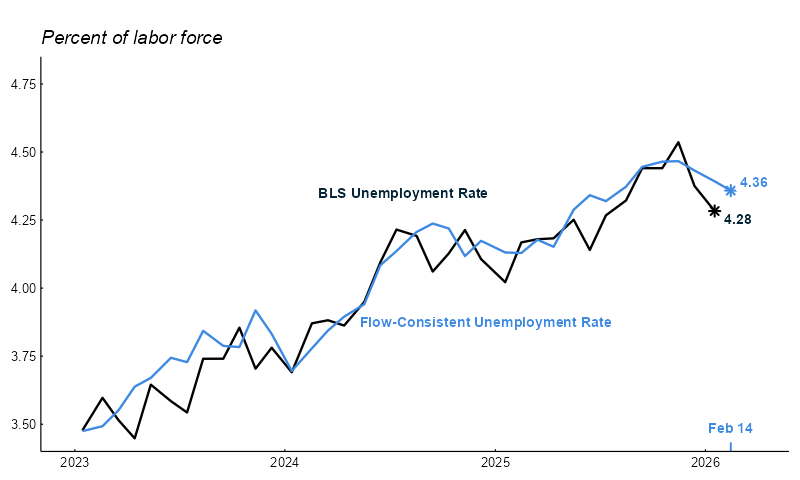
Figure 1 shows the close correspondence between the FCR and BLS unemployment rate since 2023. Going further back in time, we find that since 2018 these series have a 0.98 correlation coefficient in levels and a 0.95 correlation coefficient in first differences.
1. Flow-consistent and BLS unemployment rates
Sources: Chicago staff calculations based on data from ADP, Bloomberg, The Conference Board, Google, Haver Analytics, Indeed, Lightcast, Morning Consult, and Revelio Labs.
The low-hire, low-fire labor market
Since 2023, the U.S. labor market has seen changes in the rates of job separations and job finding such that both inflows and outflows of workers have put upward pressure on the BLS unemployment rate.5 Consistent with this development, the BLS unemployment rate during this period has risen by roughly a percentage point from an all-time low of 3.4% in April 2023 to its current low level of 4.3% in January 2026.
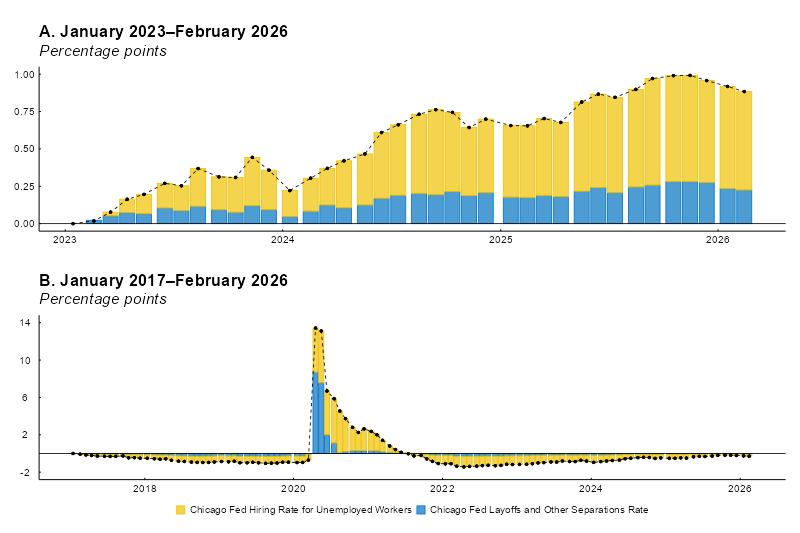
To better understand the recent increase in the BLS unemployment rate, we decompose in figure 2 our FCR into separate contributions from job finding and job separations rates. Panel A decomposes the change in the unemployment rate since January 2023, with contributions from the job separations rate in blue and those from the job finding rate in yellow. Panel B decomposes the change in the unemployment rate since January 2017 into these two components. Bars above zero indicate a positive contribution to the FCR (i.e., upward pressure on the rate) since the initial date, and bars below zero indicate the opposite.
For the most recent period (January 2023–February 2026), panel A of the figure shows that almost 80% of the increase in the FCR since early 2023 can be traced back to lower job finding—the “low-hire” part. The remaining 20% is due to increases in job separations—the “low-fire” part. Panel B demonstrates why the current period is, indeed, “low fire” from a longer-term historical perspective. Although layoffs and other job separations have risen steadily since 2024, the increases have been small and gradual, with only minimal upward pressure on the unemployment rate through February 2026. This pattern is quite distinct from a typical labor market contraction, where layoffs and other job separations are often an early signal of rising unemployment (e.g., in the 2020 recession and its aftermath).
2. Cumulative change in the flow-consistent unemployment rate
Sources: Chicago staff calculations based on data from ADP, Bloomberg, The Conference Board, Google, Haver Analytics, Indeed, Lightcast, Morning Consult, and Revelio Labs.
Recent increases in job separations
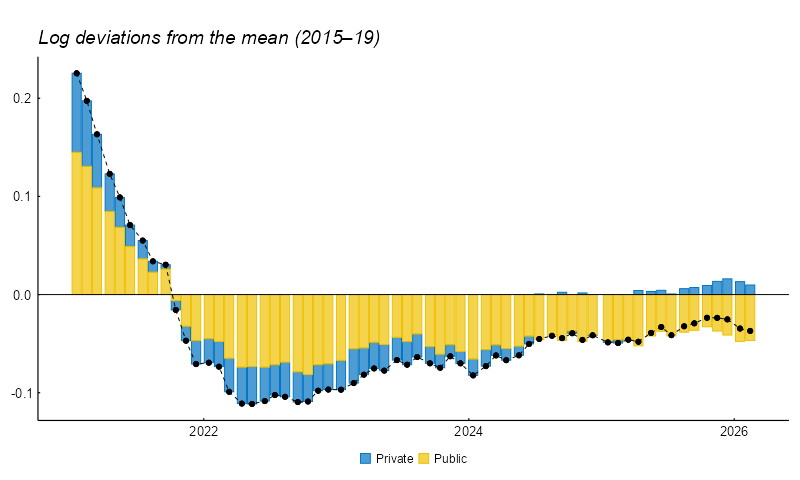
To better understand the “low-fire” dynamic, we decompose in figure 3 the deviations in the Chicago Fed Layoffs and Other Separations Rate from its 2015–19 mean into contributions from public and private sector data sources. This way of looking at the time series makes clear that the low-fire aspect of the labor market in the real-time data is largely a function of public sector data sources (the large negative yellow bars since 2022)—particularly the low level of unemployment insurance (UI) claims—while much of the increase since the second half of 2024 in job separations is explained instead by the real-time private sector data sources (the shrinking blue bars that gradually turn positive in 2025).
3. Contributions to the Chicago Fed Layoffs and Other Separations Rate, by data source type
Sources: Chicago staff calculations based on data from ADP, Bloomberg, The Conference Board, Google, Haver Analytics, Indeed, Lightcast, Morning Consult, and Revelio Labs.
While the limited historical availability of many of these private sector data sources prevents us from making a stronger judgment on their merits as leading indicators (this is mainly why figure 3 only extends back to early 2021), the divergence between real-time public and private sector data sources is still a development worth monitoring.6 Some private sector indicators in the Chicago Fed LMI (e.g., the labor market differential index from the Conference Board) do have long track records of capturing turning points in the labor market, and many others performed quite well during the recovery from the 2020 recession as shown in figure 3.
Overall, the Chicago Fed Labor Market Indicators continue to suggest that the low-hire, low-fire nature of the labor market is holding steady. The next release of the Chicago Fed LMI for March data is scheduled for March 26, 2026.
Notes
1 The Chicago Fed LMI release schedule for 2026 is available online.
2 The complete list of real-time data sources in the Chicago Fed LMI is available online.
3 Layoffs and other job separations (such as quits and discharges) represent the most common ways in which workers experience voluntary and involuntary unemployment. The Chicago Fed Layoffs and Other Separations Rate is an estimate of the percentage of previously employed workers that experienced a separation event (layoff, quit, or discharge) leading to nonemployment in the reference week of the month used by the BLS in its Employment Situation report. As the Chicago Fed Layoffs and Other Separations Rate increases, it puts upward pressure on the unemployment rate.
4 The Chicago Fed Hiring Rate for Unemployed Workers is an estimate of the percentage of previously unemployed workers that transitioned into employment (or out of the labor force) during the BLS reference week. When unemployed workers successfully find a job (or leave the labor force), it reduces the upward pressure on the unemployment rate coming from job separations. As such, an increase in the Chicago Fed Hiring Rate for Unemployed Workers puts downward pressure on the unemployment rate.
5 Further details and historical time series for these rates are available online.
6 The divergence between the contributions to the LMI from public and private sector data sources could reflect differences in the underlying sample populations of these sources and the way information is collected for each source. For instance, low levels of unemployment insurance claims may reflect the low take-up rate of unemployment benefits. Others have asserted that this may be due to the ineligibility of or unwillingness by some persons (e.g., undocumented workers, recent college graduates, or white-collar workers with severance packages) to file for these benefits; see, e.g., Sasso et al. (2025) and Daurat (2024). Several of the private sector data sources in the LMI come from anonymized surveys that, in theory, could be more likely to capture the unemployment status of these individuals.