This article looks at how the Seventh District1 labor market did in 2025 and examines whether higher tariffs affected the District differently than other parts of the country. We find that, on an annual basis, employment growth slowed some in both the U.S. and Seventh District but stayed positive. In addition, unemployment rates in both areas were little changed, ending the year at healthy levels. The Seventh District could have been affected by rising tariffs more than other U.S. regions because it trades more, but higher tariffs do not appear to have had a large differential effect on regions’ economic activity in 2025 as measured by changes in payroll employment.
Employment growth slowed some in 2025
We are interested in how the Seventh District economy performed in 2025, and we consider employment growth as a summary measure of economic activity because we will not have 2025 gross domestic product (GDP) results for U.S. regions until mid-April, though the full set of jobs data for 2025 became available in late January. It is important to note, however, that although employment and GDP growth are highly correlated, they do not always move together; their quarterly growth rates have a 0.82 correlation coefficient2 over the past 50 years. The usual culprits for differences between GDP and employment growth are shifts in patterns of population or productivity growth, both of which may have occurred in 2025. For this reason, we also look at unemployment rates as an indicator of economic conditions.
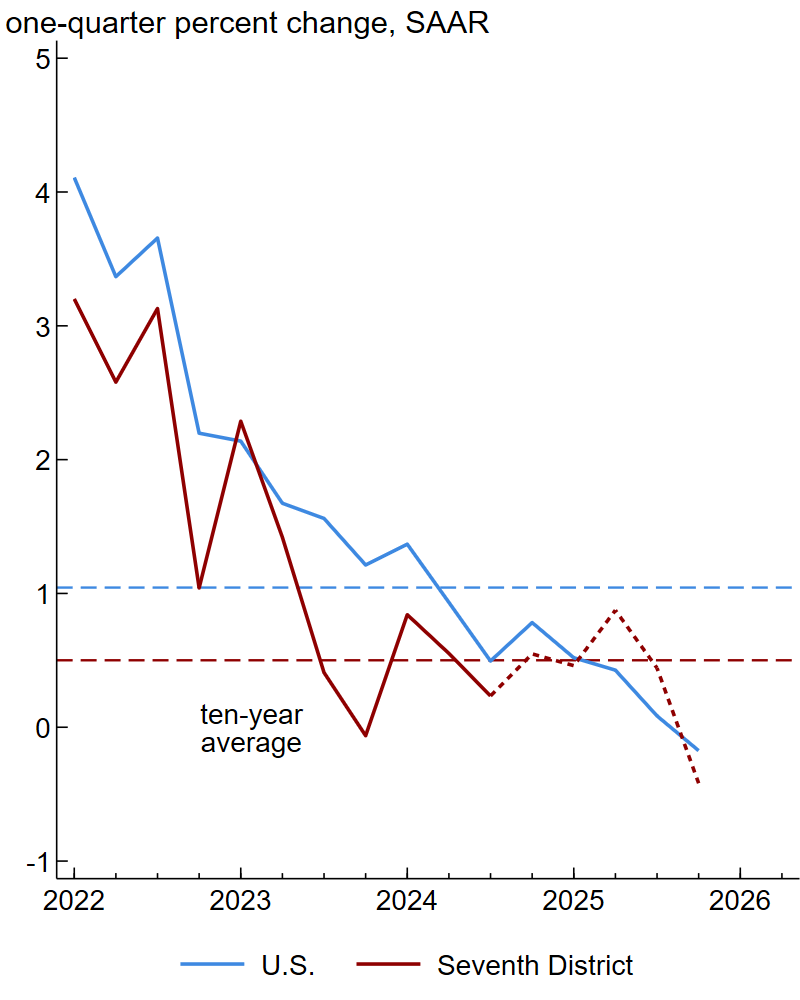
Both the Seventh District and the U.S. as a whole saw employment growth slow in 2025. Between the fourth quarter of 2024 and the fourth quarter of 2025, Seventh District employment rose by 0.3% and national employment increased by 0.2%; however, in 2024, growth was faster, at 0.5% for the District and 0.9% for the U.S.3 These results indicate that employment in the District grew faster than in the nation as a whole in 2025, bucking a long-run trend. In the currently available data, the District’s payroll employment growth rate was 0.1 percentage points faster than that of the U.S., but over the past ten years, the District’s jobs growth rate averaged 0.6 percentage points below the nation’s.4 We must point out, though, that employment data are subject to revision, meaning the result that the Seventh District grew faster than the U.S. in 2025 could change. Importantly, national data were recently revised, and Seventh District data will be revised through a similar process later this year. The national data revisions moved U.S. employment growth in 2025 notably lower, making it likely Seventh District data will be revised downward as well. It’s quite possible that revised District employment data will show that it grew more slowly than the nation in 2025.
To provide some detail on how employment growth evolved over the year, we show in panel A of figure 1 annualized employment growth by quarter, with the U.S. and Seventh District growth rates in blue and red, respectively (the short-dashed portion of the red line represents data that have not yet been benchmarked in 2026). Both series started 2025 close to their long-run averages, but declined to near zero by the fourth quarter. Interestingly, Seventh District employment growth was near or slightly above its ten-year average in 2025 until the fourth quarter, when it became slightly negative.
1. Employment growth slowed, but unemployment rates stayed low
A. Nonfarm payroll employment growth
B. Unemployment rates
Source: Authors’ calculations based on data from the U.S. Bureau of Labor Statistics from Haver Analytics.
Slowing employment growth in the U.S. and Seventh District in 2025 doesn’t necessarily mean that labor market conditions deteriorated because population growth likely slowed too. When population growth is slowing, a decline in employment growth may not coincide with higher unemployment. The U.S. Census Bureau recently estimated that population growth slowed in the U.S. and in the four major Census regions from mid-2024 to mid-2025, largely because of a decline in international migration. Likewise, using U.S. Census Bureau data at the state level, we estimate that population growth in the Seventh District slowed over the same span. Comparing these estimates, we find that District population growth was lower than national population growth during this period.
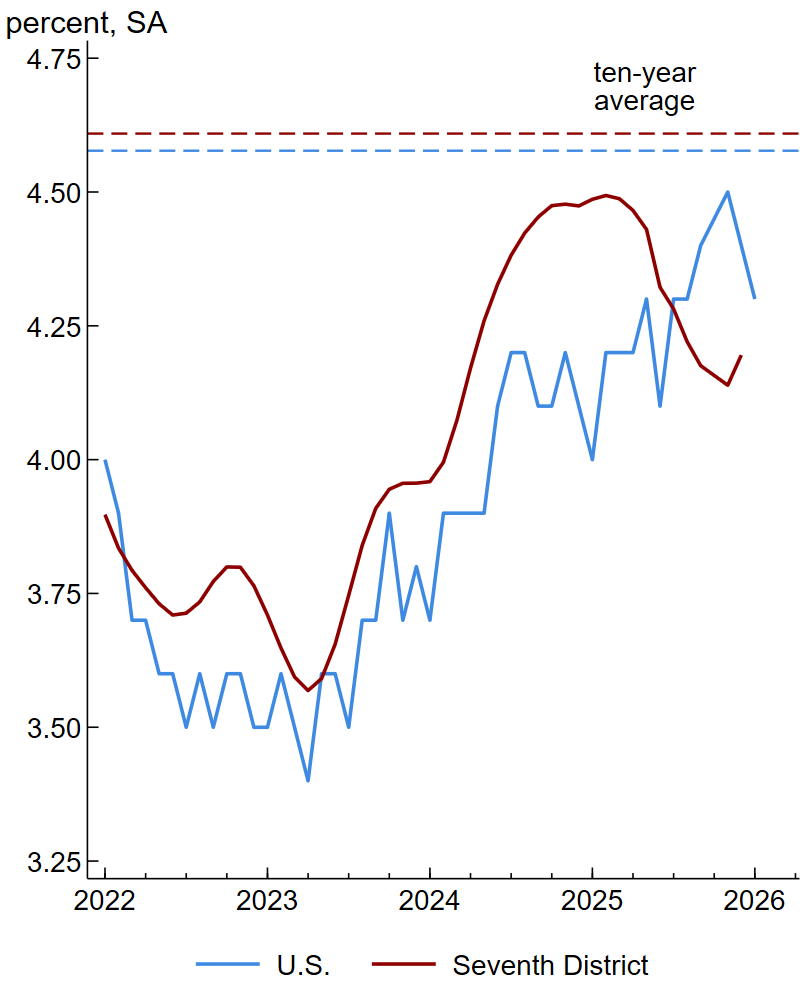
One key indicator of how difficult it is to find work is the unemployment rate, which is less sensitive to changes in population trends than employment growth because it is a ratio that adjusts for the size of the labor force. As panel B of figure 1 shows, the unemployment rates in both the U.S. and Seventh District changed little in 2025 and remained below their respective ten-year averages. The nation’s unemployment rate was at 4.4% in December 2025 compared with 4.1% in December 2024, while the Seventh District’s rate fell from 4.5% to 4.2%. Both rates are close to 4.2%, which is the median estimate of the long-run unemployment rate among Federal Open Market Committee (FOMC) members, according to their December 2025 Summary of Economic Projections.
Trade intensity was weakly related to 2025 state employment growth
One major economic story in 2025 was rising tariffs on imports. Here, we examine whether state-level trade intensity was correlated with employment growth in 2025. In June 2025, we published research showing that because of their large manufacturing industries, Seventh District states import and export more than a majority of states, with Indiana and Michigan being particularly large outliers. Tariffs can affect economies in several ways—some that potentially raise growth and some that lower it. States that trade more should see larger effects in both directions. Tariffs can slow growth via higher input costs and, if other countries impose retaliatory tariffs, lower exports. But tariffs can also spur growth through the onshoring of foreign production. In 2025, we regularly heard stories from our contacts across the Seventh District about higher input costs that were sometimes passed along to customers, as documented in the Beige Book. We also heard of some instances of onshoring production and of retaliation, such as when China paused purchases of U.S. soybeans.
Estimating the full effect of tariffs on the Seventh District and other U.S. regions is a difficult task that we do not attempt in this article. Instead, we first look at parts of the economy where tariffs could have had an outsized impact. At the national level, the two most trade-intensive industries—namely, manufacturing and mining and logging—saw employment decline in 2025. It’s possible these declines in employment occurred because higher tariffs hurt these two industries more than they helped. But it’s also possible these declines were just a continuation of long-run trends—employment in manufacturing and mining and logging has largely been on a downward trajectory since the 1980s.
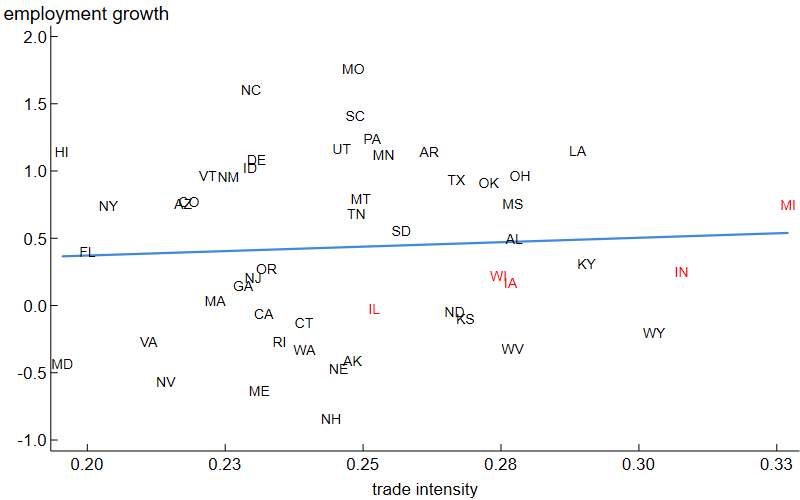
We also consider the state-level relationship between trade intensity (imports as a share of state GDP plus exports as a share of GDP, as estimated in our earlier article) and percent employment growth from December 2024 through December 2025. As shown in figure 2, the relationship is not strong, with a correlation coefficient of just 0.1 that is statistically indistinguishable from zero. Two possible explanations for the weak association are 1) that positive and negative tariff effects are offsetting each other and 2) that tariff effects are small compared with other factors that drove 2025 employment growth differences across states. Checking for offsetting tariff effects is beyond the scope of this article, but there is some evidence that other factors driving growth differences are at play. For example, employment in several slow-employment-growth, low-trade-intensity states, including California, Maine, Massachusetts, New Hampshire, and Washington, was already growing below the U.S. average prior to 2025, suggesting that longer-run factors besides tariffs played a role in 2025 employment outcomes.
2. Trade intensity was not correlated with state employment growth in 2025
Sources: Federal Reserve Bank of Chicago and authors’ calculations based on data from the U.S. Census Bureau and U.S. Bureau of Labor Statistics from Haver Analytics.
While changes to tariffs appear to have had little differential effects on states’ economies so far as measured by employment growth, it may also be that it’s simply too soon for the policies’ effects to have played out and that noticeable effects will show up later.
Three takeaways
From our analysis presented in this article, we conclude the following:
- Employment growth slowed in 2025 in the U.S. and Seventh District, but employment continued to expand on an annual basis. The result for the District is based on state-level data that could see large revisions later in the year.
- Unemployment rates remained low in 2025 in the U.S. and Seventh District, indicating that the labor market is healthy overall.
- Differences in states’ 2025 employment growth rates were uncorrelated with state trade intensity.
Notes
1 The Seventh Federal Reserve District (which is served by the Chicago Fed) comprises all of Iowa and most of Illinois, Indiana, Michigan, and Wisconsin. In this article, we analyze the entirety of each state in the District.
2 Authors’ calculations based on data from the U.S. Bureau of Economic Analysis and U.S. Bureau of Labor Statistics from Haver Analytics. Ranging from –1 to 1, a correlation coefficient indicates the strength and direction of a linear relationship between two variables. Thus, a correlation coefficient of 0.82 indicates a strong positive relationship between quarterly employment and GDP growth.
3 Authors’ calculations based on data from the U.S. Bureau of Labor Statistics from Haver Analytics.
4 Authors’ calculations based on data from the U.S. Bureau of Labor Statistics from Haver Analytics. We calculate the ten-year average as the annualized percent change in employment from 2015:Q4 through 2025:Q4.