Multiple central counterparties (CCPs)1 are poised to offer clearing services for U.S. Treasury transactions to support market participants’ compliance with the new U.S. Securities and Exchange Commission (SEC) clearing mandate taking effect by year-end 2026 for cash securities and by mid-2027 for repurchase agreements (repos).2 The prior market experience of the clearing mandate for U.S. dollar-denominated (USD) over-the-counter (OTC) derivatives beginning in 2010 with the passage of the Dodd–Frank Act offers a useful analogue for the types of structural changes that may accompany this transition. If central clearing of U.S. Treasury transactions follows the trajectory of central clearing of OTC derivatives, then market participants can expect
- improved credit risk mitigation;
- an easing of collateral requirements as CCPs compete on cost;
- an expansion of portfolio-level risk assessment for their cleared products; and/or
- a tendency toward clearing concentration, with fewer CCPs capturing the majority of activity over time owing to economies of scale.
In this Chicago Fed Letter, I describe what happened in USD OTC derivatives markets when central clearing became mandatory and highlight the developments that are likely to unfold in U.S. Treasury markets after central clearing becomes a requirement.
Background on U.S. clearing mandates
Motivated in part by the market dysfunction witnessed during the 2020 “dash for cash” at the onset of the Covid-19 pandemic, the SEC has adopted rule amendments requiring that certain transactions in U.S. Treasury cash securities and repos be cleared through an authorized CCP by December 31, 2026, and June 30, 2027, respectively (see note 2). Because central clearing consolidates positions, settlements, and collateral flows, regulatory supervisors gain a centralized view of leverage, stress, and counterparty failures across a given market. A key policy objective of the SEC rule is to mitigate systemic credit risk and promote more standardized risk-management practices throughout U.S. Treasury markets.
The rule amendments also support increased collateralization of transactions, ensuring that market participants consistently back risk exposures with high-quality assets and manage risk more uniformly under CCP-set protocols. As more contracts are centrally cleared, participants benefit from risk and payment netting, which compresses exposures and settlement obligations across the market. This, in turn, can free up balance sheet capacity and reduce capital requirements for banks and other dealers (Duffie, 2020).
Prior to the U.S. Treasury clearing mandate, approximately 25% of cash security and 45% of repo trades were centrally cleared; after the full implementation of the clearing mandate, those percentages are expected to increase to roughly 65% for cash security and 77% for repo trades (Nikolaou and Li, 2024, pp. 4–5; and Cenicola et al., 2026).
The 2023 U.S. Treasury clearing mandate has a clear precedent in the 2010 OTC derivatives clearing mandate. Following the Global Financial Crisis (GFC) of 2008–09, regulators worldwide sought to reduce systemic risk, increase transparency, and strengthen market stability. At the 2009 Pittsburgh Summit, Group of 20 (G20) leaders established a global policy direction with a specific goal that most OTC derivatives would be cleared through CCPs. In the United States, the Dodd–Frank Act of 2010, along with subsequent rules from the Commodity Futures Trading Commission (CFTC) and the SEC, implemented the framework for mandatory central clearing of USD OTC derivatives.
Even though OTC credit default swaps (CDS) related to mortgage-backed securities were widely cited as a large driver of the market stress during the GFC, the derivatives market with the largest notional value amount3 of uncleared OTC contracts was that for interest rate swaps (IRS), which I therefore focus on in this article.4 An IRS is a financial contract where two parties exchange fixed rate payments for floating rate payments. During the GFC, LCH (London Clearing House)5 was the only CCP to clear OTC IRS, and it did so only for dealer banks that were its clearing members (CMs). In June 2009, approximately 40% (i.e., $178 trillion in IRS) of the notional outstanding amount for all OTC interest rate derivatives (including IRS) was centrally cleared at a CCP.6
CCP competition in the USD OTC IRS market
With the expectation that the vast majority of OTC derivatives would be centrally cleared, market participants needed broader access to CCPs. They sought indirect clearing, in which market participants access the CCP via a CM intermediary,7 as well as the ability to clear at more than one CCP. Moreover, since U.S. market participants needed USD OTC IRS transactions to be cleared through CFTC-authorized CCPs, some participants desired an onshore U.S. solution rather than being forced to clear at London-based LCH.
To meet the industry’s demands, LCH enhanced its service offerings, and the Chicago Mercantile Exchange (CME) entered the OTC IRS clearing market, leveraging its established fixed income derivatives infrastructure. The key milestones for that transition are illustrated in figure 1.
1. Timeline of key milestones for U.S. dollar-denominated over-the-counter interest rate swaps (USD OTC IRS) clearing
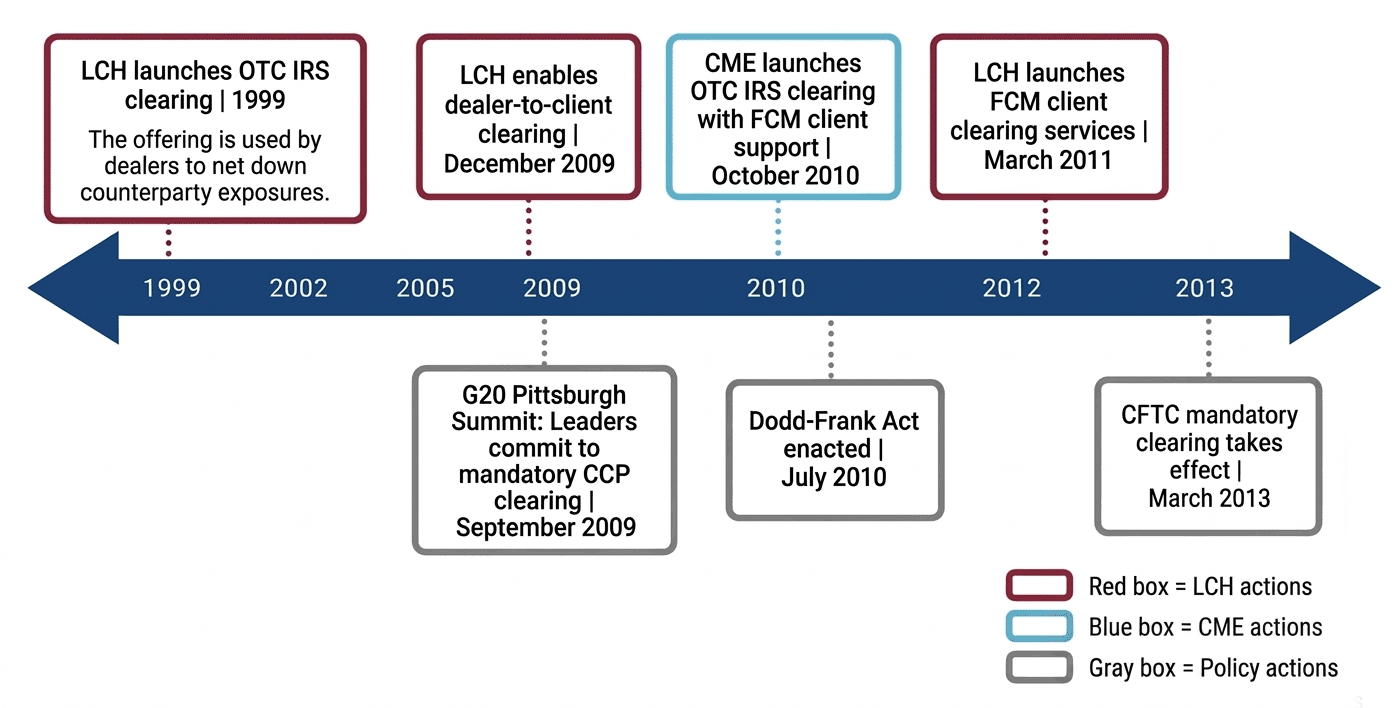
Sources: Various government and company websites and press releases, including London Stock Exchange (2024), U.S. Securities and Exchange Commission (2011), and CME Group (2011).
Three market structure changes from the derivatives clearing mandate and CCP competition
The experience of OTC IRS mandatory clearing produced three durable structural changes: a sharp increase in the amount of transactions that are centrally cleared; an evolution in risk-management standards as CCPs competed; and a persistent concentration of clearing for CMs’ clients at a single dominant CCP, which resulted from a pricing differential between CME and LCH referred to as the “CCP basis.” Each structural change is examined in turn.
Structural change 1: Substantial growth in overall centrally cleared activity
With multiple CCPs offering both direct access for CMs and indirect access for CMs’ clients, the notional value (see note 3) of USD OTC IRS cleared through CCPs experienced a sharp and sustained increase. Three factors contributed to the overall growth in cleared USD OTC IRS:
- the U.S. clearing mandate;
- clearing mandates in other jurisdictions; and
- increased clearing of derivatives without a clearing mandate, driven by a shift in market participant preferences toward centrally cleared transactions.
That preference shift was reinforced by two forces. First, the phased implementation of uncleared margin rules (UMR)8 imposed collateral exchange requirements on bilateral OTC trades, raising the cost of uncleared contracts. Second, market participants priced cleared contracts with tighter spreads (translating into lower costs) relative to uncleared trades, creating a direct economic incentive to use CCPs (Cenedese et al., 2020).
The combined effect of the mandates and the preference shift was decisive. Based on estimates from the CFTC, as of December 27, 2024, 87.1% of all OTC IRS in notional value was centrally cleared.9 By late 2024 the percentage of notional amount outstanding of OTC interest rate derivatives (including IRS) centrally cleared had increased significantly since mid-2009 (see note 6), fulfilling a key objective of the CFTC’s clearing mandate.
Structural change 2: Evolution in risk-management approaches due to CCP competition
LCH and CME competed on collateral costs to gain market share in the early years of OTC IRS clearing following the 2010 clearing mandate. This included changes in two key approaches in how they manage market risk:
- Both CCPs relaxed standards in the calculation of collateral required for clearing transactions.
- And both CCPs expanded portfolio-level risk assessment for their cleared products (i.e., they each opted to offset risk exposures across related positions that a CM held within the same clearing portfolio) so that market participants could realize improved capital efficiencies. Put another way, these CCPs expanded portfolio margining for their CMs (and their CMs’ clients).10
Changes to calculations for collateral requirements. When a CCP guarantees a contract, it applies risk-management controls to help ensure that contractual obligations are met. One of the most important controls is initial margin (IM), collateral that a CCP collects up front to cover potential mark-to-market losses if a CM were to default. Based on regulatory guidance called the Principles for Financial Market Infrastructures (PFMIs) (see note 10), CCPs are required to collect collateral large enough to cover changes in valuations with at least 99% probability, a threshold commonly referred to as the confidence level. While international regulatory standards do not specify a time horizon for the IM to cover, CCPs are expected to set collateral coverage commensurate with the expected default management period—i.e., the time needed to manage a clearing member’s default.11 The time horizon is often called the margin period of risk (MPOR), discussed in further detail in Basel Committee on Banking Supervision (2011, p. 3).
Since collateral requirements create costs for participants, CCPs must balance risk management with cost efficiencies.12 This tension can become more meaningful when CCPs compete to guarantee similar financial contracts and may lead CCPs to be less conservative in their risk-management approaches. This appeared to play out when CME began to compete with LCH to centrally clear OTC interest rate derivatives, including IRS.
Before CME’s entry into OTC IRS clearing in 2010, LCH set a 100% (i.e., worst-case loss scenario) IM confidence level and an MPOR of five days for a CM’s house positions and seven days for client (of a CM) positions.13 According to chapter 7 of the 2010 Manual of Operations for CME Cleared Interest Rate Swaps (go to p. 96 of this CME Group file), CME launched with a five-day MPOR for both clearing member and client positions, and in August 2011, it adopted a value-at-risk (VaR) risk measure with a 99.7% confidence level. LCH later reduced its confidence level to 99.7%, but by using expected tail loss (ETL) as its risk measure.14 As I discuss later, because of its choice of risk measure, LCH still charged an effective IM higher than 99.7% and therefore had higher collateral requirements for CMs than CME did.15
Figure 2 illustrates how hypothetical changes in confidence levels and risk measures could affect IM and therefore costs. I use 1,005 trading days (that occurred over approximately four years) of historical end-of-the-day rates for the ten-year maturity interest rate swap to derive changes in swap rates over five trading days (i.e., 1,000 changes in rates over five trading days). I calculate swap rate changes using VaR and ETL methods for 99.7% and 100% VaR and for 99.7% ETL. The results in basis points are listed in the third column of figure 2, with calculation parameters (risk measure and confidence level) in the first two columns. Next, I used the pricing sensitivities (see the notes to figure 2) to derive the U.S. dollar-equivalent projected change in value by taking swap pricing sensitivities for a $100 million notional ten-year USD IRS and multiplying the pricing sensitivities by the VaR and ETL values. The U.S. dollar-equivalent forecasted change in the IRS value is shown in the fourth column. In the last column, I show the total forecasted change in IRS value as a percentage of notional value. The fourth and fifth columns are illustrative of collateral costs in absolute U.S. dollar terms and as a percentage of notional value, respectively. It is evident from figure 2 that collateral costs can decrease when CCPs use less conservative risk measures for IM. One caveat is that the results in figure 2 are a simple, stylized example to show how IM can vary with changes in confidence level and risk measure.16
2. Comparison of the estimated change in value of an interest rate swap (IRS) with a notional value of 100 million U.S. dollars under various value at risk (VaR) and expected tail loss (ETL) assumptions
| Risk measure | Confidence level (%) | Change in IRS rates in basis points | Total change in IRS value (U.S. dollars) | Total change in IRS value as percentage of notional value |
|---|---|---|---|---|
| VaR | 99.70 | 37.62 | 3,184,032 | 3.18 |
| ETL | 99.70 | 42.82 | 3,633,898 | 3.63 |
| VaR | 100 | 48.64 | 4,139,935 | 4.14 |
Source: Author’s calculations based on data from Bloomberg L.P.
Despite the competition that led to lower confidence levels for IM, CME and LCH kept their confidence levels above the regulatory minimum requirements established by the CFTC.17 In 2017, CPMI–IOSCO also issued further guidance on CCPs’ margin practices for cleared contracts.18 Although such guidance did not explicitly mandate specifications for an IM model used by a CCP, it implicitly limited how far CCPs could compete to reduce IM conservatism.
Expanding portfolio margining. To improve IM efficiency and thereby reduce costs for participants, both CCPs extended portfolio margining, in which a CCP offsets risk exposures across related positions held within the same clearing portfolio. Starting in 2010, LCH expanded the number of OTC IRS currencies eligible for portfolio margining from 14 to the current 28. CME offered IM efficiencies by portfolio margining USD IRS, as well as other IRS currencies that they cleared, with futures beginning in 2012 and extended this to options in 2020.
Portfolio margining can significantly reduce collateral costs: For instance, as of 2025, CME had an average daily reduction of more than $8 billion in collateral requirements for IM, which translates to an average daily IM reduction of over 55% (CME Group, 2026, slide 3). Moreover, as reported by Crisil Coalition Greenwich for the first quarter of 2024, market participants at LCH achieved a $102 billion reduction in collateral requirements for IM for OTC IRS (Bruel, 2024). These substantial collateral savings influenced the costs that CMs faced when clearing client contracts at each venue, which in turn affected how CMs priced swaps for their clients.
Structural change 3: Persistent concentration in client clearing at a single dominant CCP and the CME–LCH CCP basis
As CCPs competed to attract clearing activity by offering different margin efficiencies and broader client access, CMs that intermediate client trades began pricing swaps differently depending on which CCP would clear the transaction. Specifically, CMs quoted lower swap rates (cheaper pricing) for trades cleared at LCH compared to those cleared at CME. This pricing differential between the two venues became known as the CME–LCH CCP basis.
The CCP basis emerged because CMs face different costs when clearing identical IRS at these two CCPs, particularly given the different collateral requirements for IM (Benos et al., 2019). When clients preferred to clear at one CCP over another, this created directional flows that led to persistent inventory imbalances on CMs’ books. To manage these imbalances and the associated funding costs of providing collateral for IM, CMs adjusted their pricing and passed these costs on to their clients through the swap rates they quoted. Despite LCH having higher IM on a contract basis, LCH’s larger netting capabilities and greater margin-efficiency allowed CMs to realize lower collateral costs. The lower collateral costs translated into better prices (lower swap rates) for CMs’ clients clearing at LCH. The CCP basis was typically larger for longer-maturity swaps because these contracts required more IM, making the cost differential between CCPs more pronounced.
A natural question arises: Why was LCH able to offer CMs lower costs that could be passed through as better prices to their clients? The IM efficiencies with portfolio margining (as mentioned in the discussion of structural change 2) appear to be a key driver. The effectiveness of portfolio margining increases as the notional amount cleared and diversity of positions cleared increases at a given CCP. When a CCP clears more contracts, it can offset more positions against each other, reducing the net IM requirements for participants. This creates a self-reinforcing dynamic: As more participants clear through a CCP, margining becomes more efficient, collateral costs decline, and the CCP becomes even more attractive relative to its competitors.
This dynamic suggests that central clearing may exhibit characteristics of a natural monopoly, where a single dominant provider can serve the market at a lower average cost than multiple competing providers. LCH entered the USD OTC IRS clearing market with an advantage as it was the established CCP that had extensive netting opportunities when the OTC IRS clearing mandate took effect in the U.S. As client clearing expanded as a result of the mandate, participants who chose LCH gained access to superior margin efficiencies, which reinforced LCH's market position. Even though CME offered competitive features, including portfolio margining across futures and swaps, it could not fully overcome LCH’s advantage in multicurrency netting within the IRS market itself. Data show that collateral cost dynamics influenced the CCP basis and that LCH’s economies of scale ultimately cemented its dominance in USD OTC IRS client clearing.
Before May 2015, the CCP basis was minimal, about 0.15 basis points for the 30-year OTC IRS. But it surged from May 2015 onward, peaking at approximately 3.5 basis points for the ten-year OTC IRS around mid-2018, as shown in the final chart of Barnes (2019). A positive basis meant that clearing at LCH was cheaper for CMs’ clients than clearing at CME. By April 2020, the CCP basis had decreased and even turned negative for the ten-year tenor (i.e., there were lower quoted swap prices to clear at CME) (Khwaja, 2020). More recently, Bloomberg L.P. data show that the CCP basis for the ten-year OTC IRS was 0.85 basis points as of March 31, 2026, after ranging from 0.399 to 1.151 basis points since March 2025. This range indicates that the CCP basis is still prevalent and varies widely over time for a given IRS maturity.
To illustrate the CCP basis, I use data from Clarus Financial Technology’s CCPView to plot the growth in cleared notional outstanding value for USD OTC IRS at CME and LCH for their CMs’ clients in panel A of figure 3.19 Initially, the bigger increase in client clearing was at CME, though LCH did experience some growth in client clearing also; then, starting in 2016, the cleared notional value in aggregate across both CCPs rose substantially, generally continuing this upward trend over the next decade or so. Panel B of figure 3 tracks the evolving market share of client clearing for USD OTC IRS at LCH relative to the total at both CME and LCH. Since 2016, the total cleared notional outstanding value has grown across both CCPs, but LCH has remained dominant in the client clearing market for USD OTC IRS. LCH garnered a larger market share, partly because of the CCP basis, which made its clearing cheaper for some clients. For certain client segments, the collateral efficiencies delivered by CME’s portfolio margining have likely more than offset the trading cost differential from the CCP basis (CME Group, 2022); this is likely why they continue to clear OTC IRS at CME.
The combined effects meant that by 2024, LCH had accounted for more than 80% of the aggregate notional value of USD OTC IRS cleared for CMs’ clients by both CME and LCH and around $30 trillion in such notional value (see figure 3, panels A and B); this underscores the economies of scale inherent in concentrated clearing.
3. Growth of client clearing for U.S. dollar-denominated over-the-counter interest rate swaps (USD OTC IRS) at CME and LCH
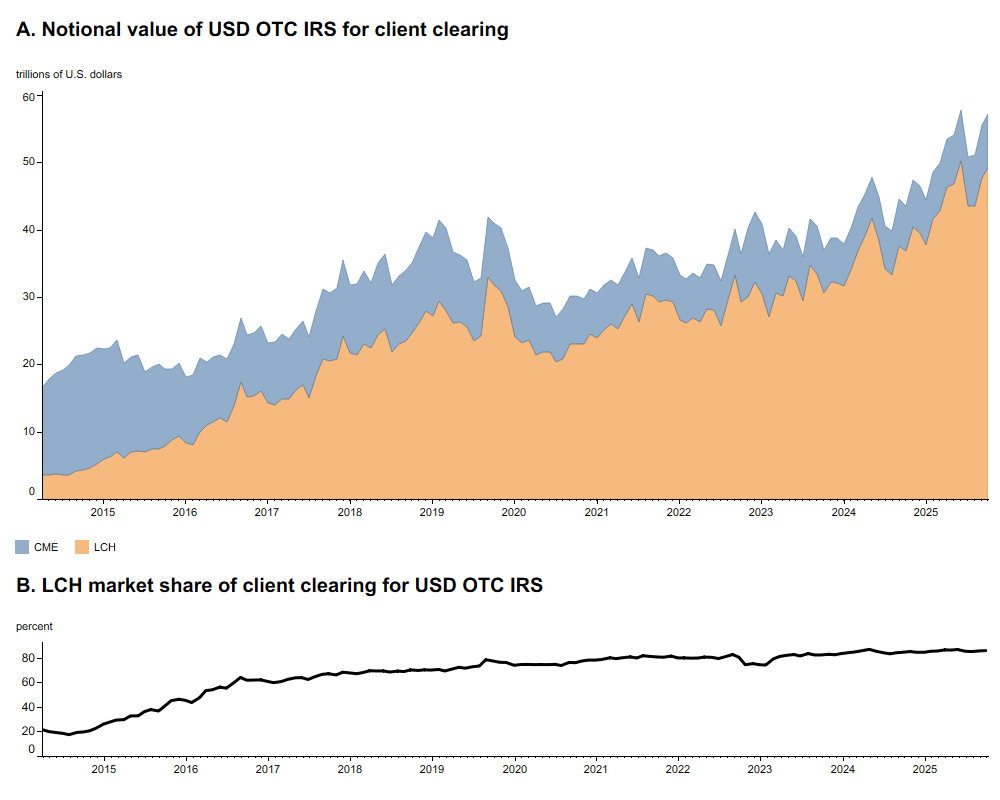
Source: Author’s calculations based on data from Clarus Financial Technology, CCPView.
Parallels between the U.S. Treasury and USD OTC IRS clearing mandates
So far, two developments in the lead-up to the implementation of the U.S. Treasury clearing mandate appear similar to changes in the OTC derivatives market after the GFC: new clearing access models and new entrants. Up until late 2025, the Fixed Income Clearing Corporation (FICC)—through its Government Securities Division (GSD)—was the only CCP authorized to clear U.S. Treasury security and repo transactions. FICC has offered direct clearing of Treasury securities and repos to its members since 1986 and 1995, respectively. To support the SEC’s new clearing mandate, FICC is expanding its offerings to include indirect clearing for its clearing members’ clients, including asset managers and leveraged funds.20 There are also new entrants seeking to clear transactions in Treasury markets. CME Group has established a new CCP called CME Securities Clearing, Inc. (CMESC), which received regulatory approval from the SEC on December 2, 2025, to offer clearing services for Treasury cash and repo trades; CMESC is expected to launch in the second half of 2026. Intercontinental Exchange (ICE), by leveraging its existing clearinghouse ICE Clear Credit, has offered a Treasury clearing service since February 2026, when it was approved by the SEC and became operationally live.
Regarding risk-management approaches, it is unclear whether any of the entrants are looking to compete by reducing conservatism in IM methodology. However, it does appear some are seeking to offer IM efficiencies through cross-margining, which recognizes offsetting risk exposures across positions held at the different CCPs. FICC and CME have partnered since 2004 to offset IM requirements across Treasury futures cleared at CME with IM requirements across Treasury cash and repo markets cleared at FICC through cross-margining. While cross-margining is already offered to CMs, both CCPs recently extended these benefits to CMs’ clients. CME also plans to offer cross-margining of Treasury cash and repo transactions cleared by its new SEC-regulated CCP, alongside OTC IRS, futures, and options cleared by its existing CFTC-regulated CCP (CME Group, 2026). While new entrants and expansion of cross-margining offerings may theoretically improve efficiencies over time, fragmentation across CCPs can also introduce another CCP basis (between two other CCPs), similar to what’s been observed in the OTC IRS market, which may, in turn, lead to further concentration in clearing activity at one CCP.
Will a Treasury CCP basis emerge as central clearing continues to grow? The potential for a Treasury CCP basis should be minimal for Treasury cash transactions, largely because of their shorter risk-management time horizon when compared with that for OTC derivatives transactions. In particular, when Treasury securities are cleared through a CCP, trades typically settle the next business day. As a result, any imbalances in dealers’ positions and the associated IM funding requirements are confined to brief time frames.
However, a Treasury CCP basis could emerge in the market for term repos (i.e., repos with specified maturity dates, typically multiple days or even weeks from when they are initiated). Although most of the repo activity is concentrated in the overnight market (Hempel et al., 2024, figure 8, p. 7), the term market is still substantial. For term repo transactions, the economics of clearing, in particular IM, become more pronounced as maturities increase. Unlike the OTC IRS market, where tenors can stretch over years, repo tenors are generally much shorter, which means most time horizons remain limited. Nonetheless, potential imbalances could emerge if distinct client segments opt to clear at different CCPs.
Consider the example of leveraged funds (defined in note 20), which are major borrowers in the Treasury repo market and already clear Treasury futures at CME. These firms may be attracted to cross-margining and operational efficiencies offered by CME Securities Clearing and CME’s established clearinghouse. Meanwhile, money market funds, which are primary cash lenders in centrally cleared Treasury repos at FICC, may prefer to continue operating within FICC. This scenario closely resembles what occurred in the swaps market, where different client segments selected different CCPs, resulting in imbalances for dealers. Ultimately, dealers responded by passing the associated funding costs for OTC IRS on to their clients. In summary, while the IM funding effects of central clearing expansion may be lower for cash Treasury securities, the repo market could experience notable shifts depending on client maturity choices and clearing venues, echoing patterns seen in other markets, such as the USD OTC IRS market.
Conclusion
The experience of implementing the clearing mandate for U.S. dollar-denominated over-the-counter interest rate swaps potentially provides valuable guidance for the U.S. Treasury clearing mandate. Central clearing, increased competition, and evolving risk-management practices have collectively reduced systemic credit risk and promoted more standardized approaches to risk management in the OTC IRS space across the U.S. As new CCPs enter the U.S. Treasury clearing market, similar structural changes are expected, including expanded access for participants and further innovations in initial margin efficiency. However, competition may also put pressure on risk-management standards, underscoring the importance of vigilant regulatory oversight. Competition to clear Treasury cash and repo transactions may also lead to pricing differentials and segment client clearing activity. Nevertheless, as more of these Treasury transactions migrate to central clearing, the market will be able to consolidate positions, settlements, and collateral flows. Importantly, regulatory supervisors will be able to gain a more consistent and centralized view into leverage, stress, and counterparty failures across market participants. Ultimately, these developments are expected to make the U.S. Treasury market more transparent, efficient, and resilient for market participants, which would resemble many outcomes from the implementation of the USD OTC IRS clearing mandate.
I thank Kelsey Burr, Michael Gordon, Cindy Hull, and Michael O’Connell, all of the Federal Reserve Bank of Chicago, Ulrich Karl, of ISDA, Mike Kobida, who is a retired executive formerly with the Chicago Mercantile Exchange, Kishore Ramakrishnan, of Wepoint, and Sasha Rozenburg, of AlgoPark, for their helpful comments.
Notes
1 A central counterparty is a financial institution that stands between buyers and sellers in a transaction, guaranteeing performance of contracts. See Steigerwald (2013) for a primer on central counterparties and central clearing.
2 The SEC has mandated central clearing for virtually all secondary cash Treasury security and Treasury repo transactions by December 31, 2026, and June 30, 2027, respectively (there are certain exemptions, such as trades involving central banks or sovereign entities).
3 Notional value is the face amount used to calculate a swap’s fixed and floating cash flows.
4 See Bank for International Settlements (BIS), Monetary and Economic Department (2009a, table 1, p. 7), which shows that the OTC IRS market was the largest OTC derivatives market by notional value from June 2007 through December 2008. By combining these BIS data with the estimate I report in note 6, I deduce that the IRS market was the derivatives market with the largest notional value amount of uncleared OTC contracts.
5 Originally established in 1888 as the London Produce Clearing House (LPCH), the firm was renamed the International Commodities Clearing House (ICCH) in 1971 before becoming the London Clearing House (LCH) in 1992. It later operated as LCH. Clearnet following a 2003 merger, eventually dropping. “Clearnet” in 2016 to rebrand simply as LCH. For further details on the firm I refer to LCH throughout this article, see this LSEG webpage.
6 The 40% was estimated by taking $178 trillion in the notional outstanding amount for centrally cleared OTC IRS from LCH.Clearnet (2009) and dividing that dollar amount by $437 trillion in notional outstanding amounts for all OTC interest rate derivatives (including IRS) reported in Bank for International Settlements, Monetary and Economic Department (2009b, p. 1).
7 For more details on the CCP, CM, and client relationships, see this CCP Global webpage.
8 Uncleared margin rules are regulations that require dealers and certain financial firms exchange collateral every day when they trade swaps that are not cleared through a central clearinghouse. The policy objective is to reduce the risk that one party’s default can ripple through the financial system as observed during the GFC. For further details on the UMR, also referred to as the “margin requirements for non-centrally cleared derivatives,” see Basel Committee on Banking Supervision and Board of the International Organization of Securities Commissions (2015).
9 Author’s calculations based on data from the Commodity Futures Trading Commission (specifically, CFTC Swaps Report, 01/13/2025, tab 1, column F, rows 2 and 3).
10 The definitions for margin (initial and variation) and several other key terms related to central counterparty clearing are available online from the Basel Committee on Banking Supervision and in the Committee on Payment and Settlement Systems and Technical Committee of the International Organization of Securities Commissions (2012, annex H). (Note that as of September 2014, the Committee on Payment and Settlement Systems became the Committee on Payments and Market Infrastructures.)
11 See paragraphs 5.2.4 through 5.2.7 in Committee on Payments and Market Infrastructures and Board of the International Organization of Securities Commissions (2017, pp. 28–29).
12 I recognize that there are other costs/frictions, such as clearing fees and collateral acceptance policies, but those are harder to compare across CCPs and industry participants have noted those costs are relatively smaller.
13 Commodity Futures Trading Commission and U.S. Securities and Exchange Commission (2012, pp. 131–132). In this context, 100% means that the CCP covered the worst observed loss from its historical sample. CCPs typically use multiyear historical sampling windows in value-at-risk (VaR) models, commonly ranging from four to ten years.
14 See the email from LCH.Clearnet to the CFTC, dated April 15, 2013. ETL is also known as expected shortfall or conditional VaR.
15 VaR marks the exact boundary where extreme losses begin, whereas ETL calculates the average of all losses beyond that boundary. For example, at a 99% confidence level, VaR identifies the single loss at the 99th percentile, while ETL averages all losses in the worst 1% tail.
16 This is not a full replication of a CCP model. In practice, CCPs use more advanced IM frameworks where they model changes in the entire swap curve with complete repricing of the swap valuations and often include some stress condition overlays and/or volatility adjustment, so that the actual IM levels are typically higher than basic historical VaR and ETL calculations that I show in figure 2.
17 See 17 CFR 39.13(g)(2)(iii).
18 See paragraphs 5.1.2 and 5.2.9 in Committee on Payments and Market Infrastructures and Board of the International Organization of Securities Commissions (2017, pp. 27, 29).
19 For the October 2014–May 2016 period, LCH had cleared notional outstanding value at a U.S. affiliate called LCH SwapClear LLC. For the LCH total, I have combined the notional values at both LCH SwapClear LLC and LCH Ltd’s SwapClear service.
20 According to the U.S. Commodity Futures Trading Commission, leveraged funds are “typically hedge funds and various types of money managers.”