Recent scientific breakthroughs have sparked a massive boom in artificial intelligence (AI) innovation. Data from the United States Patent and Trademark Office (USPTO) show that the number of patent filings for AI technology has increased at least tenfold since 2015. How is this fast technological progress affecting economic growth? In this article, we answer this question by studying 30 years of innovation in AI, linking the response of the stock market, firms, and economic sectors to the deployment of relevant AI technologies.
We find that AI patents are associated with significant stock market responses. The valuation of firms after an AI patent increases, on average, by $71 million—larger than the response to any other type of patenting. Firms that develop an AI patent grow significantly faster than those developing other types of innovation, indicating the value of AI innovations to individual firms. However, despite these individual success stories, we find that AI’s impact is not yet visible at the aggregate level, suggesting that while the technology is powerful, its adoption is currently too limited to drive major economy-wide productivity gains.
AI boom following scientific breakthroughs in machine learning
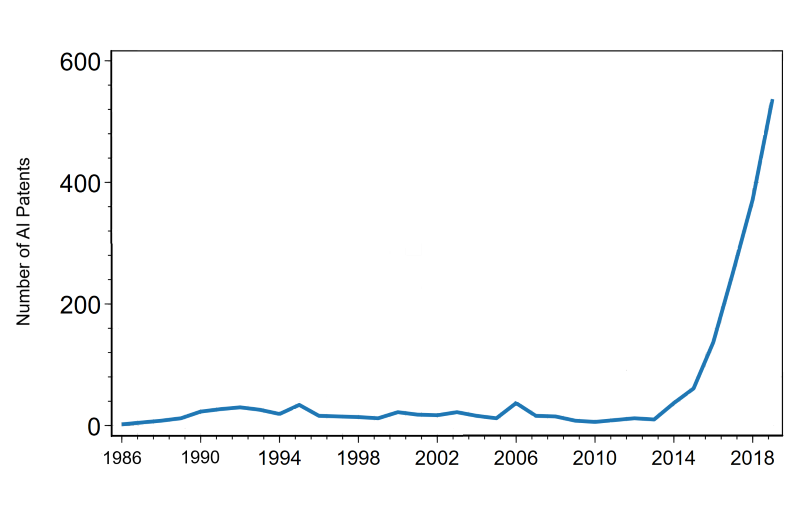
Figure 1 plots the number of AI patent applications to the USPTO over time. Beginning in 2015, AI patent filings boomed, growing roughly tenfold in just four years. This boom is the result of a number of scientific breakthroughs that, together with abundant data from the internet, have expanded the usage of AI programs in several fields.
1. U.S. AI patent applications, 1986–2019
Source: Authors’ calculations based on data from the United States Patent and Trademark Office.
A primary driver of this boom was the convergence of “deep learning” algorithms inspired by the human brain’s neural networks, combined with a fundamental shift in computer hardware. While theoretically powerful, these models were computationally expensive until Raina et al. (2009) demonstrated that graphical processing units (GPUs) could train them far more efficiently than standard central processing units (CPUs).
This efficiency allowed massive artificial neural networks to be trained with more parameters and larger data sets. By leveraging this new architecture, another breakthrough, AlexNet, proved that deep learning could vastly outperform traditional algorithms in critical tasks like image classification (Krizhevsky et al., 2012). These breakthroughs fueled the rapid expansion of AI usage in technologies ranging from facial recognition to autonomous driving.
AI as a prediction technology
Economists Ajay Agrawal, Joshua S. Gans, and Avi Goldfarb argue that the core economic value of these new AI technologies lies in their ability to lower the cost of prediction (Agarwal et al., 2018). Using large amounts of data, these technologies can predict the best price for a product, demand in the future, consumer spending, and even better products. An example of this is Amazon’s patent US10909604B1 (titled “Artificial intelligence system for automated selection and presentation of informational content”). Filed in 2018, this system uses neural networks to analyze complex product details to predict which items a user is most likely to purchase. By suggesting products that customers are more likely to buy, Amazon can likely increase sales.
AI patents are more valuable than other patents
To understand the economic importance of this boom in AI innovation, we calculate the value of a patent using the stock market response to news of the patent publication. If the firm’s stock market value jumps once a patent is accepted by the USPTO, it means that this innovation is perceived as being valuable. Following Kogan et al. (2017), we use the size of this jump to infer the value of the patent.
Figure 2 shows the average value of patent by type. All AI patents are software patents, but not all software patents are AI patents. AI patents are nearly 1.5 times more valuable than their general software counterparts—and more than double the value of non-AI and non-software patents. These results show that the stock market attributes significant value to innovations in AI, even before the advent of generative AI.
2. Average value of patents, by type, 1986–2019
| Type of patent | AI | Software | Non-AI | Non-software |
|---|---|---|---|---|
| Mean patent value | 71.5 | 51.28 | 34.71 | 34.66 |
AI is associated with firm expansion
To understand the association between AI patents and growth, we follow Kogan et al. (2017) and estimate local projection regressions on firm growth.1 The left-hand side variable is a measure of the difference between the variable of interest, , from the beginning time period, , to a future time period, , where is a measure of time (here, years). We estimate local projection regressions of the form:
1) ,
where is an outcome of firm in year . The main outcomes of interest are employment, revenue, capital, and total factor productivity (TFP).2 Note that is the ratio of the value of new AI patents in year at firm to the total value of capital; is a set of controls containing the firm’s log employment and capital stock; is a sector-year fixed effect; and is the error term. In addition, captures the effect of a more valuable AI patent on the growth rate of outcome .
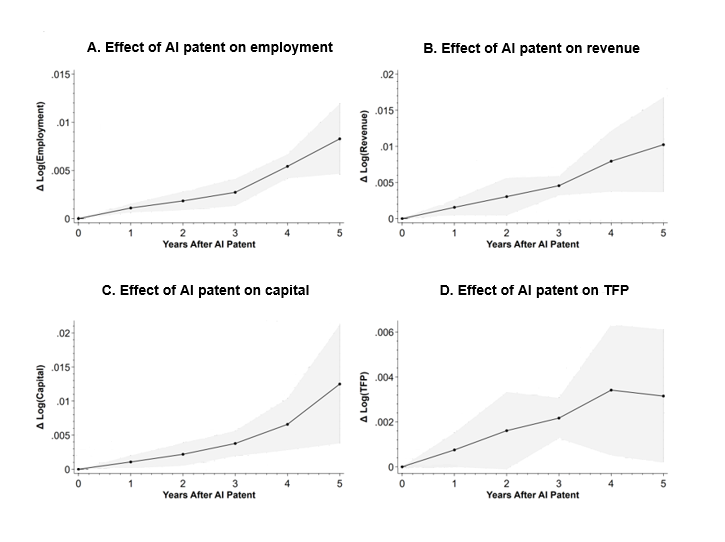
Figure 3 shows the correlation between new AI patents and firm employment, revenue, capital, and TFP growth over the five years following a typical patent application. After an AI patent is filed, a firm’s growth increases significantly and persistently over a five-year horizon. Putting these figures into economic perspective, a one standard deviation increase in the ratio of AI patent value to capital value, equal to a patent worth approximately $270,000 (measured in 2024 U.S. dollars), is associated with a 1.3% increase in capital stock, a 1% increase in revenue, a 0.8% increase in employment, and a 0.3% increase in TFP five years after the patent application.
3. Effects of AI patents on firm outcomes
Sources: Authors’ calculations based on data from Orbis IP & Law and S&P Global Market Intelligence, Compustat.
AI outperforms general software
To understand if the effect of AI is different from that of other innovations, we compare AI’s economic impact against that of other types of innovation in figure 4. We consider four different types of patents: AI patents, software patents, non-AI patents, and non-software patents. Again, all AI patents are software patents, but not all software patents are AI patents. To classify patents in these different groups, we use keywords in the patent titles, following Webb (2020).
4. Comparison of the effects of AI and other types of patents on firm outcomes five years after patent filing
| (1) AI |
(2) Software |
(3) Non-AI |
(4) Non-software |
|
|---|---|---|---|---|
| Employment | 0.83*** (0.18) |
0.11*** (0.034) |
0.0052*** (0.0011) |
0.0053*** (0.0011) |
| Revenue | 1.02*** (0.33) |
0.123** (0.05) |
0. 006*** (0.0014) |
0. 0061*** (0.0014) |
| Firm capital | 1.25*** (0.44) |
0.17*** (0.052) |
0.0076*** (0.0014) |
0.0077*** (0.0014) |
| Total factor productivity | 0.31** (0.15) |
0.02 (0.019) |
0.001018** (0.00045) |
0.00103** (0.00045) |
| Mean patent value (millions of 2024 U.S. dollars) | 71.5 | 51.28 | 34.71 | 34.66 |
Using our model (i.e., equation 1), we plot in figure 4 the effects of different types of patents on employment, revenue, capital, and TFP growth five years after patent filing. To facilitate the interpretation of the results, we transform each coefficient (see note 1) to be interpreted as the percentage increase on a firm outcome five years after filing a patent for an innovation worth $270,000 (in 2024 U.S. dollars), which is the same normalization used in figure 3. A larger coefficient in the first row, for instance, means that this technology is associated with larger employment growth.
As figure 4 shows, five years after filing, the impact of AI patents on a firm’s employment, revenue, and capital is approximately eight times greater than that of standard software patents. The contrast is even sharper when looking at total factor productivity. In contrast, non-AI innovations over this period had weaker correlation with firm growth. These results indicate that AI is associated with more growth than other types of innovations.
Muted AI effect in the aggregate
We also investigate if these firm-level effects are leading to more growth at the sector level. To this end, we aggregate firm outcomes at the four-digit Standard Industrial Classification (SIC) level. As in the prior regressions, we normalize aggregate AI patent value by the stock of capital in the sector.
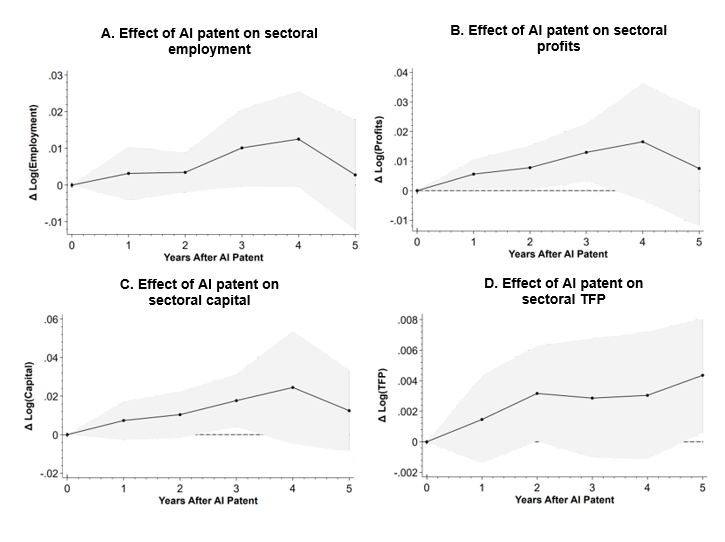
Though the effects of AI patents appear strong at the firm level, those effects are muted at the sectoral level. Figure 5 shows the impacts of AI patents on employment, profits, capital, and TFP, but aggregated at the sectoral level. Five years after an increase in the value of AI patents in a given sector, relative to that sector’s level of capital, no effect remains on employment, profits, and capital. Small positive impacts are seen at the three-year mark for profits and capital, but these results are muted compared with their firm-level revenue and capital. No significant effect on employment is seen at the sectoral level. Although the point estimates are of similar magnitude as in the firm-level analysis, the confidence interval (represented by the gray bands in figure 5) is too large to identify a statistically significant effect.
5. Effects of AI patents on sectoral outcomes
Sources: Authors’ calculations based on data from Orbis IP & Law and S&P Global Market Intelligence, Compustat.
One possible explanation for the phenomenon is the relatively limited share of firms that have patented AI. Bonney et al. (2024) have estimated that as of February 2024, approximately one in 20 firms has adopted AI technology. Though firm-level results are strong, if the number of firms that have patented AI is a small fraction of total firms in a sector, then it is likely that the impacts of AI patenting will not be seen at the sectoral level.
Conclusion
We demonstrate that there has been a boom in AI technology beginning in 2015. AI-related patents are shown to have a positive effect on a number of key measures of firm growth: capital stock, revenue, employment, and TFP. These effects are not only positive and significant; they significantly outpace the effects of all other patents, including non-AI software. Taken in tandem, these facts point to a potential increase in sectoral productivity, as firms become more productive from AI technology. This productivity increase, however, has yet to materialize in the aggregate data, with the effects of an increase in AI patents at the sectoral level being significantly more muted than those at the firm level. One possible explanation for this is that relatively few firms have adopted AI technology. Perhaps, as more firms adopt AI, the firm-level productivity gains will translate to the sectoral level, driving overall TFP growth in the economy.
We thank François Gourio and Bart Hobijn for helpful comments.
Notes
1 Linear regressions are statistical processes that measure the degree of correlation between two variables (a predictor variable and a response variable). The estimated coefficients from these regressions show the degree of correlation.
2 According to the U.S. Bureau of Labor Statistics (BLS), “TFP measures the efficiency of labor, capital, and other countable inputs” of an economy (or a sector, firm, etc.) and “TFP tells us how much can be produced without adding more inputs.”