Surveys summarizing consumer sentiment (or confidence) have a long tradition in economics. In the U.S., the University of Michigan’s Surveys of Consumers and the Conference Board’s Consumer Confidence Survey represent two prominent surveys of this nature, with histories that extend back more than 40 years. In this Chicago Fed Letter, we take a closer look at the link between these traditional measures of consumer sentiment and consumer spending. In doing so, we show how related daily measures of consumer sentiment can be used to correct for potential biases in the University of Michigan’s Index of Consumer Sentiment and construct a composite index—called the Composite Consumer Sentiment Index, or C-CSI—that correlates more closely with consumer spending.
The link between consumer sentiment and spending
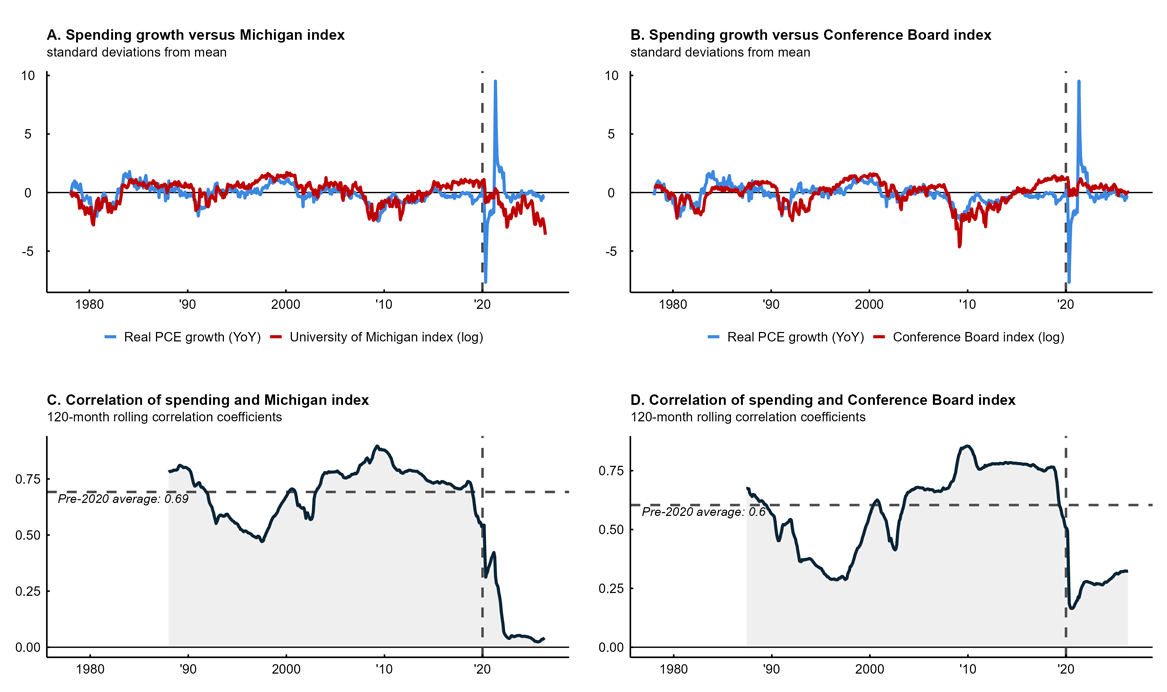
One of the main reasons that economists tend to follow consumer sentiment (or confidence) measures is because historically they have contained useful real-time information for forecasting (or nowcasting) consumer spending. However, in recent years the link between these measures and spending growth has weakened. This can be clearly seen in figure 1, which compares in panels A and B the University of Michigan and Conference Board indexes with annual growth in real personal consumption expenditures (PCE) and reports in panels C and D the 120-month rolling correlation coefficients.1
1. Time-variation in the correlation with consumer spending
Source: Authors’ calculations based on data from Haver Analytics.
Prior to 2020, there was a sizable and stable correlation between annual growth in real PCE and both the University of Michigan Index of Consumer Sentiment (0.69 on average) and Conference Board Consumer Confidence Index (0.6 on average) indexes. Since 2020, the correlation of both indexes with annual real PCE growth has declined sharply. The decline is most pronounced for the Michigan index (a near zero 120-month correlation coefficient currently)—a surprising fact that has attracted a fair amount of attention given its higher correlation historically with consumer spending. That said, even the Conference Board’s index is currently much less correlated with annual real PCE growth than at any point in the past 40 years.
There are important conceptual differences between the University of Michigan and Conference Board indexes that may help explain their differential correlation with annual real PCE growth that we find in figure 1 (specifically in their survey methodology, including the survey questions, topics covered, methods of collection, and populations sampled). Yet figure 1 makes it quite clear that these differences are overshadowed in importance by what appears to be a dominant common factor in explaining the recent decline in the correlation between consumer sentiment and spending: the onset of the recession that accompanied the Covid-19 pandemic.
That said, the deterioration of the relationship between consumer spending and sentiment is not solely confined to the pandemic recession and has instead persisted for much longer to varying degrees depending on the index (see figure 2 and its discussion to come). In fact, a careful review of the panels of figure 1 shows that this correlation was actually already on the decline prior to 2020. Our aim in this article is to restore as much as possible the strength of the historical relationship between the University of Michigan Index of Consumer Sentiment and annual real PCE growth using more-recently developed and higher-frequency measures of consumer sentiment and confidence as well as the Conference Board’s Consumer Confidence Index.
Much has been written about why the link between the University of Michigan Index of Consumer Sentiment and consumer spending has weakened over time. Most explanations fall into two categories.
- Survey methodology. For many years, the University of Michigan conducted its Surveys of Consumers (on which its consumer sentiment index is based) as a phone-based survey. Beginning in April 2024, however, the survey transitioned to become completely web-based. The transition allowed for the sample size to be substantially increased, but it also introduced a noticeable decline in the level of optimism for the average respondent (Cummings and Tedeschi, 2024). The Conference Board’s Consumer Confidence Survey also underwent a similar change a couple of years prior, transitioning to an online survey.2 Yet, unlike what happened with the Michigan index after its underlying survey transitioned to an online platform, the effect of a comparable transition on the Conference Board index was found to be fairly small.
- Vibes. The other explanation for the disconnect between consumer sentiment and spending centers around the post-pandemic period itself. Based on its historical correlation with many measures of economic performance, consumer sentiment should be stronger than the current Michigan index level suggests (Brave and Herbstman, 2023).3 This gap between sentiment and other economic indicators is what commentators have referred to as the “vibes” story.4 People are feeling downbeat about the economy, but it’s not as evident in the hard data. It can also be seen in the comparison of the Conference Board and Michigan indexes in figure 1: The Conference Board index was much less pessimistic throughout the past ten or so years than the Michigan index.
To address these and other measurement concerns, we propose that an adjustment be made to the University of Michigan’s Index of Consumer Sentiment that corrects for these potential biases using the Conference Board index and other daily measures of sentiment. Our proposal is similar in nature to that explored in Cummings and Tedeschi (2024), but it relies on a broader set of sentiment measures and explicitly takes into account the differential timings of the surveys used for these measures. In doing so, we construct a new daily index of consumer sentiment that is more reflective of recent movements in consumer spending than the Michigan and Conference Board indexes.
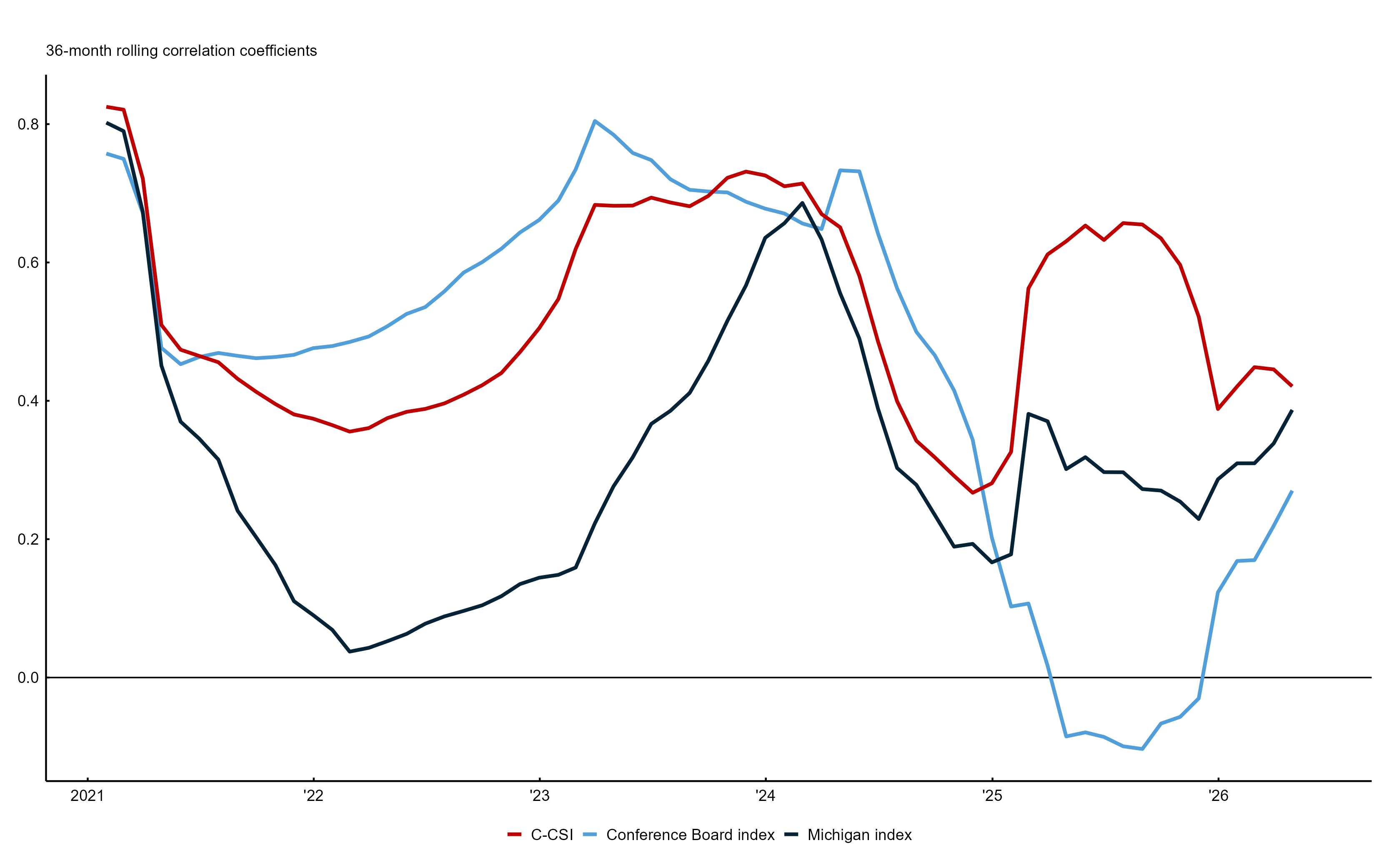
Before introducing this new index that we call the Composite Consumer Sentiment Index, we first preview our results by repeating our rolling correlation coefficients between annual real PCE growth and both the Conference Board and University of Michigan indexes over a shorter 36-month period in order to better highlight the post-2020 era. Figure 2 shows that the C-CSI has a consistently higher correlation with annual real PCE growth since 2018 than the Michigan index and is comparable to the Conference Board index, with a substantially higher correlation with consumer spending over the past year or so.
2. The correlation of the C-CSI versus other indexes of consumer sentiment with consumer spending
Sources: Authors’ calculations based on data from Haver Analytics, Rasmussen Reports, Morning Consult, Goldman Sachs, and the Federal Reserve Bank of San Francisco.
Constructing the C-CSI
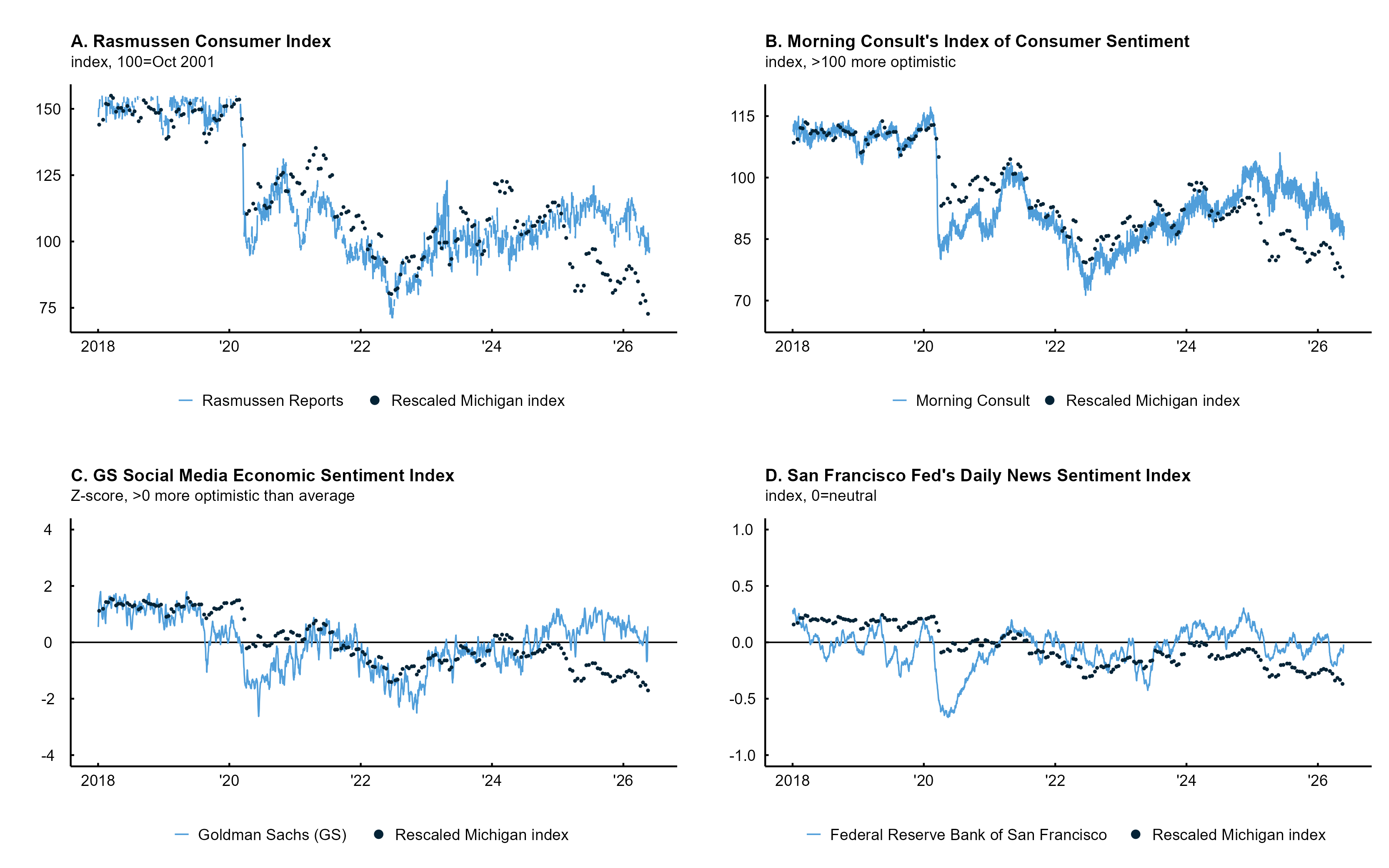
To construct the C-CSI, we estimate a mixed-frequency vector autoregression (MF-VAR)5 that allows for measurement error in the preliminary and final readings of the monthly University of Michigan Index of Consumer Sentiment and also includes the Conference Board’s Consumer Confidence Index along with daily readings of four alternative sentiment measures shown in figure 3.6 Each of these daily sentiment measures is highly correlated with the Michigan index. However, their post-2020 movements vary significantly from it in similar ways, with a clear break in the post-2020 period that points to the Michigan index being much lower currently than what historical correlations would suggest.
3. Comparing daily sentiment indexes with the University of Michigan Index of Consumer Sentiment
Sources: Authors’ calculations based on data from Haver Analytics, Rasmussen Reports, Morning Consult, Goldman Sachs, and the Federal Reserve Bank of San Francisco.
We use this breakdown in the correlation of the Michigan index with its daily and monthly counterparts in our MF-VAR to estimate its potential measurement error by allowing for a time-varying intercept (or conditional mean) in the equation for the Michigan index. We do not specify a particular timing for when (or if) this measurement error exists, but instead estimate its degree over a sample period that extends from January 2018 to the present and distinguish it from the cyclical dynamics of the VAR portion of our model by requiring it to be both idiosyncratic to the Michigan index and highly persistent.7 Further details on the MF-VAR can be found in appendix 1.
The MF-VAR links averages of the daily sentiment measures constructed over the preliminary and final release survey windows for the University of Michigan’s Surveys of Consumers and the Conference Board’s Consumer Confidence Survey to their respective consumer sentiment index values. Doing so has the added benefit of correcting for the timing of the Michigan survey, which, unlike the timing of the Conference Board’s survey, often has survey windows that overlap months (e.g., survey responses collected in April will appear in both the April and May Michigan index values). The C-CSI itself represents a daily estimate of the Michigan index from our MF-VAR after subtracting off the Michigan index’s estimated daily measurement error and correcting for its irregular survey timing.
The four daily sentiment measures in our MF-VAR were chosen to reflect the known biases (from changes in survey methodology or the topics covered) in the Michigan index since 2020 discussed previously. For instance, both Morning Consult’s Index of Consumer Sentiment and the Rasmussen Consumer Index are constructed from large, nationally representative surveys using consistent methodologies over the period shown in figure 3.8 The Morning Consult survey has the added distinction of posing the same questions that are used to construct the Michigan index.9 Thus, one would not expect either the Morning Consult or Rasmussen surveys to be affected by the break in survey methodology for the Michigan index in early 2024—a feature that is very apparent in panels A and B of figure 3 given the divergence we see that year once the Michigan survey became web-based.
Similarly, the Federal Reserve Bank of San Francisco’s Daily News Sentiment Index and the Goldman Sachs (GS) Social Media Economic Sentiment Index also employ a consistent methodology over the time period shown in figure 3. Their inclusion in our model, however, has more to do with capturing the broader vibes story discussed previously. Here, we aim to identify differences in the correlation of the Michigan index with the prevailing tone of traditional news and social media. Insofar as media sentiment also reflects the sentiment of U.S. consumers, one would expect to see a consistent correlation over time. Figure 3, however, suggests otherwise in relation to the Michigan index, particularly starting in 2024. In contrast, both the GS and San Francisco Fed measures correlate more closely with the Conference Board index over this period.
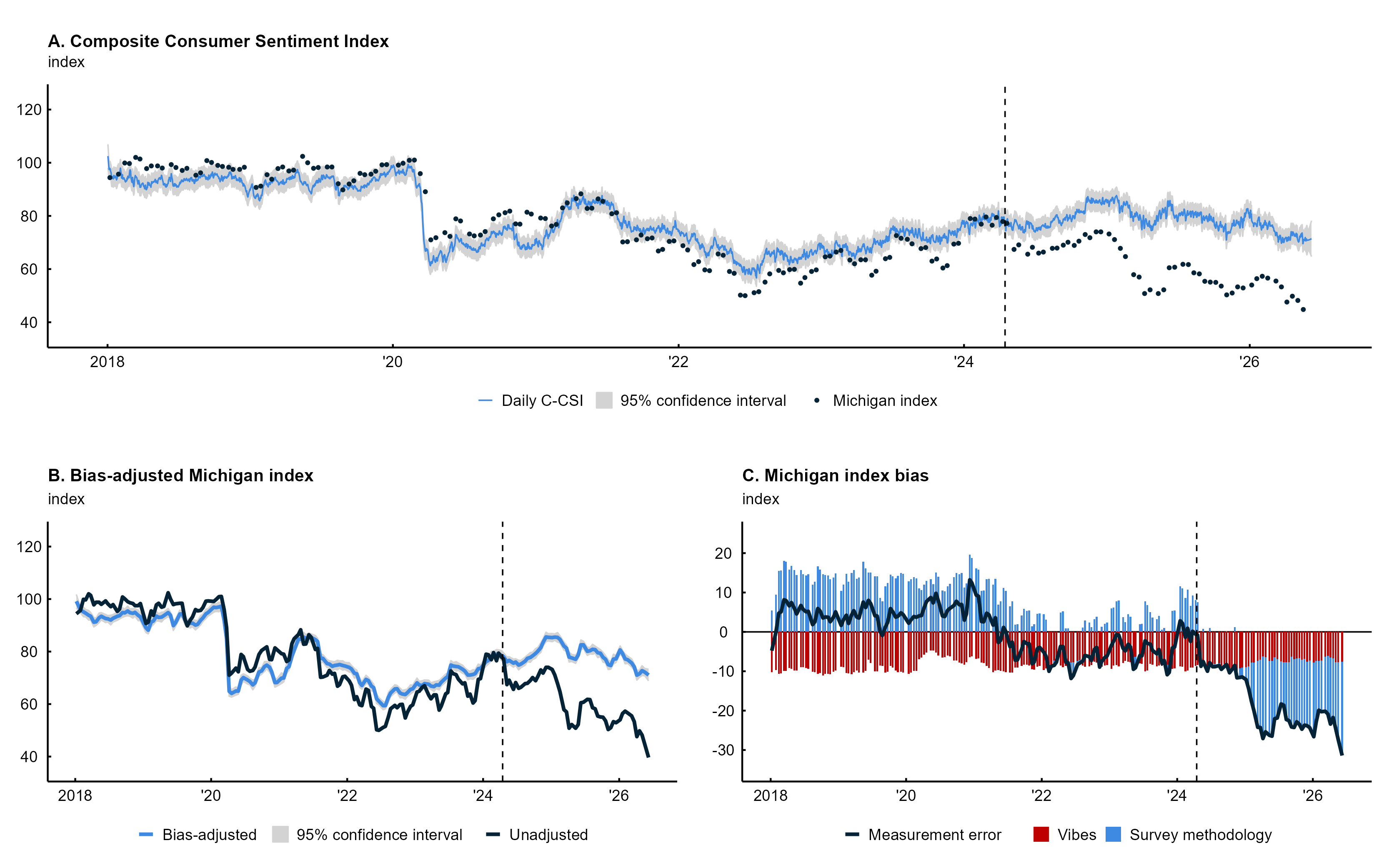
Figure 4’s panel A shows the full time series of the daily C-CSI (blue line) as well as a 95% confidence interval for those values (gray shaded regions) and the corresponding preliminary and final releases for the Michigan index (black markers). The MF-VAR can also be used to create a bias-adjusted reading for the Michigan index (represented by the monthly average of the C-CSI over the same survey windows used to construct the Michigan index). Panel B demonstrates this translation into an equivalent bias-adjusted value of the Michigan index (blue line), shows its 95% confidence interval (gray shaded regions), and compares it with the preliminary and final release values of the (unadjusted) Michigan index (black line). Panel C then isolates the measurement error (black line) that we estimate for each release of the Michigan index.
4. The C-CSI and sources of measurement error in the Michigan index
Sources: Authors’ calculations based on data from Haver Analytics, Rasmussen Reports, Morning Consult, Goldman Sachs, and the Federal Reserve Bank of San Francisco.
Despite our MF-VAR containing no direct information on the date of the methodological break in the Michigan index, it quite clearly picks it up in early 2024 from its underlying data sources. The C-CSI’s units are the same as the Michigan index’s, such that the C-CSI’s current reading suggests that recent Michigan index values are underestimated by 25–30 index points (see panels B and C of figure 4). While our estimates of the measurement error immediately after the online transition of the University of Michigan’s Surveys of Consumers are similar in magnitude to what others have found (i.e., about 10 index points), we find that it has grown substantially since then.
Interestingly, our MF-VAR methodology shows that measurement concerns with the Michigan index have existed for some time. Before April 2024, we can very often statistically reject with our model that the measurement error magnitudes are different from zero at the 95% confidence level. That said, before 2024, they were roughly zero on average. It has only been since early 2024 and the transition of the Surveys of Consumers to an online platform that our estimated measurement errors have grown consistently more negative. Indeed, they were nearly zero for several months prior to the online transition of the Michigan survey.
The magnitude and rapid growth of the measurement error that we currently estimate for the Michigan index raise important questions for consumer sentiment surveys more generally. It seems unlikely that the method of survey collection or the survey questions on their own are primarily to blame here: Nearly all of the other sentiment indicators in our MF-VAR also employ online survey collection methods, and the Morning Consult index (whose survey asks the same questions as the Michigan survey) ends up being the predominant indicator in the construction of the C-CSI.10 Our results instead suggest a more complex explanation—and, given how we identify the measurement error in the Michigan index, one that must be idiosyncratic to the Michigan index itself.
We can further break down our estimated measurement error in the Michigan index into its underlying sources to help us examine this question further. We do so in panel C of figure 4 by separately grouping together the contributions to the measurement error in our MF-VAR (the colored bars in panel C) from the Michigan, Morning Consult, and Rasmussen Reports indexes (blue bars) and the Conference Board, Goldman Sachs, and San Francisco Fed indexes (red bars). Grouping the contributions in this way is motivated by our earlier survey methodology versus vibes discussion, with the contributions labeled as such in the figure.
The decomposition in panel C of figure 4 illustrates that the “vibes” story is not a new explanation for the divergence of the Michigan index from the other sentiment measures, with a negative contribution that consistently varies between 5 and 10 index points. This result can be read as perhaps stemming from differences in topics covered by the surveys. It is well known that the Conference Board’s survey puts more emphasis on labor market developments than the Michigan survey; and aside from the 2020 recession, labor market developments during our sample period have been mostly positive. This result also aligns with Brave and Herbstman (2023) and their finding that the Michigan index has not reacted to labor market strength to the same degree post-2020.
At this point, though, it is worth reemphasizing that before 2024 the overall measurement error that we estimate for the Michigan index was roughly zero on average. So, whatever negative bias that may have existed on account of differences in topics covered by the surveys was on average offset by a corresponding positive bias during this time. It seems from our estimates that this positive bias stemmed from the method of survey collection based on the consistently positive contributions to the measurement error from the survey methodology indicators prior to 2024. However, something shifted in 2024, and our MF-VAR adds nuance to this story, showing how methodological concerns started out as an offsetting source of upward bias (0–15 index points) prior to the online transition of the University of Michigan’s Surveys of Consumers and then increasingly became an additional source of downward bias thereafter (0–20 index points).
We read the time variation in the estimated measurement error for the Michigan index from our MF-VAR as suggestive of an interaction effect between the method of survey collection and the topics covered. It may be that after its online transition the Michigan survey ended up with a suboptimal mix of these factors for measuring consumer sentiment consistently over time. Our MF-VAR cannot be used, however, to address this question on its own. Instead, we next take a closer look at the implications of the C-CSI and the Michigan index for forecasting consumer spending growth.
Implications for consumer spending
It is important to note when using the C-CSI or other sentiment indexes that surveys of consumer sentiment do not take place in the proverbial vacuum of a physics experiment. Responses are just as likely to be driven by prevailing economic and financial conditions as they are to potentially drive them. This is a well-known fact in the literature on consumer sentiment—with several authors noting that after controlling for other forward-looking measures, consumer sentiment adds little value to forecasts for future consumer spending (e.g., Ludvigson, 2004).
That said, sentiment measures are still among the timeliest indicators available to economists for forecasting consumer spending in real time. To put the magnitude of our model’s estimated measurement error in the Michigan index in economic terms, we found it useful to ground our results in the literature on forecasting consumer spending with consumer sentiment—e.g., Mustre-del-Río and Nichols (2025) and French et al. (2013)—by forecasting annual (12-month) real PCE growth six months ahead.
Full details on how our forecasts were constructed are in appendix 2; but, to summarize, we run Bayesian linear regressions11 of annual growth in six-months-ahead real PCE on the following predictors: 1) lagged annual real PCE growth, 2) lagged annual real disposable personal income growth, 3) current annual Standard & Poor’s (S&P) 500 growth and ten-year U.S. Treasury bond yields, and 4) either the log of the current monthly Michigan index or the C-CSI. Our regressions cover the period from January 1978 through March 2026, where to extend the history of the C-CSI to match the Michigan index, we assume no measurement error existed in the Michigan index prior to January 2018 and replace it with the C-CSI values thereafter.
The difference in our current forecasts for six-months-ahead annual real PCE growth using the Michigan index versus the C-CSI is not trivial. Using the Michigan index, we forecast annual real PCE growth in October 2026 (i.e., six months ahead from the latest available data for April 2026) of 1.3%, versus 2.0% with a model using the C-CSI. This latter number is comparable to the 12-month growth rate for real PCE through April 2026 of 2.1%. So, while both measures of consumer sentiment imply weaker spending growth over the next six months, the predicted slowdown is more substantial when one relies on the Michigan index.
Our results, thus, raise a natural question: Should we trust the C-CSI more than the Michigan index when forecasting future consumer spending? That’s a difficult question to fully answer given the short history of the C-CSI, but we made an attempt by running a real-time out-of-sample forecast exercise on vintage (or unrevised) data for our Bayesian linear regressions with the history of the C-CSI values used in place of the Michigan index from January 2018 onward and comparing our forecasts to a benchmark model that does not include consumer sentiment but still includes the other indicators we listed earlier when describing our current forecasts.
Figure 5 contains the results of our exercise. It reports 12-month rolling mean absolute forecast errors (MAEs) since April 2022 for models with the Michigan index and C-CSI relative to a benchmark model excluding those consumer sentiment indicators. Overall, both sentiment measures have had inconsistent forecasting power, at best, over the last few years. While the C-CSI model has generally outperformed the Michigan model, both have struggled to keep up with a benchmark model that does not include consumer sentiment. Still, both lines in figure 5 have been trending up over time, meaning that the performance gap relative to the benchmark has been narrowing—with the C-CSI model even outperforming the benchmark since late 2025. Whether this is a sign of sustained performance gains or something more temporary remains to be seen.
5. Forecast model performance relative to a no-sentiment benchmark
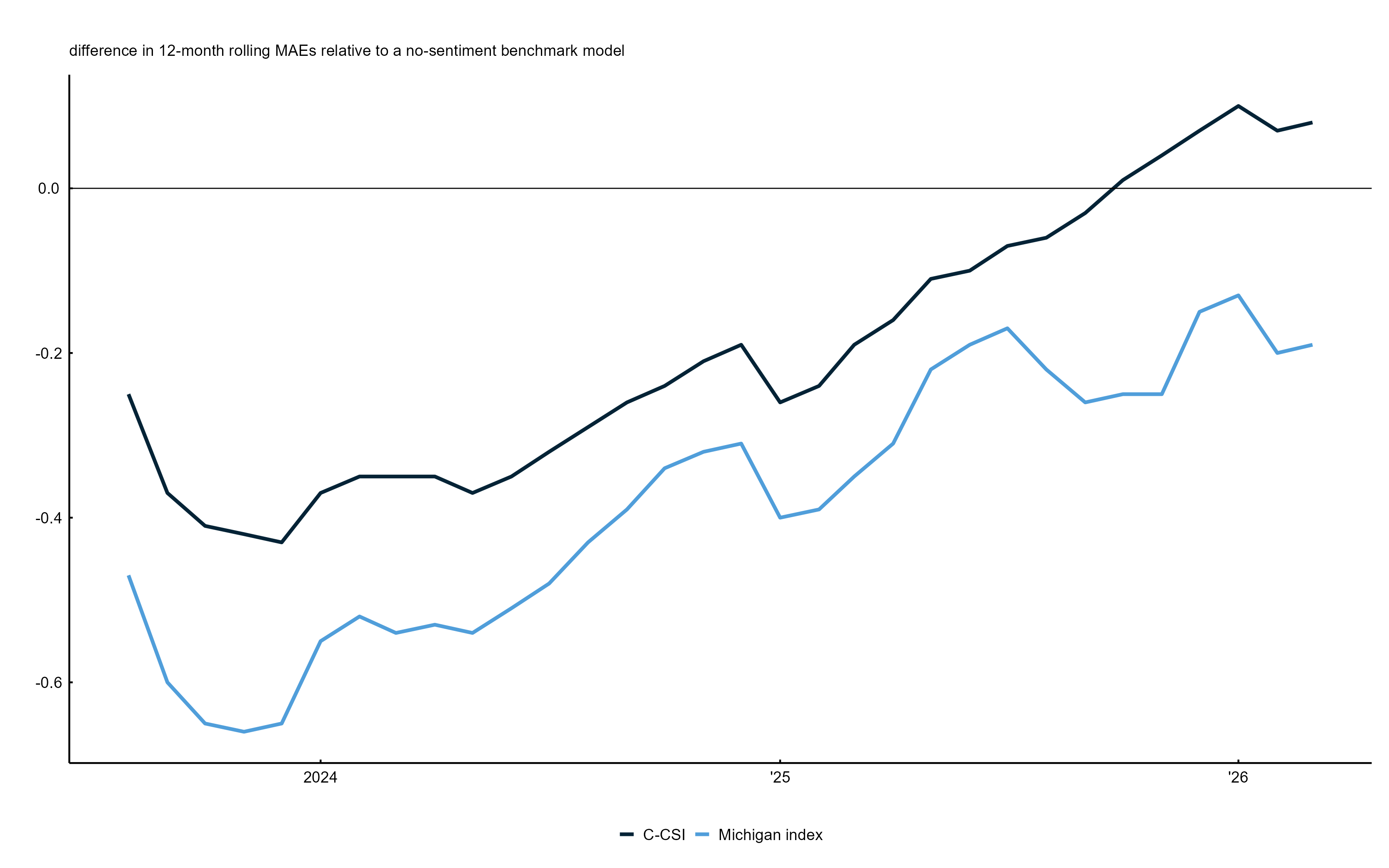
Sources: Authors’ calculations based on data from Haver Analytics, Rasmussen Reports, Morning Consult, Goldman Sachs, and the Federal Reserve Bank of San Francisco.
Conclusion
We constructed the Composite Consumer Sentiment Index—a composite index that eliminates the bias in the University of Michigan’s Index of Consumer Sentiment arising from the irregular timing and changes over time in methodology in its underlying survey. The C-CSI uses related daily measures of consumer sentiment along with the monthly consumer confidence index from the Conference Board. It also correlates more strongly with one-year-ahead annual PCE growth than traditional consumer sentiment measures and can be used to more accurately predict future consumer spending, although caution should be exercised when doing so given the inconsistency of the recent forecasting performance of consumer sentiment measures more generally for consumer spending.
Notes
1 A correlation coefficient measures the degree of association between two variables and is bounded between 0 (no association) and 1 (perfect association).
2 The Consumer Confidence Survey underlying the Conference Board index was converted from a mail-in survey to an online one run by the market research firm Toluna in May 2021.
3 Brave and Herbstman (2023) found that most of the “vibes” gap for the Michigan index could be explained statistically by a structural break in the average level of optimism post-2020, a reduced sensitivity to the movements in the unemployment rate, and a heightened sensitivity to real disposable personal income growth. For the Conference Board index, the results were similar, absent a structural break in the average level of confidence post-2020. See figure 2 in Brave and Herbstman (2023) for further details.
4 The structural break in the Michigan index in 2020 aligns well with the timing of the break in self-reported happiness in the General Social Survey noted in Pelzman (2025). Alternatively, Bernstein and Posthumus (2026) have suggested that the break instead reflects the rise of affordability concerns in the Michigan survey as key prices have grown faster than earnings during this time period.
5 Mixed-frequency refers to analyzing data that have been recorded at different time intervals. Vector autoregressions are statistical models that use historical relationships to make informed inferences about future events.
6 The MF-VAR has a daily base frequency and is estimated in MATLAB using the MFSS (mixed-frequency state-space) toolbox described in Brave et al. (2022).
7 By persistent, we mean that we require the measurement error in the Michigan index to follow a nonstationary (or non-mean-reverting) random-walk process, whereas the VAR is constrained to be a stationary (or mean-reverting) process.
8 Both of the Morning Consult and Rasmussen Reports indexes are used in the construction of real-time measures of economic activity. The Morning Consult index is an input to the Chicago Fed Advance Retail Trade Summary (CARTS), while the Rasmussen Reports index is an input to the Dallas Fed Weekly Economic Index (WEI).
9 Cummings and Tedeschi (2024) focus on the Morning Consult index to make an adjustment to the Michigan index that is similar in spirit to ours. They find that the Michigan index was understated by about 9 index points shortly after the transition to an online survey.
10 A variance decomposition of the daily C-CSI into contributions from the underlying indicators in our MF-VAR breaks down as follows (the percentages may not sum to 100% because of rounding): University of Michigan, 2.3%; Morning Consult, 93%; Rasmussen Reports, 1.9%; Goldman Sachs, 0.3%; San Francisco Fed, 0.7%; and Conference Board, 1.3%.
11 A linear regression assumes that a relationship of the form Y = Xb + e exists between a dependent variable Y and independent variables X. The regression coefficient (b) captures how Y may be expected to change given a change in X, with e capturing residual variation in Y unexplained by X. Bayesian linear regression methods in a forecasting context aim to minimize the likelihood of overfitting the estimation of b to existing data by penalizing imprecisely estimated statistical relationships between variables using prior (or external) information.