


The Federal Reserve has been engaged in discussions to “examine the costs, benefits, and institutional implications of the Federal Reserve's current balance sheet regime.”1 Several policymakers and market participants have weighed in on this topic over the last year, and many have analyzed whether and how to reduce the size of the Federal Reserve’s balance sheet. Central counterparty deposits (CCP deposits) are a small but not insignificant Federal Reserve liability that has hovered above $200 billion since about mid-2025.2 In this article, we discuss the costs and benefits of reducing the size of CCP deposits.
As operators of systemically important clearing systems, CCPs assign a particularly high value to the unique safety and liquidity characteristics of Fed deposit balances in managing their liquidity risk. Still, their demand for deposits at the Federal Reserve (known as master account balances3) is influenced by a number of key factors, such as the remuneration rate, limitations on account size, and availability of alternative liquidity tools. Consequently, adjusting these factors could encourage CCPs to reduce their master account balances and replace them with deposits at commercial banks. Although doing so might potentially lead to a smaller Fed balance sheet, it could also create financial stability implications that bear consideration, such as wrong-way risk, which is discussed in more detail later.
Lower steady-state CCP deposit balances may also somewhat increase the risks to effective monetary policy implementation. Smaller steady-state CCP deposits could mean that if CCPs’ clearing members or clients of the clearing members seek safety and liquidity of central bank deposits in times of stress, then this could generate large and sudden inflows of cash into CCP deposits. These inflows, in turn, would result in an equally large drain in the level of banking system reserves that could put upward pressure on short-term market interest rates.4
Background
Several recent papers have discussed approaches that the Fed could take to reduce the size of its balance sheet. Anderson et al. (2026) estimated the potential for reducing demand for Fed reserves by implementing a range of specific regulatory and monetary policy changes. Duffie (2026) considered a smaller range of options, with a focus on how changes in the structure of the payments system could encourage a decline in steady-state bank demand for reserve balances. Logan and Schulhofer-Wohl (2026) presented options for reducing each individual line item on the balance sheet. Among other topics, their article included an assessment of deposits of designated financial market utilities (DFMUs), the bulk of which are CCP deposits. The authors argued that allowing DFMUs to monetize holdings of U.S. Treasury securities with the Fed, for instance, by giving them routine access to the New York Fed’s standing repurchase agreement (SRP) operations5 would reduce their need to hold cash balances at the Fed or at commercial banks.
CCP deposits on the Fed’s balance sheet
DFMU deposit balances, which include CCP deposits, can be difficult to find on the Fed’s balance sheet. They fall under the category called deposits with F.R. Banks, other than reserve balances—which are among the Federal Reserve’s liabilities, as reported in the H.4.1 weekly report. More precise information is available through quarterly disclosures made by CCPs, called public quantitative disclosures, or PQDs. When we match these weekly Fed data to these quarterly CCP disclosures, we find that that CCP deposits typically make up 80% to 90% of this Fed liability.
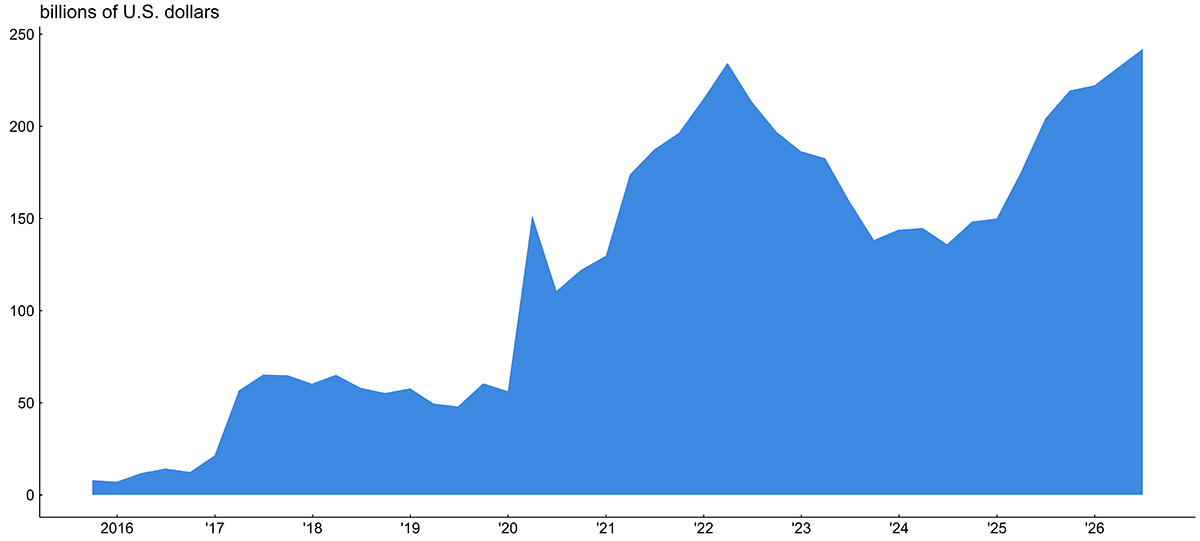
Figure 1 shows total CCP cash deposits at the Fed based on these firms’ quarterly disclosure data. Relative to bank reserves, CCP deposits do not make up a substantial part of the Fed’s balance sheet. However, CCP deposits have been consistently growing for some time. These balances have recently hovered around their highest levels on record at around $250 billion as of 2026:Q2.6
1. Total central counterparty (CCP) cash deposits at the Federal Reserve, 2015:Q3–2026:Q2
Source: Authors’ calculations based on data from Clarus Financial Technology, CCPView.
There is a direct relationship between CCP deposits at the Fed and banking system reserve balances. As with any other nonreserve liability, if there is no change in total balance sheet assets, then when CCP deposit balances change, there is a one-for-one inverse change in reserves held by banks. For example, when a CCP clearing member removes cash from their bank account and uses it to post margin at a CCP, the increase in CCP deposits is exactly offset by an equal decline in reserves.7 Figure 2 illustrates this with a simplified balance sheet of Fed assets and liabilities. The opposite is also true: All else being equal, a level shift down in CCP deposits will increase reserves.
2. Changes in the Federal Reserve balance sheet when CCP deposits increase
| Assets | Δ | Liabilities | Δ |
|---|---|---|---|
| U.S. Treasury securities | Currency | ||
| Agency MBS | Nonreserve liabilities (including CCP deposits) | ↑ | |
| Standing repo operations | Reserves | ↓ | |
| Discount window | Equity and capital |
The Fed operates in an ample reserves regime, meaning that the banking system has a cushion of reserves, allowing it to withstand fluctuations in reserve levels without an impact on market rates. A sustained decline in CCP deposits would lead to a permanent increase in the level of reserves, raising the existing reserve cushion at the current balance sheet size.8 This additional cushion of reserves would give the Fed capacity to reduce its assets over time to shrink its balance sheet size while still maintaining an ample reserves regime.
Why U.S. CCPs maintain cash deposits at the Federal Reserve
Title VIII of the Dodd–Frank Act authorizes the Federal Reserve to allow DFMUs to maintain accounts with Federal Reserve Banks. Six of the eight DFMUs are CCPs, and each has deposit accounts with a Federal Reserve Bank. This practice by CCPs is consistent with recommended international standards and supported by regulators in most major industrialized economies as a means of prudent liquidity risk management of systemically important financial institutions.9 Title VIII also authorizes the Fed to pay interest on deposits held in DFMU accounts, at the same rate as that for depository institutions or “another rate determined by the Board from time to time, not to exceed the general level of short-term interest rates.”10
As described in a previous Chicago Fed Letter, there are multiple drivers of the level of CCP deposits at the Fed: open interest of transaction volumes submitted for clearing;11 margin requirements of each CCP; and margin and default fund allocation preferences of the CCPs, their clearing members, and clients of the clearing members. Updates to rules from the CCP and the policies that govern CCP activities can impact the level of CCP deposits at the Fed and also affect reserve levels. We discuss some examples in the following paragraphs.
On transaction volumes, the pending full implementation of the Securities and Exchange Commission’s U.S. Treasury clearing mandate, starting at the end of 2026, will likely lead to a higher level of transaction volume that will be centrally cleared. The incumbent CCP in this space, the Fixed Income Clearing Corporation, has already experienced a notable increase in cleared transaction volume ahead of the mandate implementation deadline. An increase in margin posted by clearing members associated with this shift should result in a decline in bank deposits, all else being equal.
Regarding margin requirements, starting April 1, 2025, the CME (Chicago Mercantile Exchange) Group’s CCP—CME Clearing—implemented a “soft” cash minimum requirement of 30% for all initial margin, with clearing members facing a fee if their cash holdings with CME Clearing do not meet the minimum. This resulted in a discrete increase in CME Clearing’s holdings of cash collateral with the Fed. Of note, the “other” deposits on the Fed’s balance sheet increased by about $20 billion around this time.
The Fed’s remuneration rate policy for CCP deposits has not changed in several years. However, market rates can change the relative attractiveness of CCP deposits at the Fed. Although based on limited data, the Chicago Fed Letter mentioned before showed that margin allocation preferences seem to exhibit some level of sensitivity to market interest rates relative to the Fed’s remuneration rate. For example, that article showed that as rates of return for other assets exceed rates of return on cash held at the Fed, those placing cash with the CCP, either clearing members or their clients, tend to increase their margin allocation to noncash assets. This reduces the amount of cash CCPs ultimately place in their deposit accounts at the Fed.
Options for reducing the size of CCP deposit balances
We focus on three approaches that the Fed could take to reduce the size of CCP deposit balances: 1) reduce the remuneration rate, 2) cap account balance levels, and 3) provide access to contingent liquidity tools to reduce demand for CCP deposits. We walk through each option in the following subsections.
Option 1: Reduce the remuneration rate
Reducing the remuneration rate for CCP deposits might encourage clearing members and their clients to reallocate at least some of these funds elsewhere. However, the magnitude of that reallocation would likely depend on the new remuneration rate. A remuneration rate of 0% could encourage the lowest level of CCP deposits; even at this rate, firms may prefer to hold some precautionary funds with the Fed given their safety and liquidity. If the CCP deposit rate were set below the Federal Reserve’s interest on reserve balances (IORB) rate but above zero, the attractiveness of CCP deposits at the Fed would likely depend on the rates offered by other common short-term investments, such as commercial bank deposits, money market mutual fund shares, reverse repurchase agreements (reverse repos), and U.S. Treasury securities.
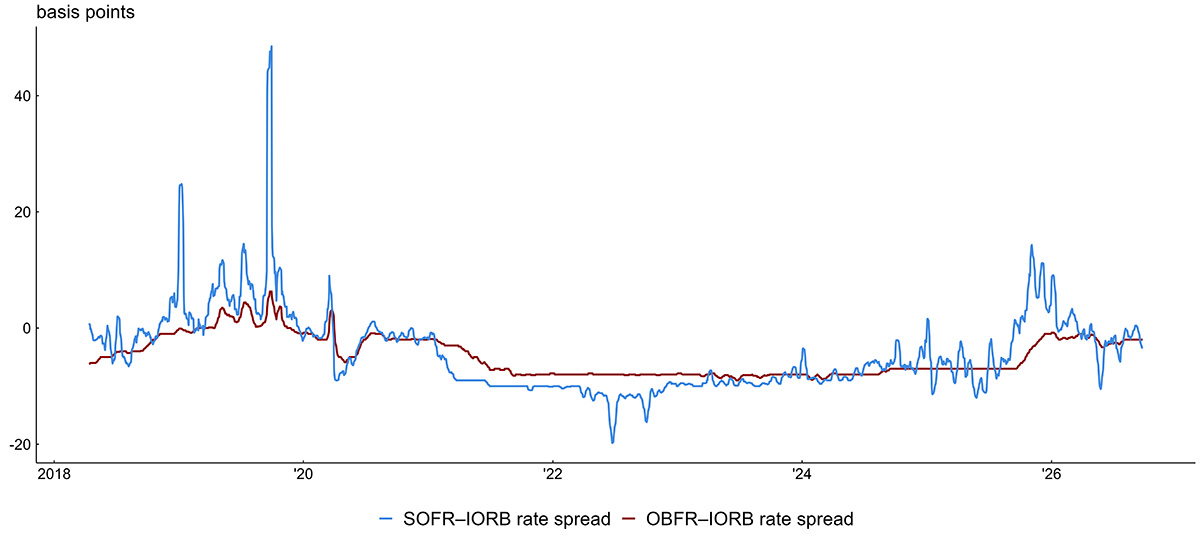
Figure 3 shows that the spreads between IORB and key money-market-equivalent rates vary over time. The Secured Overnight Financial Rate (SOFR) is a measure of U.S. overnight repurchase agreement rates, and the overnight bank funding rate (OBFR) is a measure of unsecured overnight lending to U.S. banks. When SOFR–IORB and OBFR–IORB rate spreads are positive, CCPs that allocate cash margin for clearing members and their clients will likely have a stronger incentive to invest in these types of short-term market investments (reverse repos and commercial bank deposits) rather than leave cash at the Fed.
3. Money market rates relative to the IORB rate, April 2018–September 2026
Sources: Authors’ calculations based on data from the Board of Governors of the Federal Reserve System and the Federal Reserve Bank of New York.
CCP remuneration rate policies at other central banks vary. A survey of 30 CCPs by CCP Global in 2025 indicated that central banks do not appear to use a uniform approach to CCP deposits. It is common practice for central banks to offer these types of entities deposit accounts with some form of interest. Among the central banks surveyed, the remuneration rates tend to be either the same as those paid on bank reserves or a less favorable rate. For example, the European Central Bank (ECB) updated its CCP remuneration rate policy in April 2024 from paying the deposit facility rate, or the rate paid to banks, to the euro short-term rate (€STR), a rate based on overnight unsecured interbank lending. This market-based rate is typically lower than the deposit facility rate.
Option 2: Cap account balance levels
In addition to authorizing DFMU accounts and the payment of interest on their balances, Title VIII of the Dodd–Frank Act also authorizes the Board of Governors of the Federal Reserve System to impose any “limitations, restrictions, or other requirements” on these accounts. One such limitation could be to cap the amount of cash allowed to be held in the accounts. A similar option, used by other central banks, could be to target a certain average balance for each DFMU and either pay a lower rate (or charge a penalty) to the CCP if balances deviated from that level.12 Taking either approach would ensure that CCP deposits remain stable and that CCPs have an incentive to find alternative investments for a portion of their cash balances.
The Bank of England (BoE) utilizes balance caps alongside its remuneration rate policy to manage CCP deposits and limit their impact on reserve levels. The BoE agrees on a certain average level of deposit balances with each account-holding CCP for a given four-week period, paying the BoE Bank Rate on the balances at that level while charging a fee on balances that fall above or below that agreed-upon level.13 This compels the CCPs to invest any excess funds either in the banking system or in reverse repos, both of which redistribute those balances into bank reserves and lower the risk of sudden swings in reserve levels.
Option 3: Provide access to contingent liquidity tools
A third option, suggested by Logan and Schulhofer-Wohl (2026), would be to grant certain CCPs access to the New York Fed’s SRP operations. Routine access to this source of Fed liquidity could allow CCP clearing members and their clients to lower the amount of cash balances they currently hold for precautionary reasons. Instead, CCPs could allow clearing members and their clients to pledge a higher percentage of their margin collateral with U.S. Treasury securities and agency mortgage-backed securities (both eligible collateral for SRP operations) and liquidate that collateral in times of stress. To further improve the impact of this option, the New York Fed could increase the number of times each day that it offers liquidity through SRP operations to make it easier for CCPs to maintain their daily payment deadline schedules.
Financial stability considerations regarding lower CCP deposits
Policies to encourage a decline in CCP deposits at the Fed involve financial stability trade-offs. In fact, there may be potential benefits to financial stability from eligible CCPs holding higher steady-state cash balances in their Fed accounts. International best practices explicitly state that financial market infrastructures, including CCPs, should “conduct … money settlements in central bank money where practical and available, to avoid credit and liquidity risks.”14 As the standard-setting bodies that put forth these best practices argue, commercial bank money gives rise to credit and liquidity risks that are not present with the use of central bank money. A decline in CCP deposits may increase wrong-way risk for individual CCPs, which can become systemic during times of heightened market stress.
Wrong-way risk
Wrong-way risk is the risk that arises when a firm’s counterparty credit exposure increases at the same time that the counterparty’s credit quality deteriorates. Several sources of wrong-way risk could arise if CCPs were to hold lower levels of central bank deposits and higher levels of commercial bank deposits, reverse repos, or securities collateral.
- Commercial bank deposits. Since CCP cash balances tend to be large, CCPs would likely seek to hold their deposits with larger banking institutions. These banks are also most likely to be clearing members at those CCPs. This creates the potential for wrong-way risk, in which a clearing member facing stress at a given CCP is part of the same entity in which that CCP is depositing cash balances, placing further stress on the CCP. As noted by McPartland (2017), banks that would likely accept cash from CCPs are also likely to be large clearing members, amplifying the risk that the CCP is exposed to if a large clearing member defaults.
- Reverse repos. CCPs could also invest cash holdings in reverse repos. However, this also exposes CCPs to similar wrong-way risk. If CCPs conduct these trades with broker-dealer entities affiliated with their clearing members, this can create dynamics in which cash is encumbered intraday with a counterparty when it is needed by the CCP to fund a liquidity event.
- Securities collateral. A 2023 paper from the Bank for International Settlements examined the risk faced by CCPs from the simultaneous use of government bonds rather than cash as a primary form of collateral while also clearing transactions in those securities (Aldasoro et al., 2023). When price volatility in those securities rises, this can both increase the amount of collateral required by CCPs and reduce the value of the securities already held as collateral.
Leaving aside this type of wrong-way risk, CCPs may have limited capacity to hold deposits at commercial banks. Banks may not want to hold these balances, as they may be subject to higher capital costs relative to other deposits. This is because CCP cash balances are likely to be relatively large in the steady state but could be volatile in times of stress.
Conclusion
We outlined three approaches to reducing the roughly $250 billion of “other” deposit liability on the Federal Reserve’s balance sheet from central counterparties: a lower remuneration rate, balance caps, and access to contingent liquidity. However, the benefits of decreasing these balances to potentially achieve a smaller Fed balance sheet should be weighed against the financial stability benefits of CCPs holding more ready cash at the central bank. Central bank money could help CCPs meet their time-critical liquidity demands, which are inevitably amplified in times of market stress. Additionally, facilitating higher steady-state CCP balances at the Fed will mitigate the risk of large swings in bank reserves, which could be more disruptive to money market dynamics in an environment of lower aggregate reserve levels.
Financial stability risks introduced from policy changes that lower CCP deposits could be mitigated through access to contingent liquidity sources that considers the time-critical liquidity needs of CCPs. As has been suggested by others, extending access to the Fed’s standing repurchase agreement operations to certain CCPs would not only encourage lower steady-state cash needs from CCPs but would also mitigate certain financial market vulnerabilities during times of market stress. As we have argued before, providing additional operating windows for SRP operations or making them available throughout the trading day would make them much more effective in mitigating liquidity shocks in centrally cleared markets.
Notes
1 See the overview webpage for the Federal Reserve Chairman's Task Forces for Advancing Monetary Policy.
2 See Steigerwald (2013) for a primer on central clearing, which covers central counterparties (CCPs) and their clearing members. Central counterparties adhere to the public quantitative disclosure standards for central counterparties, including a disclosure framework set out in 2012 from the Committee on Payment and Settlement Systems and the Board of the International Organization of Securities Commissions (CPSS–IOSCO). (Note that as of September 2014, the Committee on Payment and Settlement Systems became the Committee on Payments and Market Infrastructures, or CPMI.) A description of these disclosures can be found in the Principles for Financial Market Infrastructures: Disclosure Framework and Assessment Methodology. Data by individual firms can be found on company websites or via company platforms that aggregate these data, such as Clarus Financial Technology.
3 A Q&A on Federal Reserve Bank master accounts from the Board of Governors of the Federal System (which includes a definition) is available online.
4 Banking system reserves are cash funds deposited by banks and other depository institutions with the Federal Reserve (plus the money in their vaults). According to Alfonso et al. (2025), reserves at the Federal Reserve are held by U.S. banks, domestic branches of foreign banking organizations, and credit unions, with the majority held by U.S. banks.
5 Further details for the Federal Reserve’s standing repurchase agreement operations are available online.
6 Authors’ calculations based on data from Clarus Financial Technology, CCPView.
7 The definitions for margin (initial and variation) and several other key terms related to central counterparty clearing are in the Committee on Payment and Settlement Systems and Technical Committee of the International Organization of Securities Commissions (2012, annex H).
8 The relationship between CCP deposits, reserves, and related supply and demand curves is described in Hull (2026).
9 See the Principles for Financial Market Infrastructures (PFMI) by the CPSS and the Technical Committee of the IOSCO—which was published in April 2012. Specifically, key consideration 8 of principle 7 of the PFMI indicates that a firm such as a CCP “with access to central bank accounts, payment services, or securities services should use these services, where practical, to enhance its management of liquidity risk.” The list of global systemically important financial institutions (G-SIFIs) maintained (and updated each November) by the Financial Stability Board is available online.
11 Open interest is the total number of unsettled outstanding derivatives contracts (such as options or futures) for an asset. A more detailed definition of open interest is available online from the Commodity Futures Trading Commission.
12 As noted by Duffie (2026), a similar practice was considered by the Federal Reserve for banks in 2008 in determining how to implement interest on reserve balances. Further, foreign jurisdictions take this exact approach to their own CCP deposits with the central bank.
13 See paragraphs 3.5 and 3.6 of the BoE’s Sterling Monetary Framework for more details.
14 See key consideration 1 of principle 9 of the PFMI by the CPSS and the Technical Committee of the IOSCO.


