In this article, we explore the relationship between housing affordability and local economic growth among counties in the U.S. and Seventh District states between 2000 and 2023.1 This period captures the housing boom and bust of the 2000s followed by the sluggish recovery in residential construction in the 2010s and the more recent surge in house prices in the wake of the Covid-19 pandemic. While housing activity fluctuated during the years 2000–23, there was a widening of economic outcomes across U.S. counties. The nation as a whole experienced 59.3% cumulative real gross domestic product (GDP) growth in 2001–23 and 19.3% cumulative employment growth in 2000–23—the benchmarks we use to categorize county economic performance.2 Among economists, there is a widespread concern that worsening housing affordability in recent years has been a constraint on economic growth.
The specific measure of housing affordability we analyze is the ratio of house prices to median household income at the county level. In addition, following Dokko (2025), we group counties into places that underperformed the nation in terms of both real GDP and employment growth from the early 2000s through 2023 (referred to as “low-growth” counties) and those that did not (referred to as “high-growth” counties). This classification is particularly relevant for the Chicago Fed’s Seventh District states (Illinois, Indiana, Iowa, Michigan, and Wisconsin), where, based on our estimates, roughly 80% of the population lives in low-growth counties, which highlights the region’s economic challenges. Our analysis builds on this earlier article and points to three facts about housing affordability among high-growth and low-growth counties. First, while housing affordability pressures affected nearly all counties we analyze for this article, the magnitude varied. The ratio of house prices to median household income increased the least in counties in Seventh District states. Second, in low-growth counties, the number of housing units per person increased, which likely helped moderate price pressures there relative to high-growth counties. Third, the widespread deterioration in housing affordability between 2000 and 2023 appears to be especially pronounced for low-income renters across the U.S., including those in Seventh District states.
These findings should inform state and local policymakers’ views on how local economic growth, housing markets, and household well-being reinforce one another. In many economic contexts, when a county adds jobs or becomes a more attractive place to live, more people want to move in—a phenomenon known as in-migration.3 If the housing stock expands in step with growing demand, population and housing units both grow while price-to-income ratios remain relatively stable. But when homebuilding lags (because of limited buildable land, infrastructure bottlenecks, or restrictive local regulations, for instance), increased demand for housing manifests primarily as rising prices and rents relative to income, worsening affordability. Those higher costs then feed back into the economy, such as by making it harder for employers to hire and retain workers, pushing households to live farther from jobs, and limiting the ability of lower- and middle-income families to move to high-productivity places where economic opportunities are greater. All of these feedback channels can dampen the very growth that initially made the place an attractive place to live. The burden of high housing costs is especially heavy for low-income renters, for whom rent increases quickly translate into tight budgets and possibly housing instability. Taken together, the findings in this article point to how housing affordability is intertwined with local economic development, though increasing housing supply may not be sufficient to ensure broad-based growth. That said, a higher supply may improve affordability and prevent local economic gains from being capitalized primarily into higher housing prices.
House prices have outpaced median household income
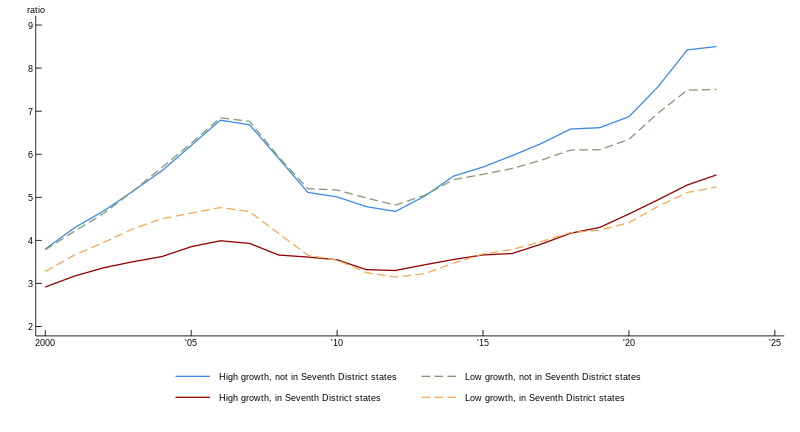
The measure of housing affordability featured in figure 1 shows that house price growth outpaced median household income growth by a large margin between 2000 and 2023. More specifically, we use the county-level CoreLogic House Price Index (HPI) corresponding to single-family homes that sell for less than 75% of the county’s median home price to adjust the county median house price from the 2000 Decennial Census of Population and Housing (see the appendix for more discussion of the HPI and median household income measure used here). We feature this measure of house prices because it more closely aligns with the price dynamics of entry-level homes, and we are interested in assessing the prices of entry-level homes relative to median household income at the county level.4 In recent years, households interested in purchasing their first homes have received attention because the median age of first-time homebuyers increased from 29 in 1980 to 38 in 2024, which suggests affordability challenges for this group. We then divide counties for which we have HPI data into four mutually exclusive groups, depending on whether they are high or low growth (as defined earlier), which we further split into whether they are inside or outside Seventh District states.
1. Ratio of house prices to median household income, 2000–23
Sources: Authors’ calculations based on data from the U.S. Bureau of Economic Analysis from Haver Analytics, U.S. Bureau of Labor Statistics, and CoreLogic.
Figure 1 shows that the ratio of house prices to median household income increased notably in all four county groups (listed in the legend) between 2000 and 2023. More specifically, the ratio of county house prices to county median household income ranges between 2.9 and just under 4.0 in 2000 among the four groups. Roughly speaking, this means that the median income household would have needed to save between three and four times their annual income (or borrow this multiple less any down payment) to purchase a house, depending on the location of the home. For each county group, this ratio increases through the mid-2000s with the housing boom before declining to reach a (local) trough in the mid-2010s in the figure. It then steadily climbs again through 2023. If house prices had increased at the same pace as median household incomes, the ratio in figure 1 would be flat over the 2000–23 period for each county group—but this is not what we see in the figure. Instead, the ratio rises and the increase is largest for high-growth counties not in Seventh District states, consistent with the stronger economic growth occurring there. By 2023, the level of the ratio in those counties suggests that the median-income household would have needed to save or borrow over eight times their annual income to purchase a house. The increase in house prices relative to median household income is smallest for low-growth counties in Seventh District states, with the ratio clocking in at 5.2 in 2023. This smaller increase is consistent with the relatively lackluster economic growth and correspondingly weaker housing demand there.
On average, between 2000 and 2023, housing affordability (by our measure) was worse in counties not located in Seventh District states in two ways. First, the ratio of house prices to median household income was higher in levels across the board, including among low-growth counties not in Seventh District states. This means that, on average, high-growth counties in Seventh District states, where real GDP and employment growth were relatively strong, featured better housing affordability than both types of counties outside Seventh District states. Second, between 2000 and 2023, the ratio of house prices to median income increased more in percentage terms among counties not in Seventh District states, including low-growth ones. This greater percentage increase occurred despite the stronger economic growth in high-growth counties in Seventh District states that, in other economic contexts, might have driven up house prices. Previous research suggests that in places with weak local job opportunities and high housing costs, even established employers can face thinner applicant pools because in-migration is constrained by housing costs and thus responds less to labor demand.5 In contrast, among counties in Seventh District states, all else being equal, relatively better housing affordability can be a draw for in-migration for both high- and low-growth counties—especially so for high-growth places (which by definition have stronger employment growth).
Importantly, worsening housing affordability was widespread. In 2023, based on our calculations, 99% of the population lived in a county where the ratio of entry-level house prices to median household income was higher than in 2000.
The number of housing units has kept up with population only in low-growth counties
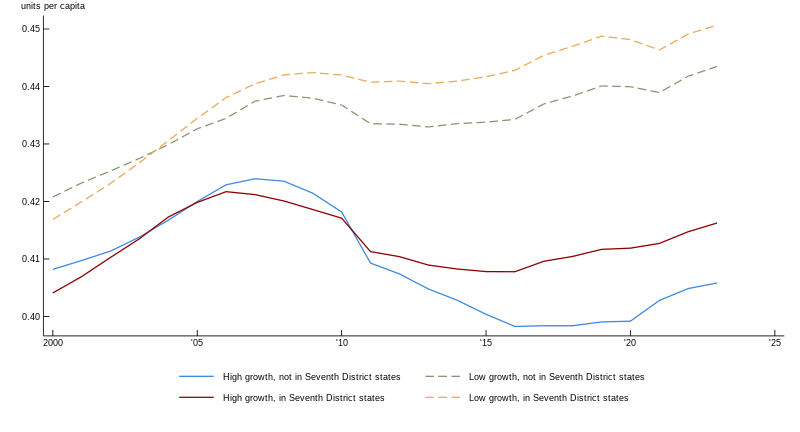
Though the number of housing units in the U.S. increased by 29.8 million between 2000 and 2023 for the nation as a whole, that growth was not even across counties, especially after accounting for population growth. In figure 2, the number of housing units per capita, which provides a measure of how loose housing supply is relative to demand, increases more in low-growth counties between 2000 and 2023. However, an increase in housing units per capita is not necessarily indicative of robust construction activity. Indeed, population growth in low-growth counties was both sluggish and somewhat lower than the 9% to 11% growth in the housing stock, which contributed to a rise in the ratio.6 And as we discussed previously, low-growth counties outside Seventh District states still experienced large increases in the ratio of house prices to median household income.7 In contrast, high-growth counties experienced housing stock growth but also experienced robust population growth, preventing per capita gains.
2. Housing units per capita, 2000–23
Sources: Authors’ calculations based on data from the U.S. Bureau of Economic Analysis from Haver Analytics, U.S. Census Bureau, and U.S. Bureau of Labor Statistics.
Notably, in figure 2, housing units per capita in high-growth counties begin at a lower level in 2000 and remain below the levels seen in low-growth counties through 2023. In addition, the housing stock per capita decreases in high-growth counties outside Seventh District states, meaning that there were fewer housing units per person in 2023 than in 2000 in those places. Generally speaking, high-growth counties experienced more population growth than low-growth counties, especially in places outside the Seventh District states, as well as stronger gains in median household income (see Dokko, 2025). Some part of the decrease in housing units per capita among high-growth counties outside the Seventh District was likely to be related to the slowdown in new housing construction between 2000 and 2020 among Sun Belt markets (i.e., markets such as Atlanta, Dallas, Miami, and Phoenix), which previous research has documented as having once been housing construction “superstars.” Consistent with fewer housing units per capita, high-growth counties outside the Seventh District states also experienced the largest increases in house prices relative to median household income (see figure 1 and our discussion in the previous section).
Low-income renters across the U.S. experienced the most pronounced deterioration in housing affordability
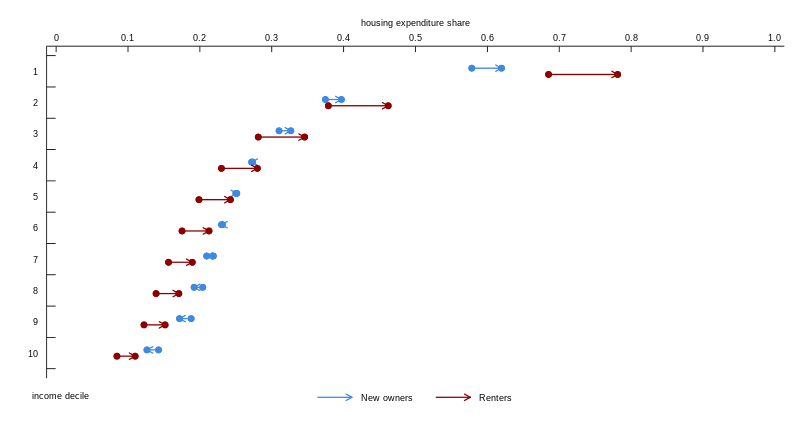
The deterioration in housing affordability discussed earlier through the lens of house prices is also relevant for renters. House prices and rents are related because they are two ways of pricing the value of living in a particular home and neighborhood. Rents reflect the current value, while housing prices reflect the current value and the expected future value. For this reason, economic fundamentals drive both house prices and rents such that when a place becomes more desirable and the housing stock cannot expand quickly, higher housing costs result for owners and renters (though perhaps at different speeds). In figure 3, consistent with previous research, we see that renter households with incomes in the bottom two deciles of the income distribution of U.S. households (i.e., deciles 1 and 2) experienced the largest increases in the housing expenditures share of income.8 In 2000, annual housing expenditures as a share of annual income were 69% among renter households in the bottom income decile. This figure was 38% for renters in the second-lowest income decile. The magnitude of the increase falls with income, as shown in figure 3.
3. Changes in housing expenditures share, by household income decile: New homeowners and renters, 2000–23
Source: Authors’ calculations based on data from the U.S. Census Bureau.
Two things are worth keeping in mind when interpreting these estimates. First, retired households may appear to have low income and high housing expenditures if they rely heavily on home production or consume from wealth in ways that do not show up in typical income measures. However, dropping households for which the head of the household is over 62 years old does not change the figure much (in fact the housing expenditures share of income appears slightly higher for the lowest-income deciles after dropping such households). Second, because household surveys tend to underreport income, these estimates may overstate the true expense burden and lead to questions about their true level. Even so, there is an unambiguous increase in housing expenditures as a share of income between 2000 and 2023 among low-income renters. In addition, the observed increase is largest for the poorest renters—i.e., those in the lowest decile of the income distribution.
Similarly, among homeowners, the largest increases in housing expenditures as a share of income are at the bottom of the income distribution. Established homeowners benefit from “sticky” housing costs and capital gains when prices rise. Thus, in figure 3, we focus on homeowners who purchased within the past two years to capture the affordability challenges facing new buyers. For such new owners in the lowest-income decile, housing expenditures are just under 58% of income in 2000 in the lowest decile of the income distribution, and this share rises to 62% in 2023. Just as with renters, the change in housing expenditures as a share of income between 2000 and 2023 falls with income—and its level is less than 30% in the upper seven deciles of the income distribution.
Consistent with previous research, we find that the largest housing expenditure burdens relative to income fall on the lowest-income households. Broadly speaking, the literature points to four sets of explanations for this pattern. First, low-income households tend to have low, slow-growing, and more volatile incomes, meaning that any given rent increase is likely to push housing expenditure shares above a manageable threshold as incomes tend not to keep up. Second, aside from doubling up by sharing quarters with another household, low-income households have fewer practical ways to adjust their housing in the face of rising rents or house prices; moving is costly and the supply of affordable units often depends on slow-moving forces, such as filtering, which is the process by which homes age into lower price tiers, or new housing construction (allowing higher-income households to move to newer units and free up older, more affordable units). Third, in contrast to low-income households, higher-income renters and owners often see faster income growth and have greater flexibility to adjust to other housing options. Higher-income households are more likely to experience income growth that keeps pace with housing costs. Also, higher-income renters may have more ability to substitute across neighborhoods, unit sizes, or building types without as much disruption. Fourth, recent evidence strikingly finds that the affordable end of the rental market delivers unusually high investment returns for property owners possibly because informational and financial frictions limit entry, enabling landlords to charge higher markups to low-income renters.9
Conclusion
In this article, we reviewed trends in housing affordability and local economic growth from 2000 through 2023 across counties in the U.S. and Seventh District states. These two issues have generated public concern because for most households housing is the single largest expenditure category in their budgets and over the 2000–23 period house prices and rents increased while differences in economic outcomes across counties widened. We analyzed the interaction between house prices and local economic growth because during the years 2000–23, changes to housing affordability and local economies reshaped who can live and work in prosperous places. Our key findings are as follows: 1) house price growth outpaced median household income growth between 2000 and 2023 nearly everywhere, but less so in counties in Seventh District states; 2) housing units per capita increased only modestly between 2000 and 2023 and even decreased in some of the fastest-growing counties in the U.S.; and 3) low-income renters were especially burdened by rising housing costs relative to their incomes over this period.
Counties in Seventh District states stand out for their relative affordability, which (all else being equal) can help draw residents, particularly in high-growth counties. Even so, housing affordability worsened for households between 2000 and 2023 in ways that present different sets of challenges for local economic development officials seeking to grow local economies. Among high-growth counties in Seventh District states, the number of housing units per capita was inching up in the final years of our sample period but was still below its 2006 peak, according to our analysis. This suggests that prioritizing a faster pace of housing construction could help sustain these counties’ real GDP and employment growth. In contrast, among low-growth counties in Seventh District states, the number of housing units per capita consistently increased between 2000 and 2023 and was the highest in 2023 among the four types of counties we analyzed in this article. This suggests that such counties have adequate housing capacity but lack sufficient job growth, making labor demand strategies more immediately relevant than housing supply initiatives. And because worsening housing affordability is particularly acute for low-income renters, across all counties in Seventh District states, efforts to strengthen housing affordability for this group, both through the social safety net and housing-specific policies, such as vouchers or emergency rental assistance, may help alleviate the hardships of high rent burdens.
Notes
1 In this article, we consider counties in the entirety of Illinois, Indiana, Michigan, and Wisconsin, though only major portions of these four states and the entirety of Iowa officially make up the Seventh Federal Reserve District, which the Federal Reserve Bank of Chicago serves. In other words, the analysis in this article includes counties in the entirety of all five Seventh District states, though some are not in the geographic boundaries of the Seventh District.
2 Authors’ calculations based on data from the U.S. Bureau of Economic Analysis from Haver Analytics and U.S. Bureau of Labor Statistics.
3 See Hsieh and Moretti (2019), Gyourko et al. (2013), and Glaeser et al. (2005).
4 We note that house prices have outpaced median household income over the 2000–23 period when using more broad-based house price indexes as well.
5 See Zabel (2012) and Ganong and Shoag (2017).
6 Estimates of the growth in the housing stock for each county group are based on authors’ calculations using the U.S. Census Bureau’s American Community Survey.
7 More generally, house prices can rise even with lackluster local economic growth because house prices respond to user costs, especially mortgage rates, and because mortgage credit supply can drive house price booms. In addition, trailing counties outside Seventh District states may have strong demand for housing because of desirable local amenities.
8 Results for households living in Seventh District states are similar to those for all U.S. households shown in figure 3. Also, because county identifiers are suppressed for some households in the American Community Survey conducted by the U.S. Census Bureau, we do not estimate housing expenditures as a share of income for the four groups of counties analyzed in figures 1 and 2. The appendix has additional information on how the estimates in figure 3 were calculated.
9 In particular, Damen et al. (2025) argue that landlords in the lowest price tier of the rental market are earning the highest risk-adjusted returns not only because of the rents they charge but also because of low maintenance expenses (leading to undermaintained buildings) and limited entry from other types of landlords.
Appendix
House price index data are from CoreLogic and are inflation-adjusted to 2023 U.S. dollars using the Personal Consumption Expenditures Chain-Type Price Index (PCEPI) from the U.S. Bureau of Economic Analysis (BEA). The “lowest tier” house price index used in this article estimates a repeat-sales index among properties that transact for less than 75% of the county median house price. This index is applied to county median house prices from the 2000 Decennial Census of Population and Housing to obtain the level of house prices in subsequent years.
Data on the number of housing units are from the U.S. Census Bureau's Population Estimates Program (intercensal estimates) for 2000–10 and the American Community Survey (ACS) for 2011–23.
To categorize counties into low-growth and high-growth groups, we obtained real GDP estimates at the county level from the U.S. Bureau of Economic Analysis, which reports them from 2001 through 2023, and data on county employment from the U.S. Bureau of Labor Statistics’ (BLS) Quarterly Census of Employment and Wages (QCEW), which correspond to private sector employment. An advantage of these two sources of county-level data is that they measure where the economic activity occurs, so a “residence adjustment” that accounts for intercounty commuting is not necessary.
County median household income estimates are from the U.S. Census Bureau’s Small Area Income and Poverty Estimates Program for 2000–08 and the American Community Survey for 2009–23. Population data are also from the U.S. Census Bureau’s Population Estimates Program for 2000–23 (using Vintage 2024).
National estimates of real GDP growth are from the BEA’s National Income and Product Accounts of the United States. National estimates of job growth are from the BLS’s QCEW.
Housing expenditures for renters and owners were obtained from the 2023 ACS and 2000 U.S. Census 5% Public Use Microdata Sample. All U.S. dollar values are inflation-adjusted to 2023 U.S. dollars with the PCEPI. Households with zero income or housing expenditures are excluded from the analysis.
All county-level analyses are population-weighted.